Buying Guide
Buying From an NRI Seller: TDS and Payment Checks
Understand seller residence, October 2026 Form 141 Schedule E guidance, withholding calculations, signing authority and payment checks.

Table of contents
Check the seller's tax residence before the first payment—not after registration.
Buying a home from a seller who lives abroad can be perfectly workable. The extra care lies in identifying the seller's legal and tax position, confirming who can sign, using the correct payment route and meeting the buyer's withholding obligations.
An Indian passport, PAN, Aadhaar or local address does not by itself establish that the seller is resident in India for income-tax purposes. Equally, an overseas telephone number is not a complete tax-residence test. Get the position examined for the relevant tax year and transaction.
This guide is written for a resident buyer considering a non-resident seller. It explains the workflow rather than presenting a single TDS percentage as suitable for every NRI sale. Tax procedures discussed below reflect official guidance checked in October 2026; recheck the current utility when making a payment.
Separate tax residence, citizenship and FEMA status
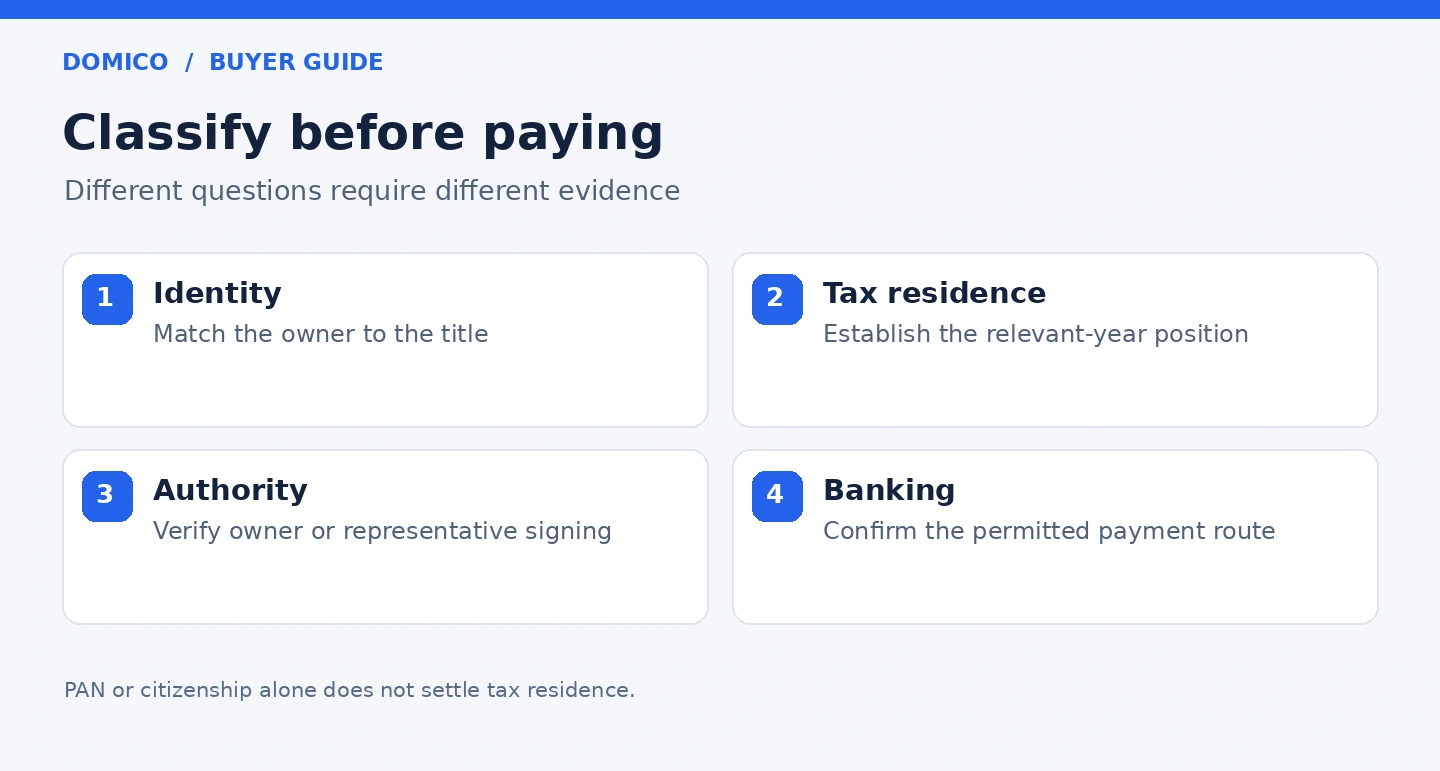
These concepts answer different questions. Citizenship identifies nationality. Income-tax residence determines the applicable tax framework. Foreign-exchange residence and the property's acquisition history can affect permitted transfers and banking requirements.
Ask your tax adviser which facts and documents support the classification. A signed declaration can help record information, but it should not replace professional review where the circumstances point to a non-resident position.
Keep the conclusion and the supporting facts with the transaction file. If there are multiple sellers, analyse each seller separately. One co-owner's residence does not automatically determine another's.
| Issue | What the buyer needs to establish |
|---|---|
| Identity | Is the person the owner shown in the title chain? |
| Income-tax residence | Which withholding framework applies to this seller? |
| Signing authority | Will the owner sign or use a valid representative? |
| Foreign-exchange position | Are the transfer and payment route permitted? |
| Banking instructions | Which verified beneficiary can receive the lawful payment? |
What changed in October 2026
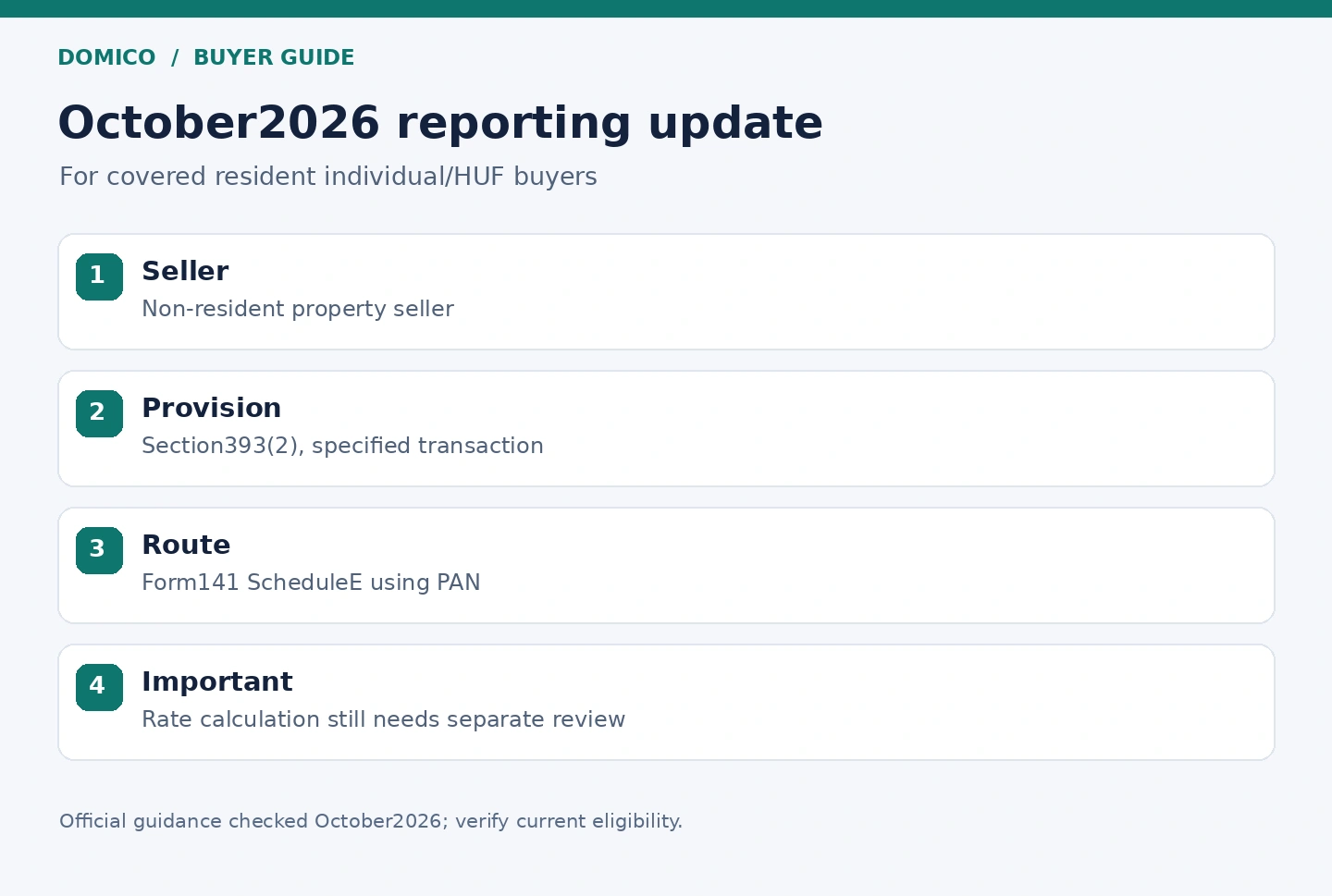
The Income Tax Department's Form 141 Schedule E manual identifies a PAN-based reporting route for a resident individual or resident HUF purchasing immovable property from a non-resident seller under section 393(2) of the Income-tax Act, 2025. It states that this Schedule E route applies from 1 October 2026 and that TAN is no longer mandatory for those covered transactions.
That is a reporting change for specified buyers. It does not make the non-resident transaction identical to a resident-seller purchase or establish a universal withholding rate. Buyers outside the stated eligibility, and payments governed by an earlier period, need their own compliance analysis.
The Department's Form 141 FAQs explain the form's schedules. Read the current guidance before selecting a schedule; older articles referring only to legacy forms can be unsuitable for a November 2026 payment.
Have the TDS calculation settled before paying a token
A property booking payment can be part of the consideration. Do not assume tax withholding becomes relevant only at registration or at the final instalment. Ask your adviser to identify the triggering event and calculation for each proposed payment.
The applicable withholding can depend on the relevant law, the nature of the income, applicable rates, surcharge or cess, treaty questions where relevant and any valid lower or nil deduction certificate. The seller's estimate of final capital-gains tax is not automatically the amount the buyer may deduct.
Do not calculate withholding merely on an estimated gain supplied in a WhatsApp message. Where a certificate permits a particular treatment, verify its authenticity, validity, recipient, transaction coverage and limits before relying on it.
Put gross price and net payment in separate columns
The purchase consideration, tax withheld and money remitted to the seller should reconcile. Withheld tax is not a discount negotiated off the property price. It is a compliance amount paid through the appropriate route.
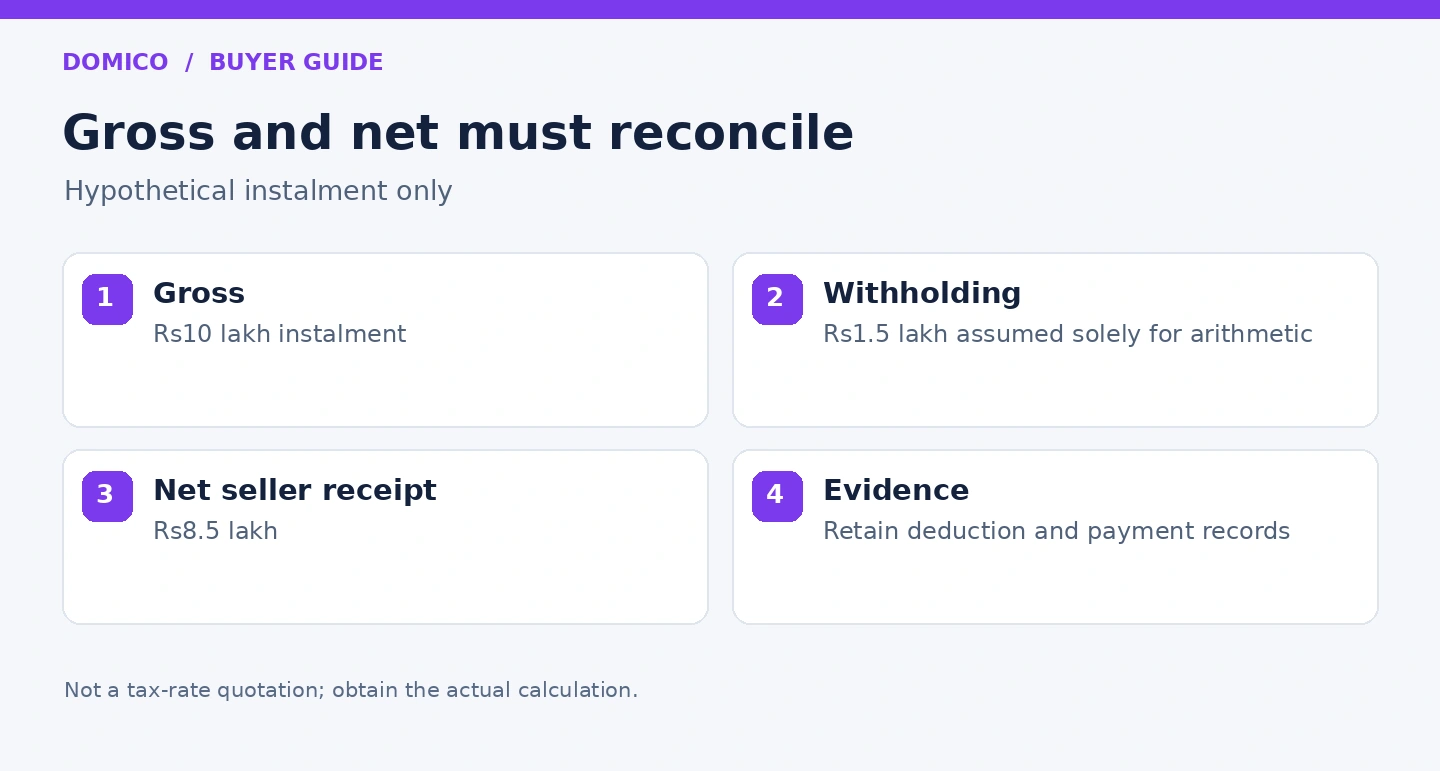
Consider a purely illustrative instalment of Rs 10 lakh. Suppose your adviser has determined that Rs 1.5 lakh must be withheld for that instalment under the actual applicable position. The seller would receive Rs 8.5 lakh, while Rs 1.5 lakh is dealt with through the prescribed tax process.
| Hypothetical instalment reconciliation | Amount |
|---|---|
| Gross consideration instalment | Rs 10,00,000 |
| Illustrative withholding already determined by adviser | Rs 1,50,000 |
| Net remittance to seller | Rs 8,50,000 |
| Total accounted for | Rs 10,00,000 |
The Rs 1.5 lakh is an invented arithmetic example, not a quoted tax rate or recommendation. Your working must use the actual required deduction. Record who prepares the filing, who pays it, the due date and where the acknowledgement is saved.
Review each owner and payment share
A transaction can have several resident and non-resident owners with different ownership proportions. Confirm the sellers' shares from the title and legal review before splitting payments or filings.
Create a seller-wise ledger showing gross allocation, each payment date, deduction, challan or filing reference and net receipt. Ask the adviser how the current utility handles multiple buyers, multiple sellers and instalments. Do not copy a filing pattern designed for a simple single-owner sale.
Make sure the agreement and deed reflect the actual ownership and consideration. A payment sent to one family member for convenience can create both authority and compliance questions when several people are entitled to the proceeds.
Verify a power of attorney carefully
An owner abroad may appoint someone to handle the sale. Your lawyer should examine the instrument's execution, authentication, stamping or adjudication requirements, scope and continuing validity as applicable.
Check whether it authorises this property transaction, execution of the conveyance, presentation for registration and receipt of consideration. A general authority to manage the home may not answer every one of those questions.
Confirm the owner's instructions through a reliable independent channel. If the representative asks that money be paid into their personal account, obtain specific legal and banking advice before accepting that route. Convenience should not replace evidence of entitlement to receive the funds.
Confirm the banking route with the authorised dealer
The seller's account type and repatriation plan can depend on their status, acquisition history and applicable foreign-exchange rules. The RBI's property and foreign-exchange FAQs explain that different acquisition and remittance situations have conditions.
Have the seller obtain instructions from their authorised dealer bank for the actual facts. As buyer, use verified beneficiary details and preserve the payment trail. Do not promise that a particular account type or overseas remittance route is always allowed.
Tax withholding and foreign-exchange compliance are separate workstreams. Successfully filing a tax statement does not establish that every proposed remittance is permitted.
Keep ordinary property diligence intact
An overseas seller still needs to establish title, lawful use, possession and the ability to transfer. Check mortgages, society or authority records, unpaid dues and any occupant's rights. Distance is not a reason to reduce scrutiny.
If original deeds are with a lender, coordinate their release. If the seller has lost a document or cannot attend registration, solve the actual procedural issue before promising a closing date.
| Before the next payment | Evidence to have ready |
|---|---|
| Seller classification | Residence analysis and supporting information |
| Withholding position | Written calculation and certificate checks, if relevant |
| Filing route | Correct current schedule and responsible preparer |
| Authority | Owner's participation or valid representative documents |
| Payment route | Verified beneficiary and banking instructions |
| Property position | Title review, dues and possession plan |
Avoid last-minute compliance surprises
Make an instalment calendar before signing. Include the expected payment, applicable deduction, filing and certificate tasks, and the person responsible. Give yourself time to correct PAN or property-description errors.
Ask the seller to supply required information early through secure channels. Passport, PAN and account documents contain sensitive data; circulate them only to professionals and institutions involved in the transaction, and avoid open chat groups.
If a deduction error is discovered, seek prompt professional correction. Do not assume the seller can simply promise to pay tax later and eliminate the buyer's separate obligations.
Printable buyer worksheet
Download the topic-specific review checklist. Use it to record evidence, unanswered questions and follow-up actions for the exact property.
Frequently asked questions
Does an Indian PAN mean the seller is a resident?
No. PAN is a tax identifier, not a determination of residential status for the relevant year. Establish residence from the applicable legal test and facts.
Can I use the same TDS rate as a resident-seller transaction?
Do not assume that. The non-resident withholding analysis is different and should be calculated for the transaction. Selecting a convenient rate can create a short-deduction problem.
Must every buyer from an NRI obtain a TAN?
Current official guidance provides the Form 141 Schedule E PAN-based route from 1 October 2026 for covered resident individual or HUF purchasers. Other buyers, earlier payments and different circumstances need their applicable route checked.
Can the seller's relative sign and receive payment?
Only a valid legal authority and compliant transaction structure can establish what the representative may do. Review the instrument and payment entitlement rather than relying on the family relationship.
Should I leave tax compliance to the seller?
The seller may have their own tax obligations, but the buyer's deduction and reporting duties need separate attention. Appoint a qualified preparer and keep the acknowledgements yourself.
Settle the tax route before the price leaves your account
For an NRI-seller purchase, the safest sequence begins with residence, authority, withholding, filing and banking instructions, followed by the ordinary title and possession checks. Clear preparation makes a cross-border seller easier to transact with without pretending the extra steps do not exist.
Official sources
- buyer-guide-100
- homebuyers
- nri-seller-property
- indore
Planning to buy or rent in Indore? Browse verified properties in Indore or read more Indore guides.