Buying Guide
Buying Minor-Owned Property: Permission and Sale Checks
Understand ownership shares, guardian authority, required court permission and payment safeguards before buying property owned by a minor.

Table of contents
A parent's signature is not a substitute for checking the child's property rights.
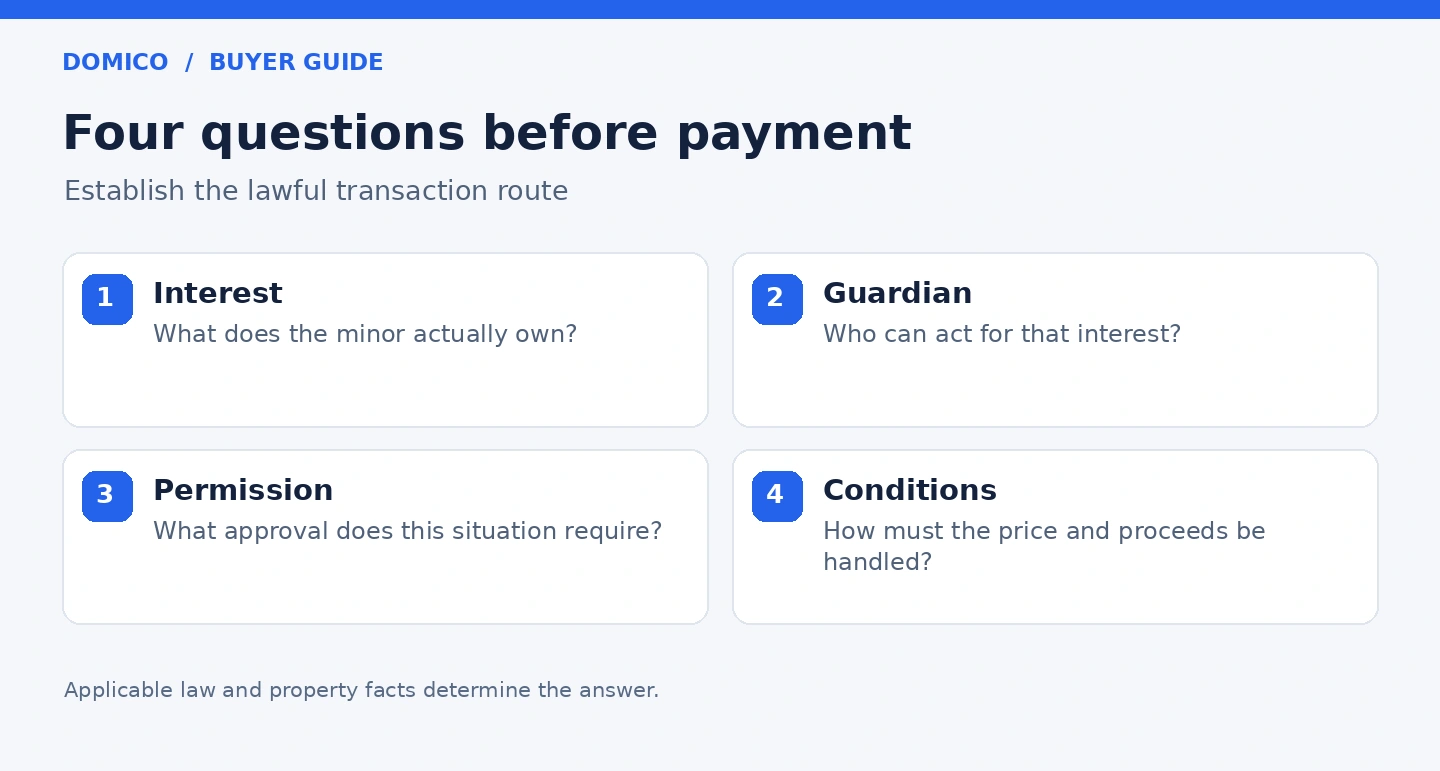
A home may be wholly or partly owned by a minor because of inheritance, a gift or an earlier purchase arrangement. When the family wants to sell, a prospective buyer needs to understand both the ownership and the authority to transfer that interest.
This is not an ordinary sale with an extra birth certificate attached. The applicable guardianship law, the nature of the minor's interest and any necessary court permission can affect whether and how the sale may proceed.
Treat the legal route as an early diligence question. Paying a large advance first and asking about permission later can leave the family and buyer committed to a transaction that cannot be completed as expected.
Identify the minor's actual interest
Start with the acquisition documents and any inheritance papers. Does the child hold an identified share in this property? Is the interest part of a different legal arrangement, such as an undivided family interest? Are several people co-owners?
Your lawyer should trace the interest rather than relying on a revenue or society entry alone. A minor's name may appear in one record because of an administrative update, while the underlying title requires a more detailed succession analysis.
Ask for the relevant age evidence and establish the legal position at the proposed transaction date. Do not assume that someone who appears older can sign as an adult or that an informal family agreement resolves a recorded ownership share.
Find the governing law and guardian's authority
Guardianship can involve personal law, a court appointment, a will and the general statutory framework. The correct analysis depends on the facts. Avoid using a statement about one personal-law situation as a rule covering every minor-owned property in India.
For example, Section 8 of the Hindu Minority and Guardianship Act restricts specified dealings by a natural guardian with a Hindu minor's immovable property and addresses prior court permission. The section's scope and the nature of the property interest must be reviewed before applying it.
The Guardians and Wards Act also contains provisions governing the powers of certain court-appointed or declared guardians and permission for relevant transfers. A child's daily caregiver is not necessarily the legally authorised guardian of their property.
Understand what court permission needs to cover
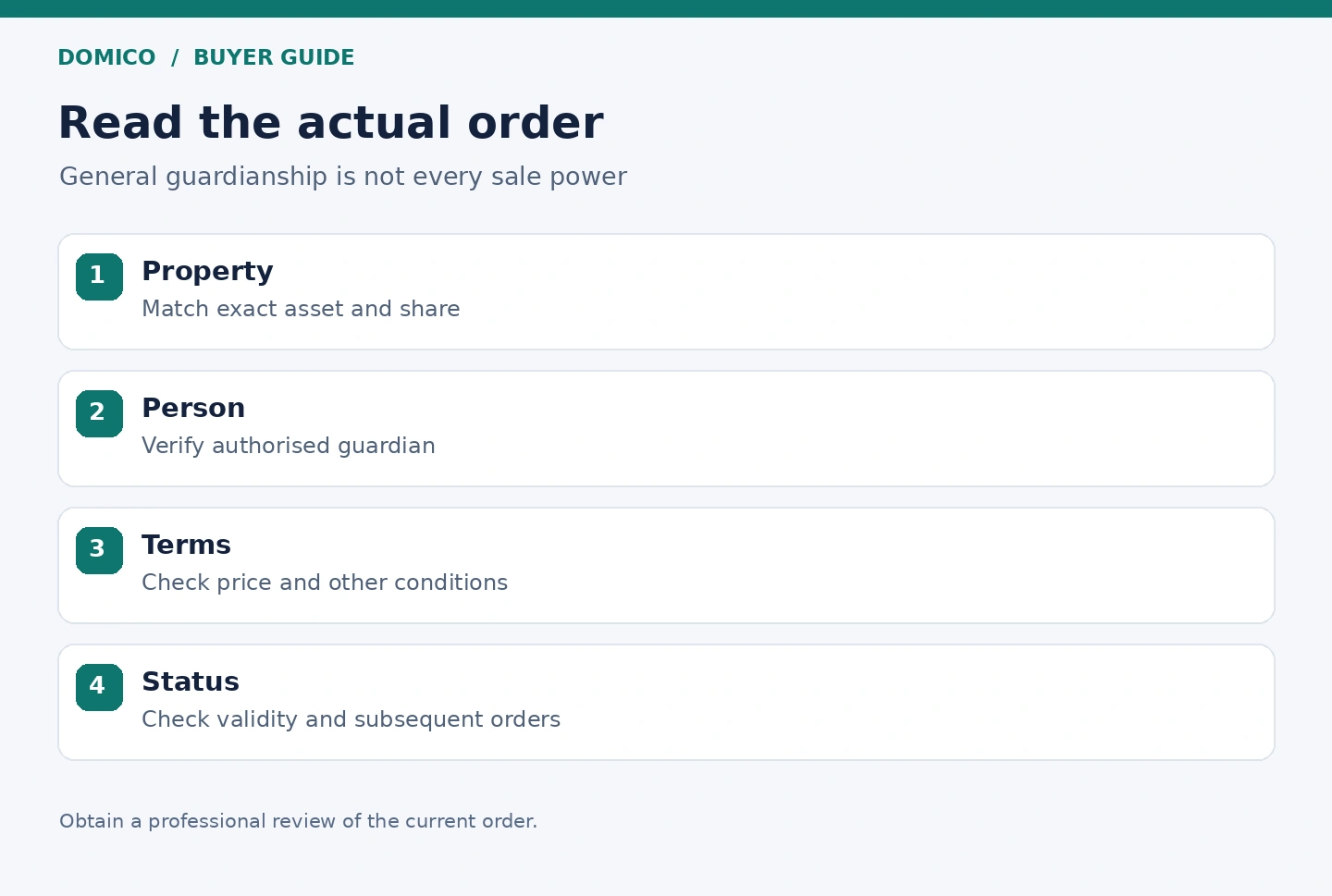
Where prior permission is required, obtain the actual order and have it verified. Check the property description, the authorised guardian, the permitted transaction and every relevant condition.
The order may deal with the consideration, valuation, deposit or use of proceeds, timing or other safeguards. Its wording controls. A general order appointing a guardian is not necessarily the same as permission to sell this property on these terms.
| Document or point | Why it matters |
|---|---|
| Minor's acquisition or succession documents | Establishes the actual ownership interest |
| Age evidence | Confirms the person's status at the relevant date |
| Guardian's legal authority | Shows who may act for the property interest |
| Required court permission | Establishes the permitted transaction and conditions |
| Proposed deed and payment plan | Must correspond with the lawful authority obtained |
Ask the lawyer whether any subsequent order, appeal or stay affects the permission. A photocopy supplied without a way to verify its current position is not enough for a high-value transaction.
Match permission with the deal you are negotiating
Suppose an order permits sale of a described property on specified conditions. The parties should not casually change the area, seller's share, payment method or other material terms without legal advice on whether the authority still covers the revised deal.
If the buyer changes, the price changes or completion moves beyond a stated period, have the implications checked. The answer depends on the order; there is no safe universal assumption that every variation is acceptable.
Likewise, a permission relating to one parcel should not be treated as authorising sale of an adjoining parcel merely because the family considers them one property. Identify every survey, plot and unit reference accurately.
Keep the child's proceeds traceable
The payment route should comply with the applicable law and any order. If the order requires a particular deposit or other protection for the minor's share, build that into the closing plan.
Do not send all money to an adult's personal account and rely on a promise that the child's share will be sorted out later. The buyer should obtain appropriate acknowledgement and evidence that the permitted payment conditions were followed.
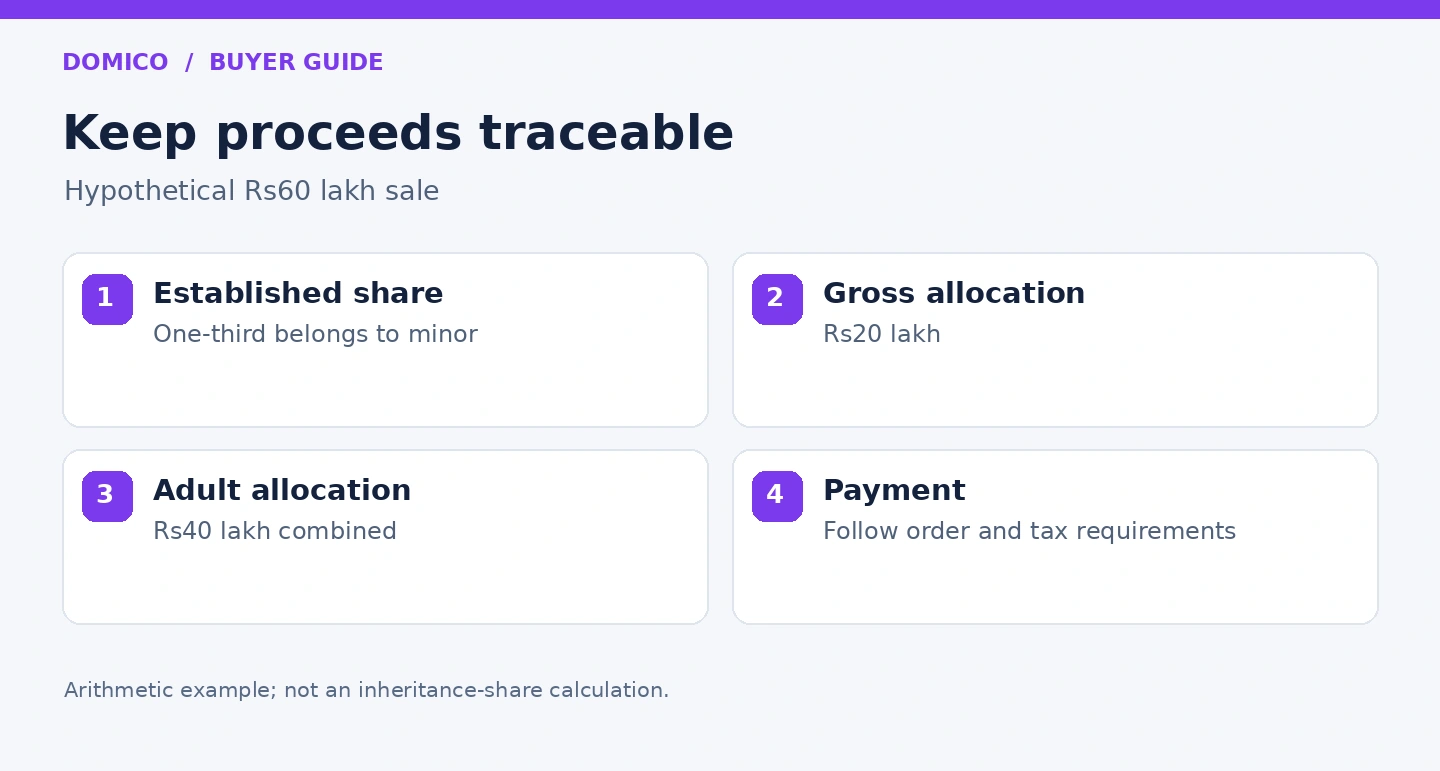
Here is a simple illustrative reconciliation. A property price is Rs 60 lakh and the legally established minor's share is one-third. That gives Rs 20 lakh as the minor's gross consideration allocation. The lawful handling of that amount depends on the order and tax advice, not on the family informally choosing a convenient account.
| Hypothetical ownership allocation | Gross consideration share |
|---|---|
| Minor's established one-third interest | Rs 20 lakh |
| Other owners' combined two-thirds interest | Rs 40 lakh |
| Total consideration | Rs 60 lakh |
| Payment safeguards and tax adjustments | Apply the actual order and law separately |
This example is arithmetic only. It does not determine an inheritance share or suggest that every minor has an equal share with the adults.
Avoid relying on an indemnity as a cure
A family may offer a declaration that the buyer will face no future claim. Such paperwork cannot automatically substitute for a permission or legal authority required by law.
The consequences of an unauthorised transfer can depend on the applicable framework and facts. Do not reduce the issue to “the registry office accepted it, so it is safe.” Registration and valid authority are separate legal questions.
Ask your lawyer to explain the specific exposure and the proposed solution in writing. If the file cannot establish a lawful route, postponing completion is more useful than collecting additional vague assurances.
Coordinate your lender before agreeing deadlines
Tell the lender about the minor's interest at the application stage. Provide the title papers, guardian documents and order for property-specific review. A normal income-based approval does not confirm acceptance of the title and payment structure.
Ask which documents the lender needs before sanction, before disbursement and at registration. If the order requires a payment route the lender does not support, the transaction needs coordination before the balance becomes due.
Also check whether all co-owners will participate in the relevant documents. Resolving the minor's interest does not automatically establish the adults' shares, consents or mortgage position.
Keep ordinary property checks in the file
A court permission is directed to a particular legal issue. It should not be treated as a replacement for reviewing title, boundaries, approvals, encumbrances, dues and physical possession.
Inspect whether anyone occupies the home and what rights they claim. Check the original deeds and relevant lender releases. If the property is leasehold or authority-allotted, find out whether separate transfer conditions also apply.
| Before completion | Evidence to connect |
|---|---|
| Correct asset | Title schedule, survey or unit identity |
| Correct owners | Established shares and complete acquisition chain |
| Correct authority | Guardian's power and required current permission |
| Correct terms | Deed and payment structure within the authority |
| Correct completion | Receipts, required deposits, registration and possession |
What if the owner becomes an adult before completion?
A change in age can change the appropriate execution route, but it should be handled through fresh legal review. Confirm the date, capacity, current title position and what earlier agreements or proceedings mean for the sale.
Do not simply replace the guardian's signature with the now-adult owner's signature on an old draft without checking the entire transaction. The buyer should also verify whether the person understands and agrees to the current terms independently.
This is particularly important if a deposit was paid long before the planned completion. The file should explain who was authorised at each stage and how the present conveyance is lawfully completed.
Printable buyer worksheet
Download the topic-specific review checklist. Use it to record evidence, unanswered questions and follow-up actions for the exact property.
Frequently asked questions
Can a parent sell property registered in a child's name?
The parent's authority must be established under the applicable law, and required permission must be obtained. Being the parent alone does not answer every property-transfer question.
Is court permission required in every situation involving a minor?
Do not assume a single rule. The minor's interest, type of guardian and applicable law matter. Have a lawyer identify the legal route for the actual facts.
Does a registered sale deed eliminate future challenges?
Registration does not by itself cure missing authority or non-compliance with required permission. The validity and consequences need legal assessment.
Can I pay an advance while permission is pending?
Discuss the risk and proposed contract with your lawyer first. The agreement should address what happens if permission is refused, delayed or granted on different conditions. Avoid an unconditional non-refundable commitment before the route is established.
Who determines how the child's share is paid?
Applicable law and any relevant court order govern the safeguards. The buyer, family and bank should organise payments accordingly and retain proof of compliance.
Establish the route before committing the funds
A minor-owned sale can require careful preparation, but the questions are clear: what is the interest, who can act, what permission is required, and how will its conditions be fulfilled? Resolve those points before setting a final payment or registration deadline.
Official sources
- buyer-guide-100
- homebuyers
- minor-owned-property
- indore
Planning to buy or rent in Indore? Browse verified properties in Indore or read more Indore guides.



