Buying Guide
Low CIBIL Score Home Loan: Improve Your Application
Review credit-report errors, existing debt, repayment habits and affordability before making a stronger, selective home-loan application.

Table of contents
Improve the file before multiplying the applications.
A low CIBIL score can make a home-loan application harder, but the useful response is not to send the same weak file to ten lenders at once. First find out what the report says, whether the information is accurate and which parts of your finances you can improve.
A home loan is assessed through more than a score. Income stability, current debt, own contribution, age, repayment record and the property also matter. Different lenders use different credit policies. No honest adviser can guarantee approval simply because you reach a particular number.
This guide helps you build a practical improvement plan while protecting your home-buying budget.
Read the full report, not only the score
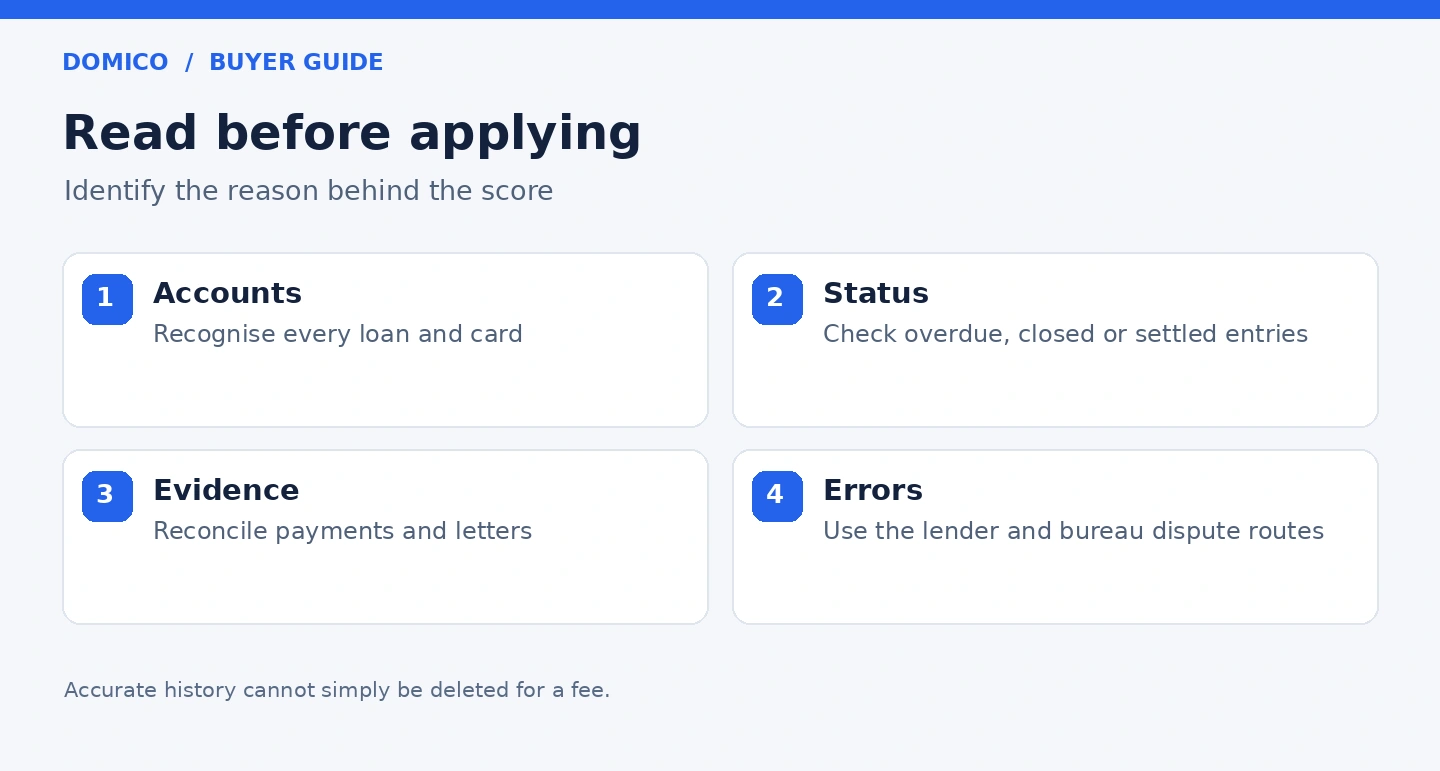
The CIBIL report guide explains the report's account and enquiry information. Check the lenders, account numbers in masked form, ownership category, payment history, balances, limits and reported status.
Look for unfamiliar loans, duplicate-looking entries, a repaid account still showing overdue, incorrect personal details or a settlement status you did not understand. A low score with an accurate late-payment history needs a different response from an error involving a loan that is not yours.
Save the report date. If a repayment was made recently, ask the lender when it was reported before assuming that an older bureau snapshot has already reflected it.
Separate errors from genuine repayment problems
For an apparent error, gather supporting records such as the lender's closure letter, receipt or account statement. Use the lender's grievance process and CIBIL's appropriate dispute route.
CIBIL's loan-rejection and dispute FAQs describe how disputed information is handled with the reporting credit institution. A bureau correction is not a service that legitimately deletes accurate adverse information simply because you pay an agent.
For a genuine overdue, contact the lender and understand what is payable and how the account will be reported after resolution. Avoid assuming that a negotiated settlement and full closure have the same reporting meaning.
| Report finding | Useful next action |
|---|---|
| Account you do not recognise | Verify with lender and raise a supported dispute |
| Repaid loan showing overdue | Reconcile payment and reporting records |
| Genuine unpaid amount | Discuss a documented resolution with the lender |
| High revolving balances | Reduce borrowing pressure within a sustainable budget |
| Many recent applications | Pause and organise a targeted lender approach |
Make existing repayments reliable
List every EMI, credit-card due date and recurring debt payment. Set reminders and keep enough money in the payment account before collection. A failed auto-debit should not become a monthly surprise.
If your income arrives irregularly, build a separate repayment buffer rather than depending on a client paying on the exact due date. For self-employed buyers, this can be more useful than a complicated spreadsheet that never changes the cash available in the account.
Do not borrow from a high-cost short-term lender only to create the appearance of a clean month. That can move the problem into a more expensive account and reduce your future home-loan repayment capacity.
Reduce debt pressure, not just the visible balance
A bank will consider your existing obligations alongside the proposed home loan. Closing a manageable small loan may improve monthly cash flow, but using all your savings to do it can leave too little for the down payment and emergency reserve.
Compare alternatives before paying. Which action removes a meaningful monthly obligation? Are there applicable closure costs? Will the repayment use money reserved for registration or essential household needs?
For credit cards, understand both the balance and the approved limit. Avoid treating minimum payment as evidence that the borrowing is inexpensive or easy to sustain. A score improvement plan should also improve the household's real finances.
Build an affordability view before discussing approval
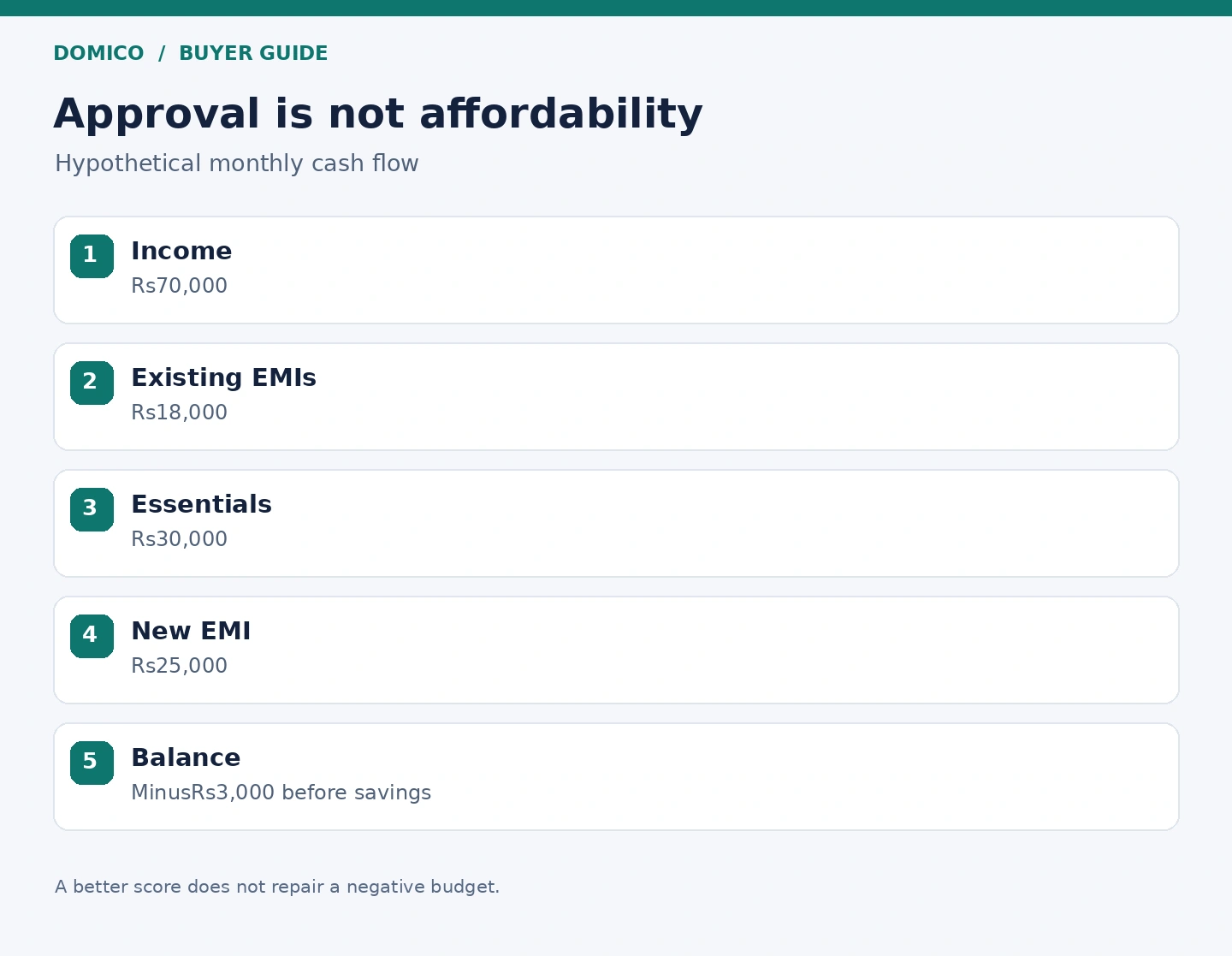
Consider an illustrative buyer earning Rs 70,000 net monthly. Existing EMIs are Rs 18,000, essential household expenses are Rs 30,000, and the proposed home EMI is Rs 25,000.
| Illustrative monthly cash flow | Amount |
|---|---|
| Net household income | Rs 70,000 |
| Existing debt payments | Rs 18,000 |
| Essential expenses | Rs 30,000 |
| Proposed home EMI | Rs 25,000 |
| Balance before savings and other spending | Minus Rs 3,000 |
Even if a lender could be persuaded to consider the file, the household budget is already negative. A better score would not fix that arithmetic. Reducing the target price, increasing a sustainable own contribution or waiting for debt to reduce may be the more useful change.
Run the same exercise with a higher interest-rate scenario and a temporary income reduction. The aim is a home you can keep paying for, not an approval that immediately creates financial stress.
Approach lenders with a prepared explanation
Once you understand the report, choose a small number of suitable lenders or a transparent adviser. Ask about their preliminary assessment process and whether it involves a credit enquiry. Avoid submitting full applications everywhere before understanding the likely fit.
Prepare a concise explanation of any genuine past problem: what happened, when it was resolved, what evidence supports that and what changed in your repayment arrangements. Documents are more useful than a promise that the past will not repeat.
CIBIL's enquiry information explains that lender access in connection with a new credit application creates an enquiry record. That is another reason to manage applications deliberately.
Understand what a co-applicant can and cannot solve
An eligible co-applicant may add assessable income, but the lender still evaluates the whole application. Adding a person does not erase your credit history or guarantee that the property will be accepted.
The co-applicant needs to understand the loan obligations and how the bank treats their liability. Do not add a relative as a casual formality without discussing ownership, repayment and future exit.
Ask the bank whether the proposed relationship is eligible and whether all owners need to join the borrowing documents. Align the title, loan and actual contributions rather than changing names only to improve an online estimate.
Beware of guaranteed score-repair claims
Be cautious when someone promises a fixed score increase in a fixed number of days, deletion of accurate history or a guaranteed home loan after a large advance fee. Ask what service is actually being provided and what documentation supports it.
Never share OTPs or account passwords with a repair agent. Obtain reports through official or appropriately authorised channels and provide only the data necessary for the legitimate service.
An adviser can help you read a report, organise a dispute or compare lenders. They should not ask you to misstate income, hide loans or create false employment and tax papers.
Use a realistic review plan
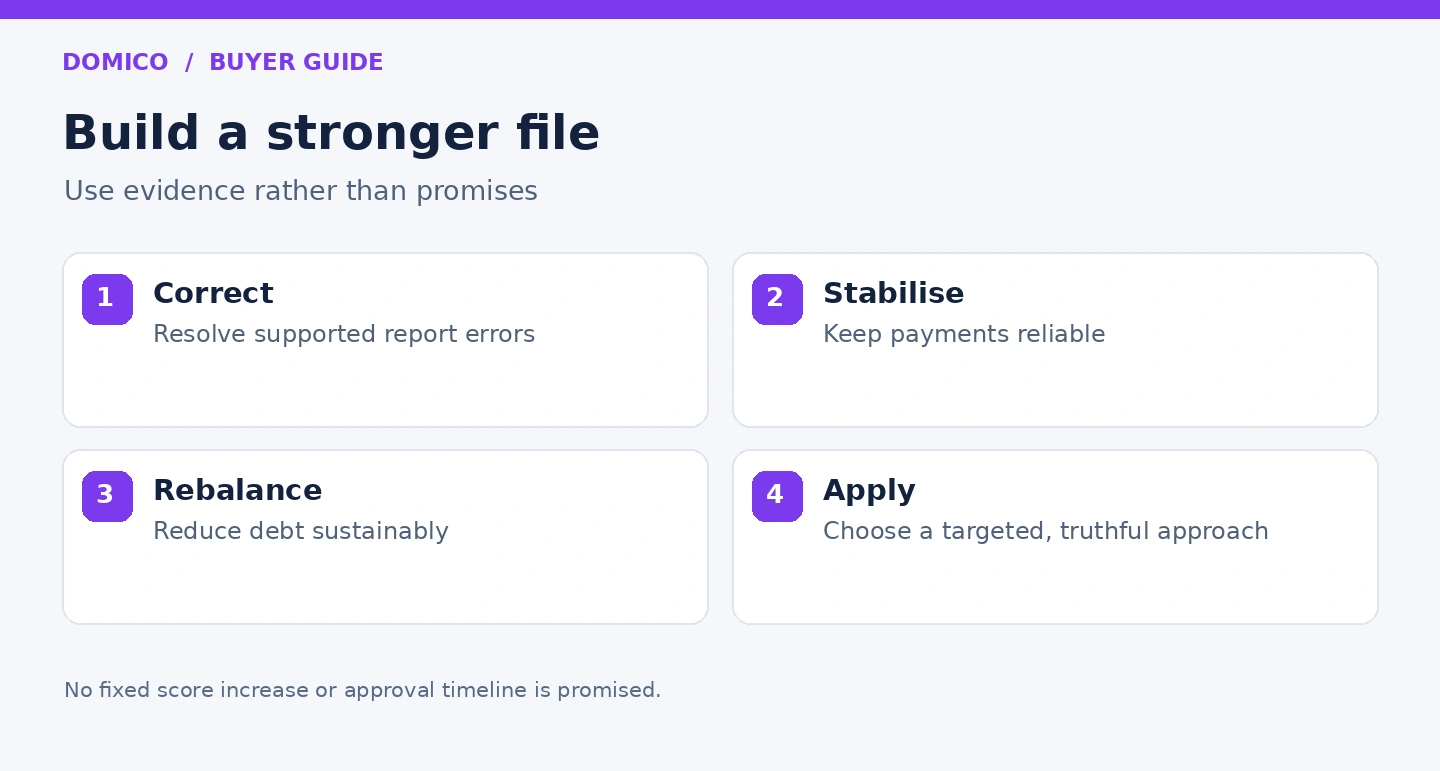
Improvement depends on what was wrong, how it is resolved and when updated information is reported. There is no universal three-month or six-month guarantee.
| Stage | Practical task | Evidence to retain |
|---|---|---|
| Understand | Read the report and build the debt list | Dated report and account reconciliation |
| Correct | Resolve genuine errors through proper channels | Dispute reference and lender response |
| Stabilise | Make payments reliably and reduce pressure | Statements and repayment records |
| Reassess | Review updated information and affordability | Fresh report and household budget |
| Apply selectively | Present a complete, truthful file | Application and written lender terms |
If your home purchase is urgent, separate what can be fixed quickly from what needs time. You may need to change the property budget or completion date rather than buy a promise of instant credit repair.
Printable buyer worksheet
Download the topic-specific review checklist. Use it to record evidence, unanswered questions and follow-up actions for the exact property.
Frequently asked questions
Is there one minimum CIBIL score for every home loan?
No universal approval number should be assumed. Lenders have their own policies and assess the broader applicant and property position. Ask for the current criteria relevant to your file.
Will checking my own report damage my chances?
A consumer's own report access is different from a lender enquiry connected with a new application. Use the official report service and distinguish it from authorising repeated loan applications.
Can CIBIL remove an accurate late payment?
A genuine error should be disputed with evidence. Do not expect a paid service to lawfully erase accurate information merely because it is inconvenient for the application.
Should I close all my loans before applying?
Assess the effect on monthly obligations, savings, costs and emergency funds. Paying every loan at once may not be the right use of your down-payment money.
Can I apply with my spouse instead?
Ask the lender about an eligible structure and disclosure of all relevant obligations. Moving names around does not justify hiding the actual ownership, finances or intended repayment arrangement.
Make the next application stronger
Your next useful step is a clean report review, truthful explanation and workable repayment budget. A strong home-loan application begins with a household that can sustain the loan, not just a score that looks better on a screen.
Primary sources and related reading
- buyer-guide-100
- homebuyers
- low-cibil-home-loan
- indore
Planning to buy or rent in Indore? Browse verified properties in Indore or read more Indore guides.