Buying Guide
Joint Home Loan: Co-Owner and Co-Borrower Explained
Understand co-applicant, co-borrower and co-owner roles, bank liability, repayment arrangements and exit planning before taking a joint home loan.

Table of contents
The names on the loan and the names on the home need a deliberate plan.
Adding a family member to a home-loan application can make more income available for assessment. It can also create a long-term repayment obligation for that person. Before using the phrase “joint loan,” understand who will apply, who will borrow and who will own the property.
These roles can overlap, but they answer different questions. A person may help with the application without understanding that the signed documents impose substantial liability. Another person may expect ownership because they pay an EMI, while their name is missing from the conveyance.
A clear structure connects the title, loan contract, actual payments and the family's intentions.
Understand the three roles
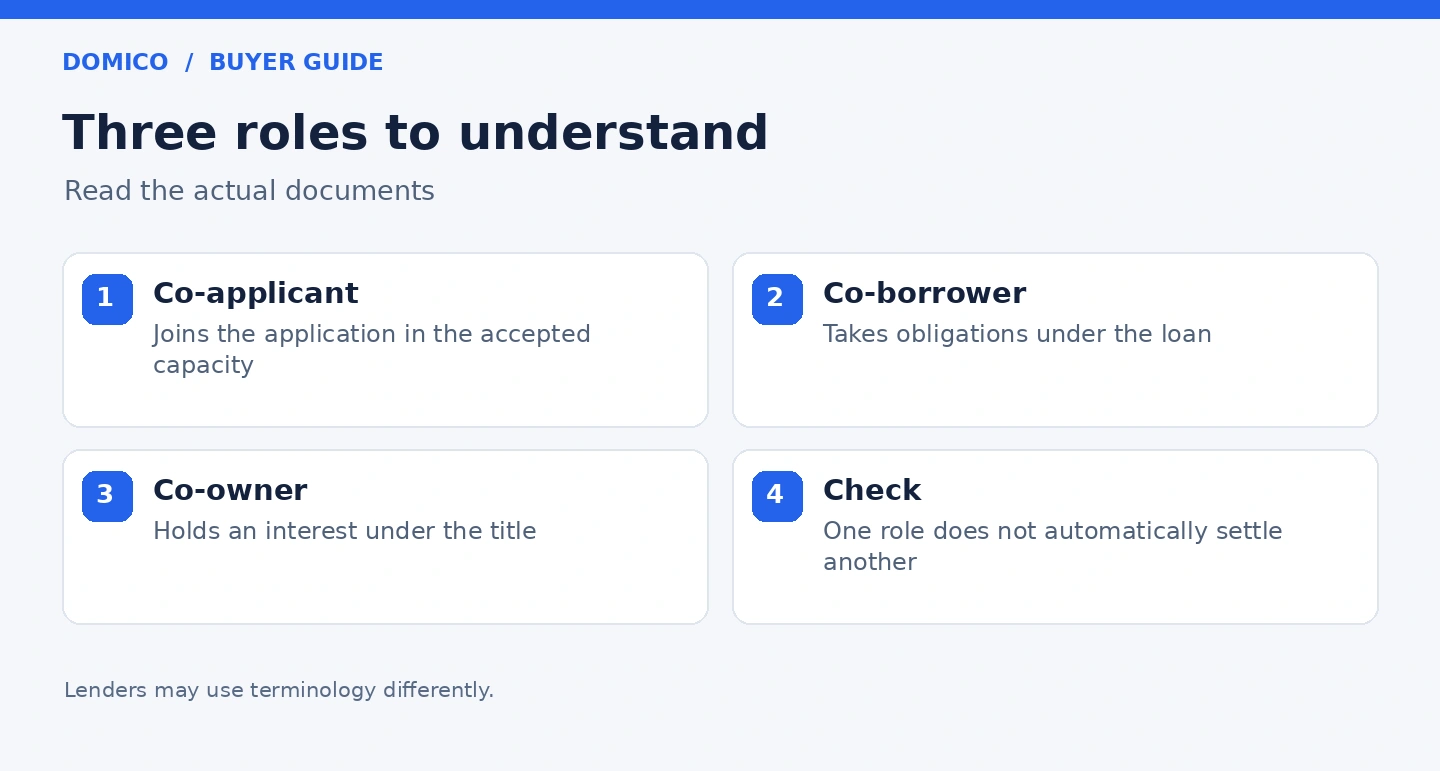
A co-applicant joins the application in the capacity accepted by the lender. A co-borrower takes on obligations under the loan documents. A co-owner holds an ownership interest under the property's legal documents.
Banks may use application terminology differently, so read the actual contract and ask for an explanation of the role assigned to each person. Do not assume a form label fully describes the legal liability.
| Role | Main question | Document to examine |
|---|---|---|
| Co-applicant | Who is joining the application and in what capacity? | Application and lender's requirements |
| Co-borrower | Who owes obligations under the loan? | Sanction and executed loan agreement |
| Co-owner | Who owns the property and in what share? | Acquisition deed and applicable title documents |
A guarantor is another distinct role. If the lender proposes one, ask what guarantee obligations arise and do not treat the signature as an attendance formality.
Ask which relationships the lender accepts
Lenders define eligible combinations for joint applications. Spouses or parents may be accepted under a product's criteria, while friends or particular sibling combinations may need a different assessment or may not be eligible.
ICICI Bank's home-loan FAQs describe eligible joint applicants under its policy. That is a lender-specific reference, not a universal rule binding all banks.
Tell the lender the real relationship, age, occupation and proposed ownership structure. Ask whether the co-applicant's income will be considered and how their age affects tenure or assessment. Do not rely on an online calculator that has not reviewed the applicant combination.
Confirm how each person's liability works
Ask the bank to explain what it can require from each signatory if payments stop. A private agreement that one borrower contributes 30% may not limit the lender's recovery rights to that proportion.
Read default, recovery, security and cross-obligation clauses with appropriate advice. Ask how missed payments may be reported for the borrowers. A loan taken mainly for one person's benefit can still affect another borrower's future borrowing position.
The useful question is specific: “If the other borrower stops paying, what exactly can the bank require from me under these documents?” Obtain a clear answer before signing.
Align ownership with the intended arrangement
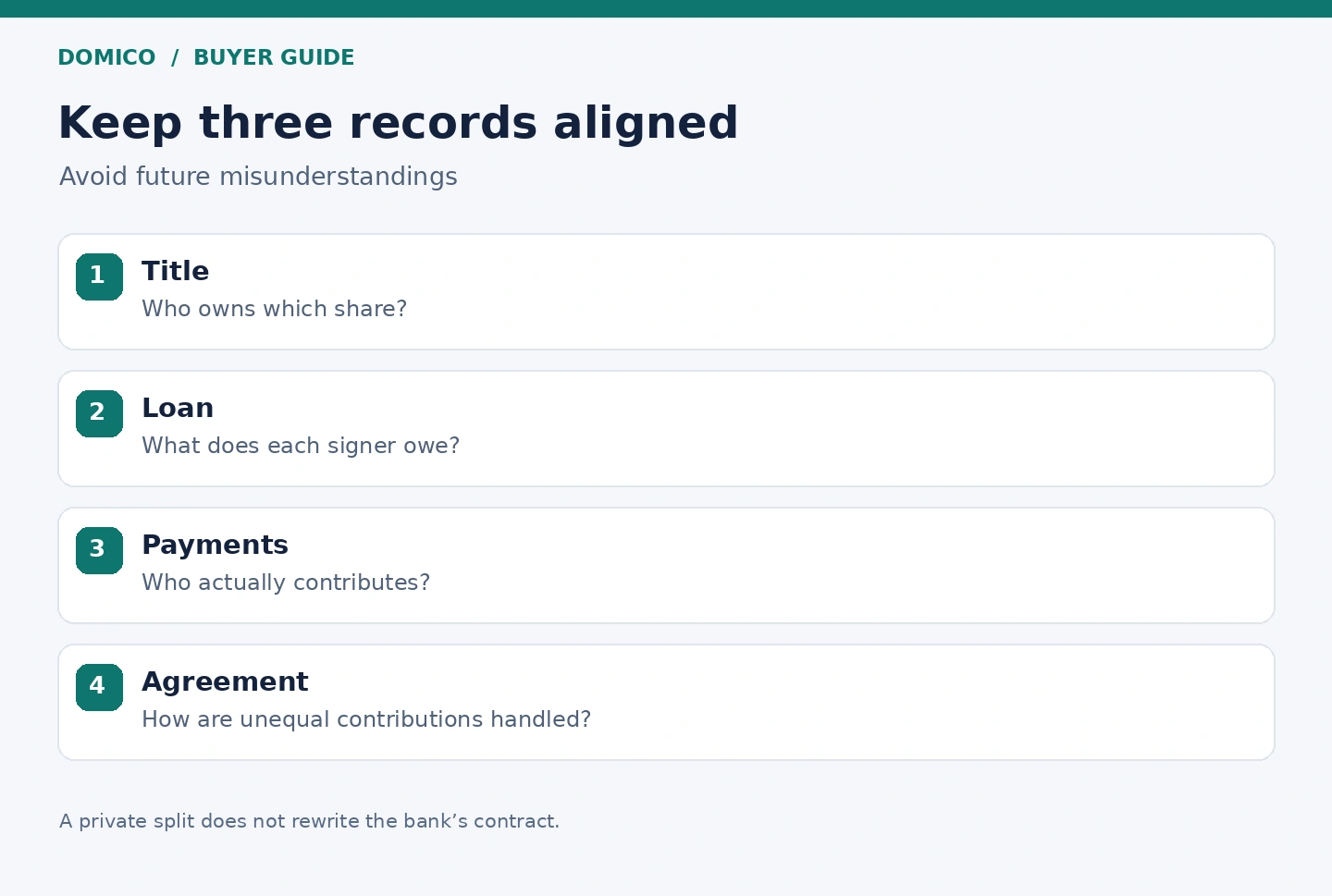
If both people intend to own the home, have the shares appropriately recorded. Decide how the down payment, loan and transaction costs connect with that ownership.
Paying an EMI does not by itself provide a simple substitute for being named in the title. Conversely, being a co-owner does not automatically establish which income the lender will count or which tax deduction is available.
Where parents contribute funds but do not want ownership, or spouses contribute different amounts, discuss the intended gift, loan or ownership arrangement with legal and tax advisers. Avoid leaving it to a later family argument.
An example of ownership and repayment
Consider a hypothetical Rs 60 lakh property bought by two spouses in equal shares. They contribute Rs 20 lakh from their own funds and borrow Rs 40 lakh jointly. They plan to pay the EMI equally.
| Illustrative element | Agreed position |
|---|---|
| Purchase price | Rs 60 lakh |
| Own contribution | Rs 20 lakh combined |
| Joint borrowing | Rs 40 lakh |
| Intended ownership | 50:50, properly recorded |
| Internal EMI sharing | 50:50 by agreement |
| Liability to bank | Determined by the executed loan contract |
Now suppose one spouse pays all EMIs during the other's career break. The family should understand whether that is simply their household arrangement or creates an agreed reimbursement balance. It does not automatically rewrite ownership shares or the bank's contract.
This example is not a recommendation that equal ownership is best for everyone. Its purpose is to show which questions should be answered separately.
Submit complete information for both applicants
Prepare identity, address, income, banking and existing-debt records for everyone involved, as requested. ICICI Bank's document page states that co-applicants need their applicable individual documents along with common property papers.
Disclose existing loans and guarantees accurately. Adding a second person may add income but also adds the obligations the lender needs to consider. A co-applicant's weaker credit or unstable income can affect the combined assessment.
If one person is self-employed and the other salaried, organise the two evidence sets clearly. Do not force business turnover into the place of personal income or assume the bank values every receipt in the same way.
Set the household repayment method
Decide which account pays the EMI, how each person contributes and how the money arrives before the due date. Keep a buffer so a delayed salary or bank transfer does not cause a missed collection.
Track actual payments. The record can help with budgeting, later disagreements and tax calculations where relevant. It does not need to become a daily argument about every rupee; a simple monthly reconciliation is often enough.
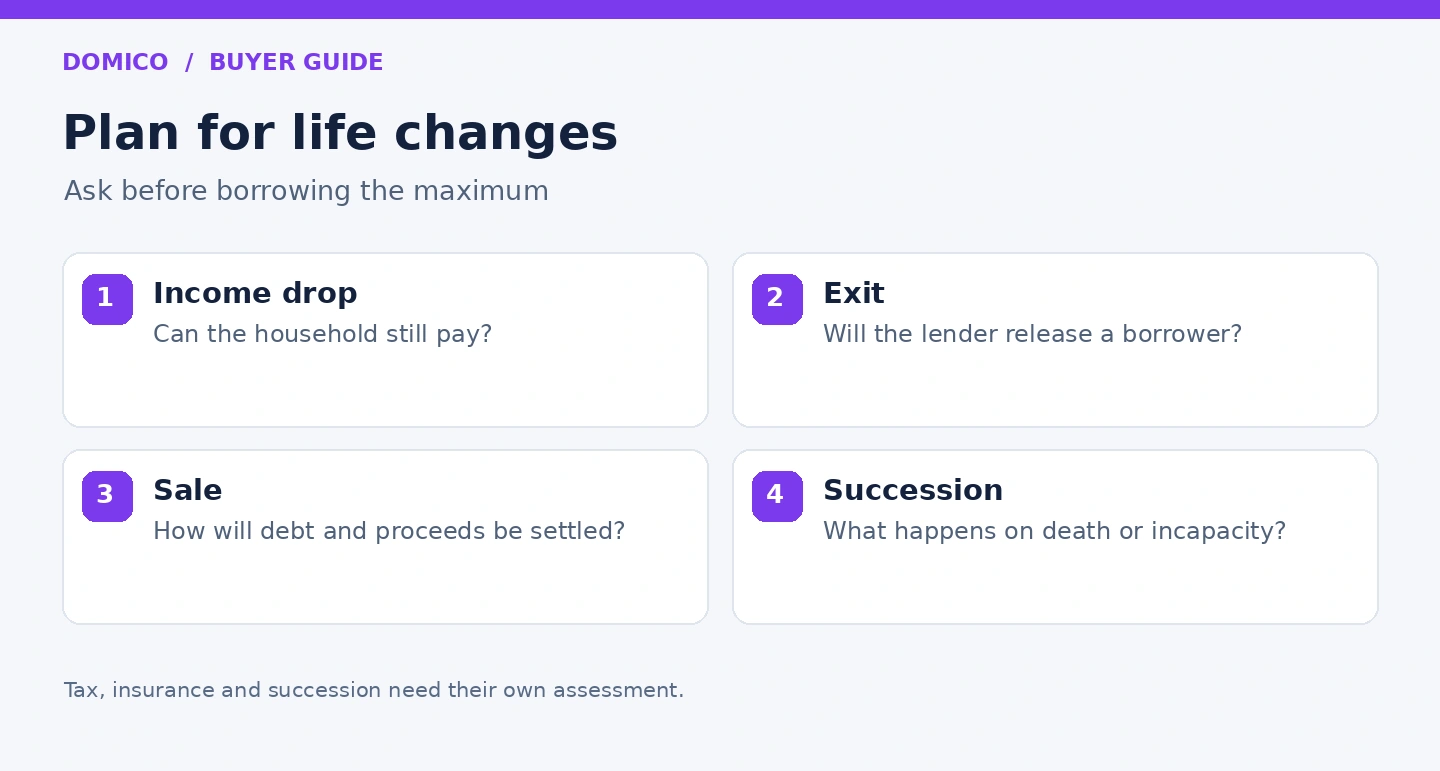
Review the plan when income changes. A joint loan should remain affordable if one income temporarily reduces. Test the budget for a career break, business slowdown or higher floating rate before borrowing the maximum amount offered.
Treat tax benefits as a separate analysis
Ownership, borrowing, actual repayment, property use and the chosen tax regime can affect deductions. Both people being named on a loan does not automatically mean both can claim the maximum possible benefit.
Ask a tax adviser to review the current year's rules and the evidence of payments. Avoid selecting an unnecessarily expensive home mainly to pursue a deduction. A tax benefit is only one part of the total cost of borrowing.
Keep annual interest statements, repayment records and the title documents. Where the internal contribution ratio differs from ownership, get advice instead of making a convenient unsupported tax split.
Understand the difficulty of removing a borrower
A borrower cannot normally assume they can exit the bank contract merely because the family agrees. The lender must assess and approve the relevant change, refinance or replacement structure.
A transfer of ownership can also require a proper instrument, applicable charges and the lender's consent. Removing a name from an informal family spreadsheet changes none of those records.
| Future event | Question to plan now |
|---|---|
| One borrower wants to leave | Can the other qualify alone, and what approval is needed? |
| Property is sold | How will the loan be closed and proceeds divided? |
| Relationship changes | What do the title and loan documents require? |
| A borrower dies | How will the estate, insurance and loan be handled? |
| Income falls | What household buffer or revised plan exists? |
Plan succession and insurance carefully
Discuss what happens if a co-owner or borrower dies or becomes unable to manage affairs. The home does not necessarily pass to the surviving borrower simply because the loan is joint.
Succession, nomination, wills and insurance have different roles. Have appropriate advisers explain the structure and maintain an accessible record of the loan, title and any cover.
If an insurance product is proposed, compare its scope, exclusions, premium and whether cover changes with the loan balance. Do not assume that adding a co-borrower provides the same protection as suitable insurance or estate planning.
Printable buyer worksheet
Download the topic-specific review checklist. Use it to record evidence, unanswered questions and follow-up actions for the exact property.
Frequently asked questions
Must a co-applicant also be a co-owner?
Requirements depend on lender policy and the proposed structure. Ask the bank which applicants must own and which owners must join the loan documents for this purchase.
Does a joint loan guarantee a higher sanctioned amount?
No. Income, age, existing obligations, credit records and property assessment all matter. A lender will assess the actual combined file.
Can we split the EMI in a different ratio from ownership?
The practical and legal consequences should be understood and documented. Actual payments, internal agreements, tax treatment and bank liability need to be considered separately.
Can I leave the loan after paying my share?
Your own calculation of a share does not automatically release you from the lender's contract. Obtain the bank's approved route for any exit or restructuring.
Will both borrowers receive the same tax deduction?
Do not assume so. The current tax regime, ownership, payment evidence and other conditions affect eligibility and amount. Get a calculation for each person.
Choose the structure before choosing the maximum loan
A useful joint-loan meeting should settle roles, ownership, liability, income assessment, payment method and exit. Borrow together only when everyone understands the commitment and the household can support it over time.
Primary sources and related reading
- buyer-guide-100
- homebuyers
- joint-home-loan
- indore
Planning to buy or rent in Indore? Browse verified properties in Indore or read more Indore guides.



