Jhalaria Underpass Indore: 30-Day Target Explained
Jhalaria underpass has a reported 30-day target. Explore the pending works and practical commute and home-viewing checks near MR-10 Bypass.
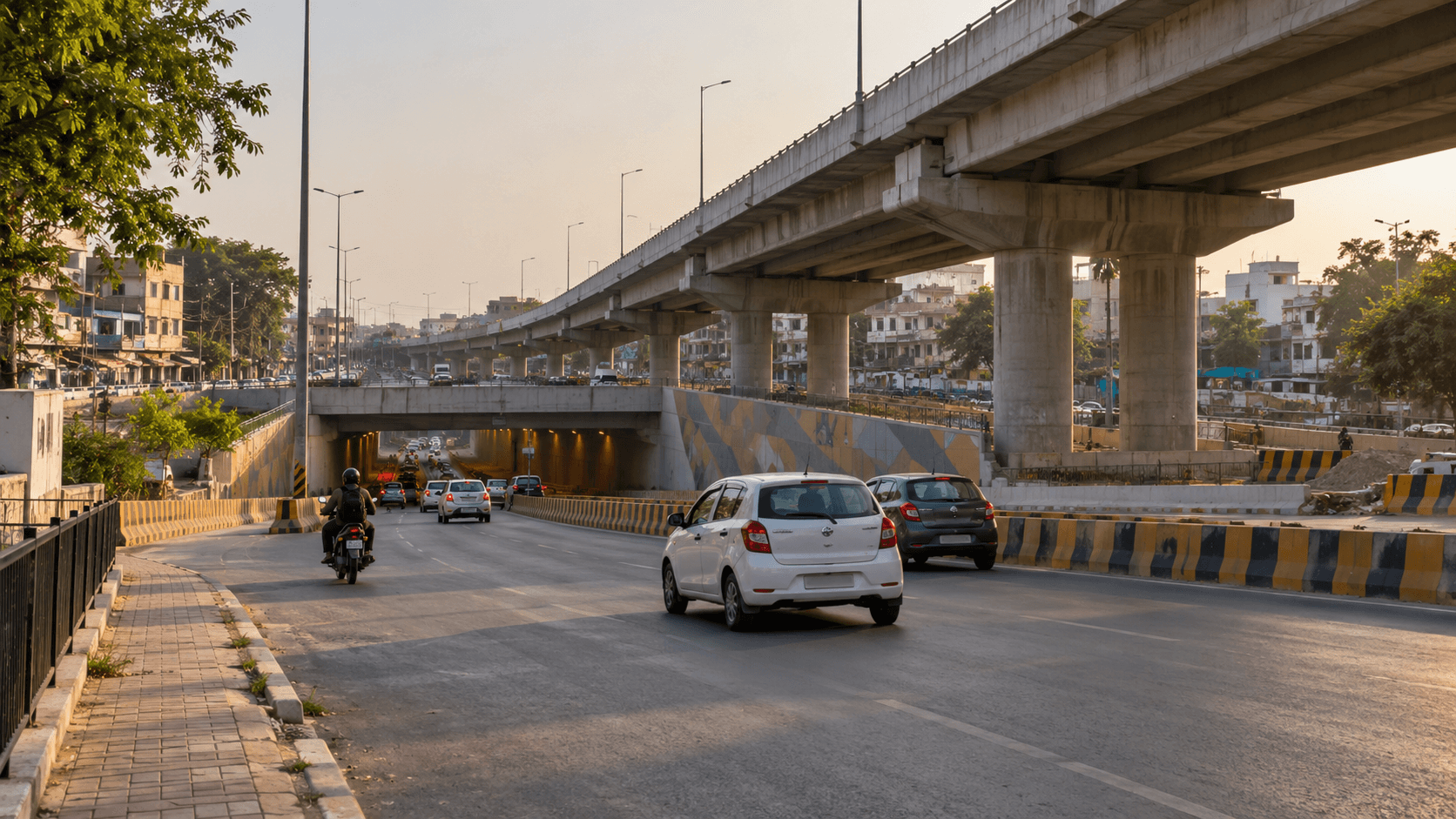
Table of contents
Reviewed on 18 October 2026. Cover image is an illustration, not a photograph of the Jhalaria project.
A shorter route matters most when it makes an ordinary day easier.
The Jhalaria underpass near Indore's MR-10 Bypass junction has a reported 30-day completion target. For nearby households, the useful question is what complete, usable connectivity will look like from their own doorstep.
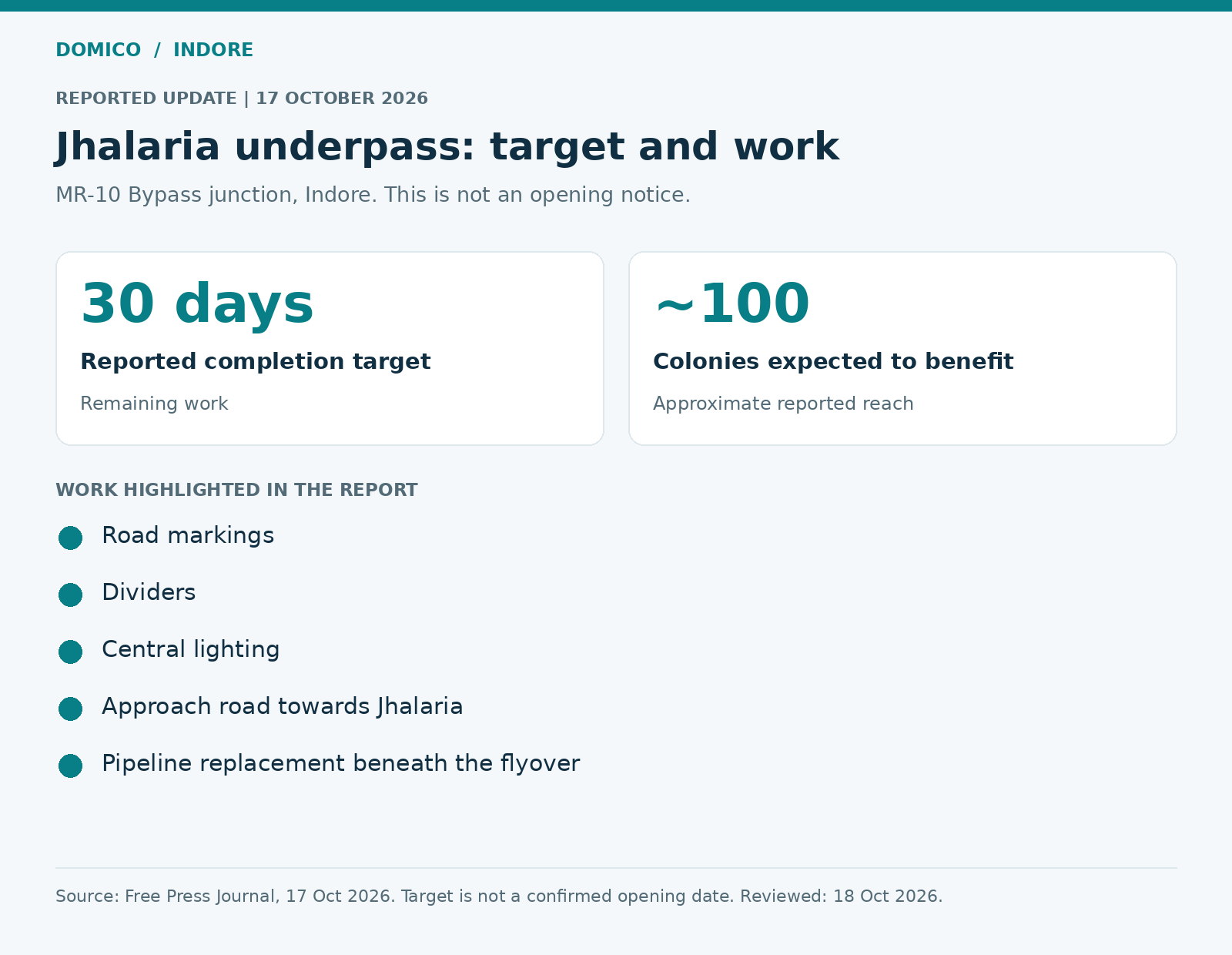
Free Press Journal's report, updated on 17 October 2026, attributes the assurance to NHAI officials during an inspection by Water Resources Minister Tulsi Ram Silawat. The table below separates that update from the practical checks that follow.
Jhalaria underpass: the reported position
| Item | What the report says |
|---|---|
| Location | MR-10 junction on the Bypass, near Best Price |
| Remaining-work target | Within 30 days |
| Expected reach | Approximately 100 colonies |
| Work directed for completion | Road markings, dividers, central lighting and the approach road towards Jhalaria |
| Associated utility work | Replacement of the pipeline beneath the flyover |
This is a reported target, not a confirmed opening date. Existing flyover traffic movement should not be read as confirmation that every underpass connection is ready.
Why the last part of a journey deserves attention
A large road structure attracts attention because it is visible from far away. Daily travel, however, begins in a smaller place: the gate of a colony, the lane outside a home or the turn beside a neighbourhood shop.
A household may reach a main road quickly and still spend time working out how to join the correct direction. The return journey may involve a different turn. A walking route to a bus stop can raise another set of questions. That is why an infrastructure update becomes more useful when it is connected to an actual journey.
For readers following the Jhalaria underpass, the practical approach is to look at the full route once the relevant connection is officially open for use. Notice how a vehicle reaches it, how the driver identifies the right lane and how the journey continues after leaving it.
The observations in this article are a reader's guide. They are not a traffic study, an engineering inspection or a claim that the project has already delivered a measured travel-time saving.
Five details worth checking when the route opens
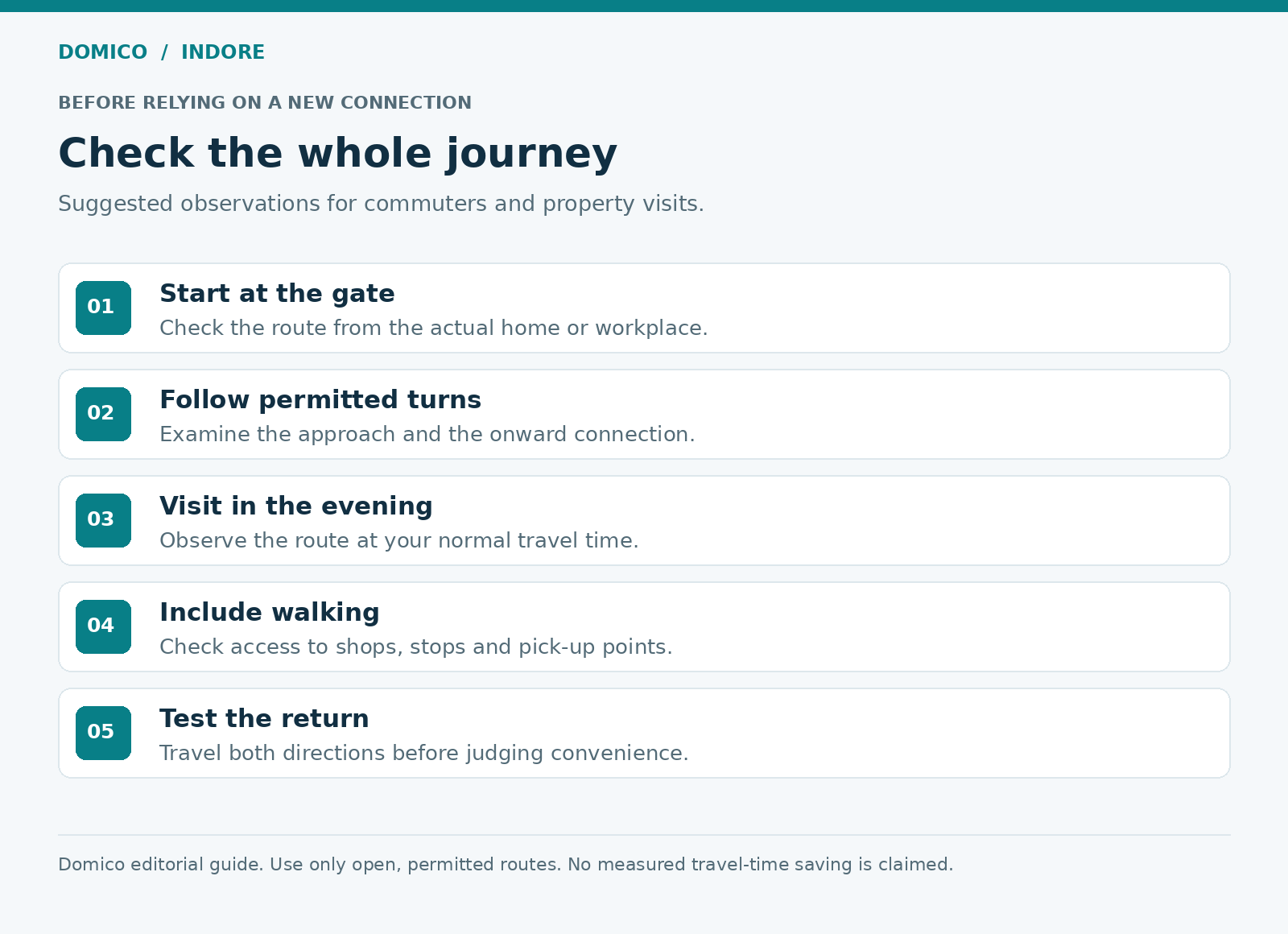
1. Can you understand the route before reaching the turn?
On a familiar road, people often navigate from memory. A changed junction asks them to make a new decision. Useful direction signs and visible lane information should allow that decision to happen early enough for a calm approach.
As a passenger, note where the destination becomes clear. Do you understand which way to continue before the junction arrives? Are other road users making sudden corrections? Describe what you can see without treating a brief visit as a professional safety finding.
2. Does the approach connect smoothly to the next road?
A connection has several parts: the lane you start from, the approach, the structure itself and the road that follows. Check the entire sequence in the direction you actually travel.
A route that looks direct on a map may involve a longer legal turn in one direction. Follow displayed instructions and use permitted routes. Never test an unfinished or restricted stretch simply to see whether a shortcut is possible.
3. What changes after sunset?
A daylight visit tells only part of the story. If you normally return home in the evening, observe the route at that time too, when it is open and lawful to use.
From a safe position, notice whether the way ahead, the turn and the walking edge are easy to identify. A dark patch or confusing sign can be described with a location and approximate time. Avoid using a phone while driving; let a passenger take notes or write them after stopping safely.
4. How does the journey work for people outside a car?
A family may use a car on some days and walk, take an auto or use a two-wheeler on others. A useful property or commute visit should reflect those ordinary choices.
Look for the actual route between a home, a local shop and a pick-up point. Ask whether a person needs to cross a busy road or take a detour. These questions help a household judge its own convenience without assuming that every traveller experiences a junction in the same way.
5. Can you make the return trip comfortably?
Always test both directions. The journey to work can appear simple while the route back involves a different approach. A clear return route is especially important for a household that regularly receives visitors, deliveries or school transport.
Write down the permitted sequence of turns for each direction. Share that description with family members only after checking the route on the ground and against current signs. Treat temporary diversions as temporary, and check again when arrangements change.
Make a simple commute record instead of guessing
If this connection is relevant to your daily travel, a small personal worksheet can be more useful than a sweeping claim about the whole area. Choose one normal journey, such as home to work, and record it consistently.
Use roughly comparable departure times on ordinary days. Start and end at the same points. Note unusual conditions such as heavy rain, a school event or an obstruction, since those can make one trip unrepresentative. Record the time only when safely stopped, or ask a passenger to help.
The aim is to understand your own experience. A few personal trips do not establish a city-wide average, and a single quick drive should not be advertised as a guaranteed commute time.
| What to record | Why it helps |
|---|---|
| Exact starting and ending points | Keeps the comparison about the same journey |
| Departure time | Makes morning and evening conditions easier to compare |
| Direction and permitted turns | Captures the difference between outward and return travel |
| Approximate journey duration | Gives your household a practical planning reference |
| Unusual conditions | Helps explain an unusually slow or quick trip |
| Walking or pick-up connection | Includes the part of travel beyond the main road |
For example, a family might compare its usual school drop-off route with the newly available permitted route after opening. It should record both the drive and the return journey. This is a suggested method, not a measured result for Jhalaria.
What nearby homebuyers should ask
Connectivity is a useful part of a home search because it affects repeated tasks: leaving for work, collecting children, buying groceries and receiving deliveries. It is still only one part of deciding whether a particular home suits a household.
Start at the property gate and travel towards the junction. A broad location description such as “near the Bypass” does not show the exact access. Ask the seller or developer to demonstrate the route currently available, then compare it with any future route being promised.
Visit at the times that matter to you. Someone working an early shift may care about a different journey from a person who returns late in the evening. A household with an older family member may place more weight on a comfortable walking connection or a convenient pick-up point.
Keep property documentation, building permissions and transaction checks within their own professional review. An improved road connection does not establish that an individual project has all the approvals or documents needed for a purchase.
| Home-viewing question | A practical way to examine it |
|---|---|
| How do we reach the junction today? | Drive the permitted route from the actual gate |
| How do we return home? | Check the return direction separately |
| Can school or office transport reach us? | Discuss the exact pick-up location with the operator |
| What is the evening experience? | Visit at the time your family normally travels |
| How is the home affected by road activity? | Observe sound and movement from inside the property |
| Which part of the sales promise is future-facing? | Ask for written details and distinguish it from access available now |
These are viewing prompts, not a ranking of colonies or a recommendation to buy a particular property.
How to read a claim about rising property prices
An infrastructure headline can quickly become a sales message. A buyer may hear that a new connection will transform prices or that a decision must be made immediately. Such claims need evidence beyond the existence of a road project.
Ask what comparison supports the claim. Is the seller referring to asking prices or completed transactions? Are the homes similar in size, condition, documentation and exact location? A figure for a distant stretch may say little about the property you are viewing.
Keep the household budget grounded in current affordability and the home's actual usefulness. If a price depends heavily on a promised future benefit, have that assumption reviewed before treating it as money already earned.
This article does not offer a price forecast or claim a measured rise linked to the underpass. A sound decision should remain understandable even if a construction target changes or the daily travel benefit differs from the sales pitch.
Visit the route. Check the home. Question the promise.
A useful connection should work for local businesses too
For a shop, office or small service business, the final approach can influence how easily a customer finds the entrance. Delivery access and a clear pick-up point may matter as much as the broad direction from a major road.
Business owners can prepare by reviewing the directions they give customers. Once a new route is open and verified, a short, accurate description can be more useful than forwarding an old pin with no explanation. Check that the destination marker points to the usable entrance rather than the back of the building.
Plan deliveries around the access that is currently permitted. Ask regular drivers whether a larger vehicle needs a different approach, and keep loading activity clear of moving traffic. These are operational suggestions, not new local restrictions announced in the report.
If construction temporarily affects the entrance, explain the practical route to customers and update the message when conditions change. A useful notice gives an understandable direction and a current contact, without promising that a restricted road will be available.
How residents can give useful feedback
A specific observation is easier to understand than a general complaint. Record the location, direction of travel, approximate time and the problem noticed. For example, a description that a direction sign is hard to read from a particular approach gives more context than saying the entire junction is confusing.
If a photograph would help, take it from a safe public position when stationary. Do not enter work zones or stop in a live lane to document a concern. Keep other people's private details out of a public post where they are unnecessary.
Use the current channel published by the relevant authority for a complaint or enquiry. This article does not provide an unverified helpline or promise a response time. Keep any acknowledgement so that a later follow-up can refer to the same issue.
It is equally useful to describe what has become easier. Clear feedback can identify both a remaining difficulty and an improvement that should be maintained.
Frequently asked questions
Is the Jhalaria underpass confirmed open?
The reviewed report discusses remaining work and a target. Check a current official opening notice and on-site instructions before relying on the connection.
Should I calculate a fixed opening date from the headline?
Use an officially confirmed date when one is announced. A construction target can guide expectations, but it should not be converted into a guaranteed date for travel plans or a property sales promise.
Will every nearby household save the same amount of time?
That cannot be established from this update. Starting points, destinations, legal turns and travel times differ. Test the journey relevant to your household after the route is available for use.
Is there a verified colony-by-colony benefit list here?
No detailed official service-area list is reproduced in this article. Check the actual connection from a specific address rather than assuming coverage from a broad neighbourhood description.
Can a map replace a visit?
A map is a useful planning aid. A visit helps you see the gate, approach, permitted turns and return journey. Use both, and follow current road signs if an old route suggestion conflicts with the arrangement on the ground.
Follow the journey from the gate to the destination
The most useful way to follow this project is to look beyond the structure and examine the journey it is meant to support. A clear approach, an understandable turn and a comfortable return trip are the details people experience every day.
For commuters, keep plans tied to the route actually available. For homebuyers, connect the news with a careful site visit and independent property checks. For residents, share specific observations that can help explain how the junction works in practice.
Better connectivity should be felt in everyday life.
Source and editorial note
- Free Press Journal: Jhalaria underpass completion target and MR-10 inspection, updated 17 October 2026.
The project update is attributed to this report. The journey worksheet, viewing questions and practical suggestions are original Domico editorial guidance. No independent traffic count, site inspection, travel-time measurement or property-price study is claimed. The graphics show a reported target and suggested checks, not an official engineering plan or verified opening notice.
- indore
- jhalaria-underpass
- mr-10
- bypass
- connectivity
- infrastructure
Planning to buy or rent in Indore? Browse verified properties in Indore or read more Indore guides.



