News
Indore Swamitva Row: What Property Owners Should Know
Indore's Swamitva registration dispute has taken a new turn. Read the reported action, latest update and practical checks for rural property owners.
Table of contents
Illustrative image. Not a photograph of a reported event or verified site.
A headline can explain the dispute. Your property's records explain your position.
Indore's Swamitva registration work is back in the news after reported action against probationary patwaris in Sanwer. For a rural homeowner, the useful question is simple: how should you follow your own property paperwork while the administrative dispute develops?
The employee action and an individual property's record are separate matters. This update explains what has been reported, what still needs official clarification and how to prepare a focused enquiry about your own file.
Updated on 14 October 2026. This article separates news reports from official scheme information.
What happened in Indore?
The Sootr reported on 13 October that Collector Shivam Verma had terminated the services of seven probationary patwaris in Sanwer over Swamitva registration work. The report said they had not completed any registrations under the scheme. These are reported reasons for the action, rather than findings independently verified by Domico.
There is an important difference between the available reports. Naidunia's article published on 14 October describes action against six patwaris. We have not reviewed the underlying signed orders, so the exact count remains unresolved here. Individual employees are not named in this article.
| Point | What readers should know |
|---|---|
| Location | The reported action concerns Sanwer in Indore district. |
| Nature of action | Reports describe termination of probationary services. |
| Number affected | The Sootr reports seven; Naidunia reports six. |
| Evidence still needed | The signed orders would clarify the count and exact reasons. |
The latest update changes the picture
A follow-up by The Sootr on 14 October says the patwari association met the collector and sought withdrawal of the action. It reports that improved registration work could lead to consideration of that request. The article also says the orders became public on 13 October but carried a 9 October date.
This is a reported possibility of reconsideration. The material reviewed does not confirm that the employees have been reinstated. A fresh written decision would be needed before presenting reinstatement as settled news.
That distinction matters when a story is shared in neighbourhood groups. A meeting, a request and a final decision are different stages. Check which stage a new update actually describes before forwarding it.
What is Swamitva, in plain English?
Official information from the Ministry of Panchayati Raj describes Swamitva as a scheme for creating a Record of Rights for property owners in rural inhabited, or abadi, areas. Drone surveys help map these areas. Ground verification and the handling of objections by the competent state authorities form part of the process before property cards are issued.
The practical purpose is clearer property records. A village home's boundaries and recorded details should be easier to identify when people need to understand the property on paper. The ministry also describes property cards as a way to support access to institutional credit. That does not mean a loan is automatically approved.
The rural abadi focus is important for an Indore audience. Before assuming this news applies to a city apartment or a particular plot, first establish whether your property falls within the relevant village area and process.
What should a property owner do now?
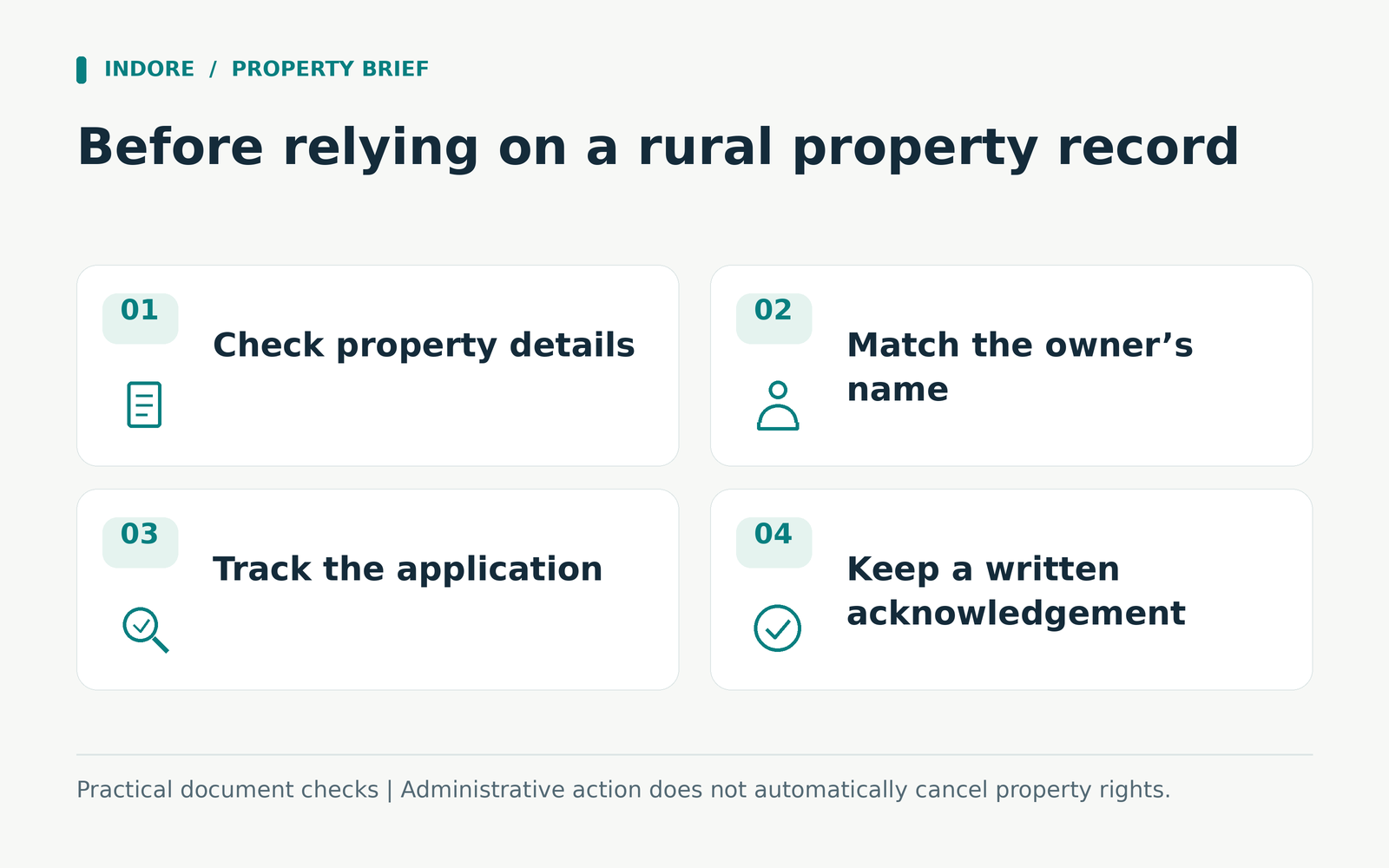
Start with your file, rather than an estimate circulating online. Write down the village name, the property identifier shown on your papers and the reference number of any application or acknowledgement you already have. Keep copies together so that an official can identify the matter quickly.
Then ask one clear question: what stage has this particular file reached, and what is required next? A specific enquiry is more useful than asking whether all registrations in Indore have stopped or restarted.
The district's official Revenue Department page provides a revenue contacts directory covering officers from patwari to SDM level. It allows searches using village, patwari halka and subdivision details. Use that official directory to find the relevant contact for your location, rather than relying only on a forwarded phone number.
| Before making an enquiry | Question to prepare |
|---|---|
| Identify the file | Which reference number should I quote? |
| Check the location | Which village and revenue jurisdiction cover this property? |
| Understand the status | Which step is complete, and which step is pending? |
| Check a mismatch | How should I submit or follow up on an objection? |
| Keep a record | Can I obtain an acknowledgement of my submission? |
If a detail appears wrong, note the exact difference. For example, distinguish a spelling issue from a disagreement about the boundary. Describe the problem accurately and ask which authority should address it. Do not assume that faster processing will correct an unresolved issue by itself.
Buying a property in the area? Ask better questions
A registration-related headline can attract attention to a location. It should also prompt a buyer to ask for clearer paperwork.
If a seller refers to Swamitva documents, request the actual document and identify the property it describes. Ask what is available today and what is still being processed. Avoid treating a promised future document as a document already issued.
Before making a financial commitment, obtain advice on the documents for the specific transaction. A news article cannot settle a property's ownership, an existing dispute or the terms of a proposed sale. Keep the discussion focused on verifiable records and clear answers.
This is also a useful way to reduce confusion during a viewing. Separate three questions: what property is being offered, which papers support it and which issues remain open.
Frequently asked questions
Were seven patwaris definitely removed?
Seven is the figure reported by The Sootr. Naidunia reports six. The underlying official orders have not been reviewed for this article, so the count should be treated as a reporting discrepancy.
Have the termination orders been withdrawn?
The reviewed follow-up describes a request for withdrawal and possible reconsideration. It does not confirm a withdrawal order.
Should I wait before asking about my property file?
You can still prepare a specific enquiry. Keep your reference details ready and use the appropriate official contact. Ask about your file's actual status rather than assuming every case has the same delay.
Does this news mean Indore property prices will rise?
This employee-action story provides no basis for predicting property prices. Assess any proposed purchase using the property's records, price and suitability for your needs.
For property owners, the strongest next step is a clear file and a clear question. Follow verified updates, keep your acknowledgements and check the status of the property that matters to you.
Sources and reporting notes
- The Sootr: original report, 13 October 2026 at 18:16 IST
- The Sootr: follow-up, 14 October 2026 at 12:17 IST
- Naidunia: report describing action against six patwaris, 14 October 2026
- Ministry of Panchayati Raj / PIB: drone surveys and property records, 21 July 2026
- Indore district: official Revenue Department and contacts directory
News developments are attributed to the publications above. Scheme background is drawn from official government information. No signed district termination or reinstatement order was located during this review.
Cover image: illustration of a generic setting. It does not depict the reported event or an identified site.
- indore news
- swamitva scheme
- sanwer
- property records
- rural property
- patwari news
Planning to buy or rent in Indore? Browse verified properties in Indore or read more Indore guides.



