Buying Guide
Municipal, Borewell or Tanker Water: Buyer Checks
Check a home's water sources, summer reliability, testing, storage, treatment, pressure and costs before buying an apartment or township home.
Updated 8 min read
Buying Guide
Check a home's water sources, summer reliability, testing, storage, treatment, pressure and costs before buying an apartment or township home.
A water connection is a starting point. Reliable quantity and verified quality are the real service.
A seller may describe a property as having municipal water, borewell water or round-the-clock supply. Each phrase needs explanation. A municipal connection can feed a storage tank on a limited schedule. A borewell can have seasonal constraints. A tanker can supplement another source or provide most of the building's water.
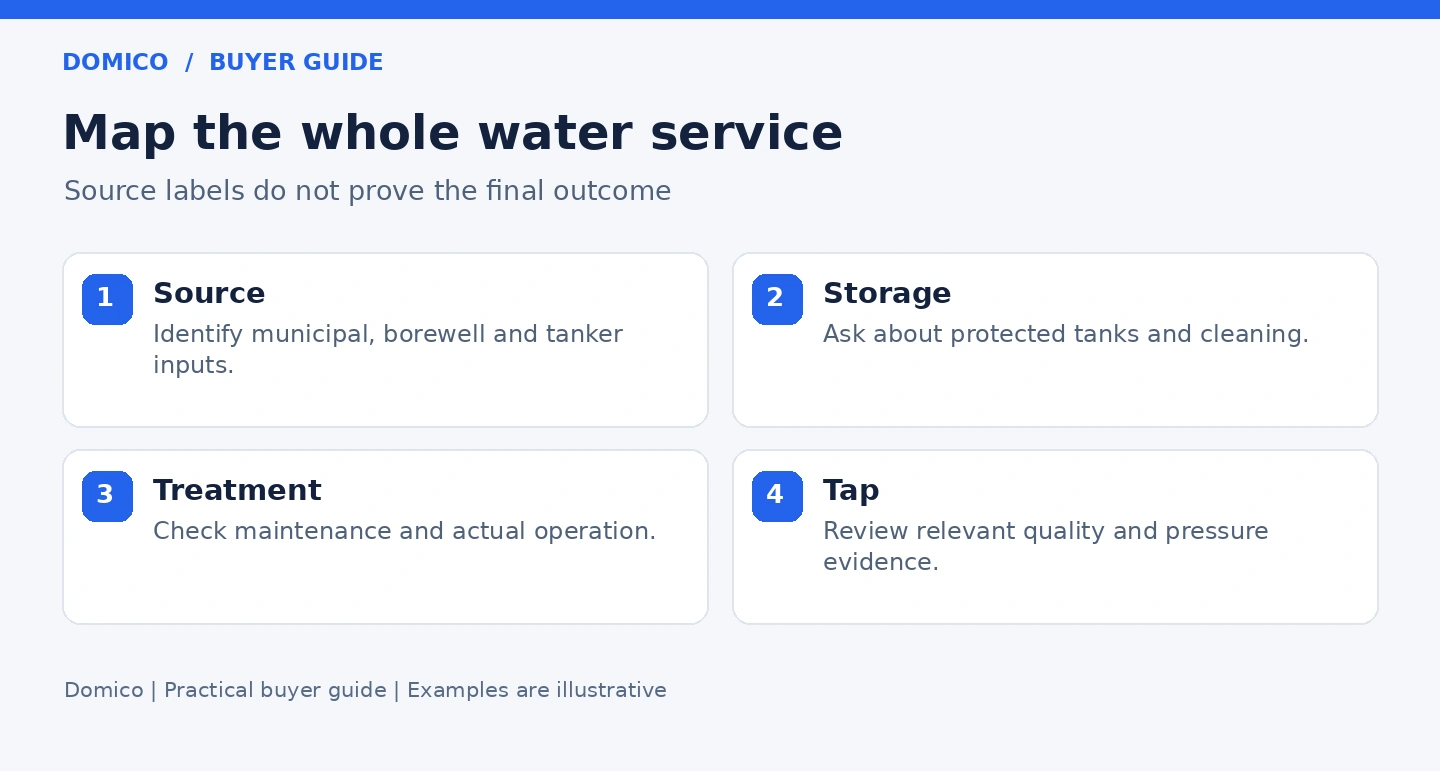
Before buying, understand the entire route from source to tap. Ask how water is obtained, stored, treated, distributed, tested and paid for. This gives you a more useful picture than deciding that one source is automatically safe or another automatically unsuitable.
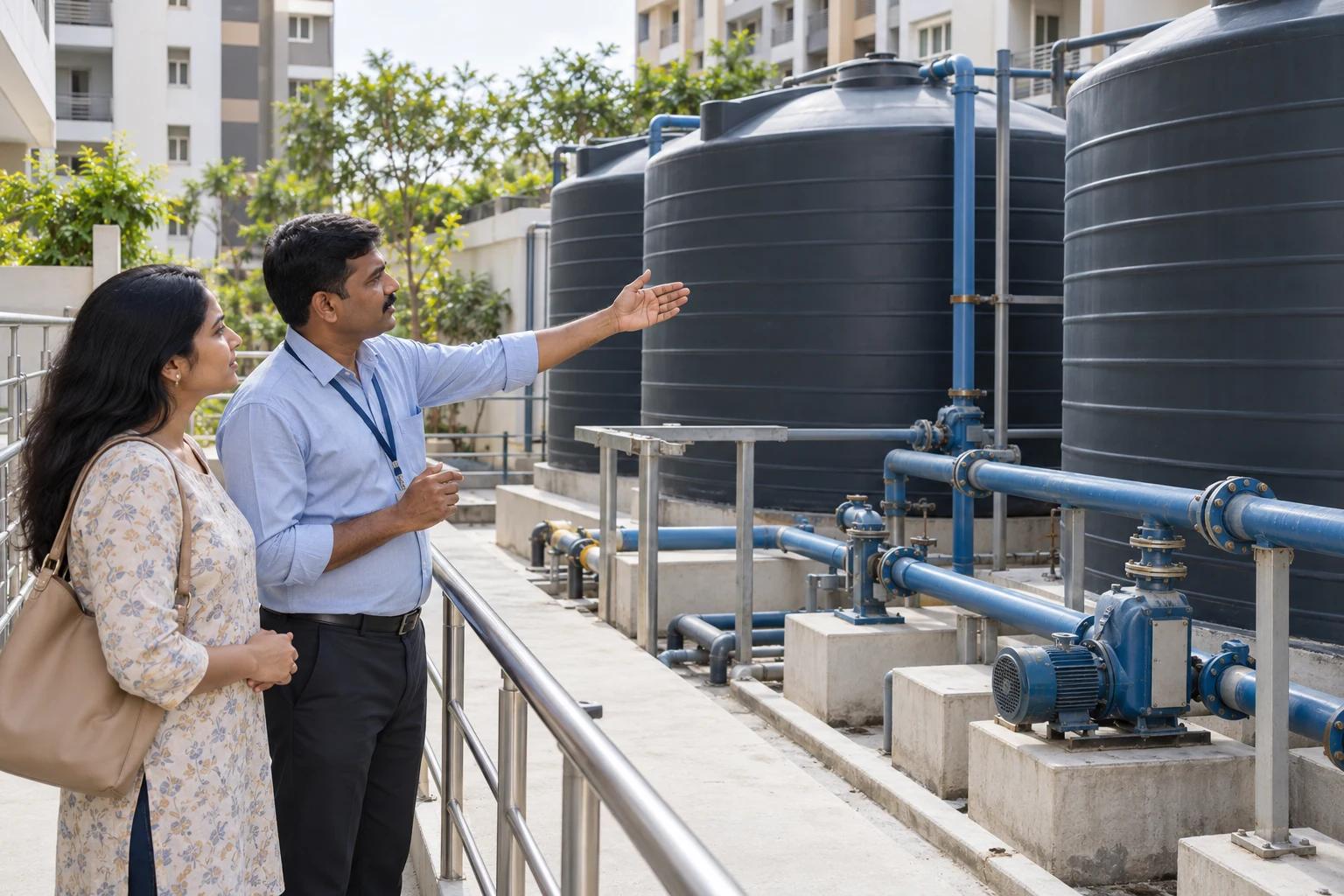
Ask the manager to draw the system in simple terms. Identify every source, the receiving tanks, any treatment equipment, the distribution pumps and the supply points in the flat. Clarify whether drinking and other uses follow different routes.
If treated wastewater is used for flushing or landscaping, ask how those systems are identified and kept separate from potable supply. A buyer should not inspect confined tanks, operate valves or test plumbing connections independently. Qualified staff should explain the system safely.
The MoHUA water-quality monitoring advisory addresses monitoring through the supply system. For a homebuyer, the practical question is whether relevant records and responsibilities exist at the points that affect the building's water.
| Source or arrangement | Advantage to investigate | Risk or limitation to investigate |
|---|---|---|
| Municipal connection | Documented public supply arrangement | Actual schedule, storage and local interruptions |
| Borewell | A local source under the applicable permissions | Yield, quality, seasonality and pumping needs |
| Tanker supply | An additional or alternative delivery source | Source traceability, quality, delivery and cost |
| Mixed sources | More than one supply option | Whether records distinguish sources and treatment |
| Stored supply | Buffer between deliveries or supply periods | Tank condition, cleaning and distribution management |
Ask whether the claim refers to municipal delivery, water available from a common tank, or supply inside the flat. These are different statements. A building can offer continuous internal access while refilling storage only during certain periods.
Request the ordinary schedule and the difficult-season schedule. Ask residents about the most recent interruption and how it was handled. A useful answer includes duration, communication and the temporary arrangement, rather than simply “water is never a problem.”
For a new project, obtain the documented proposed system and status of the external connection. Do not treat an application as a completed operational service. Identify any temporary construction or early-occupancy arrangement and when it is expected to change.
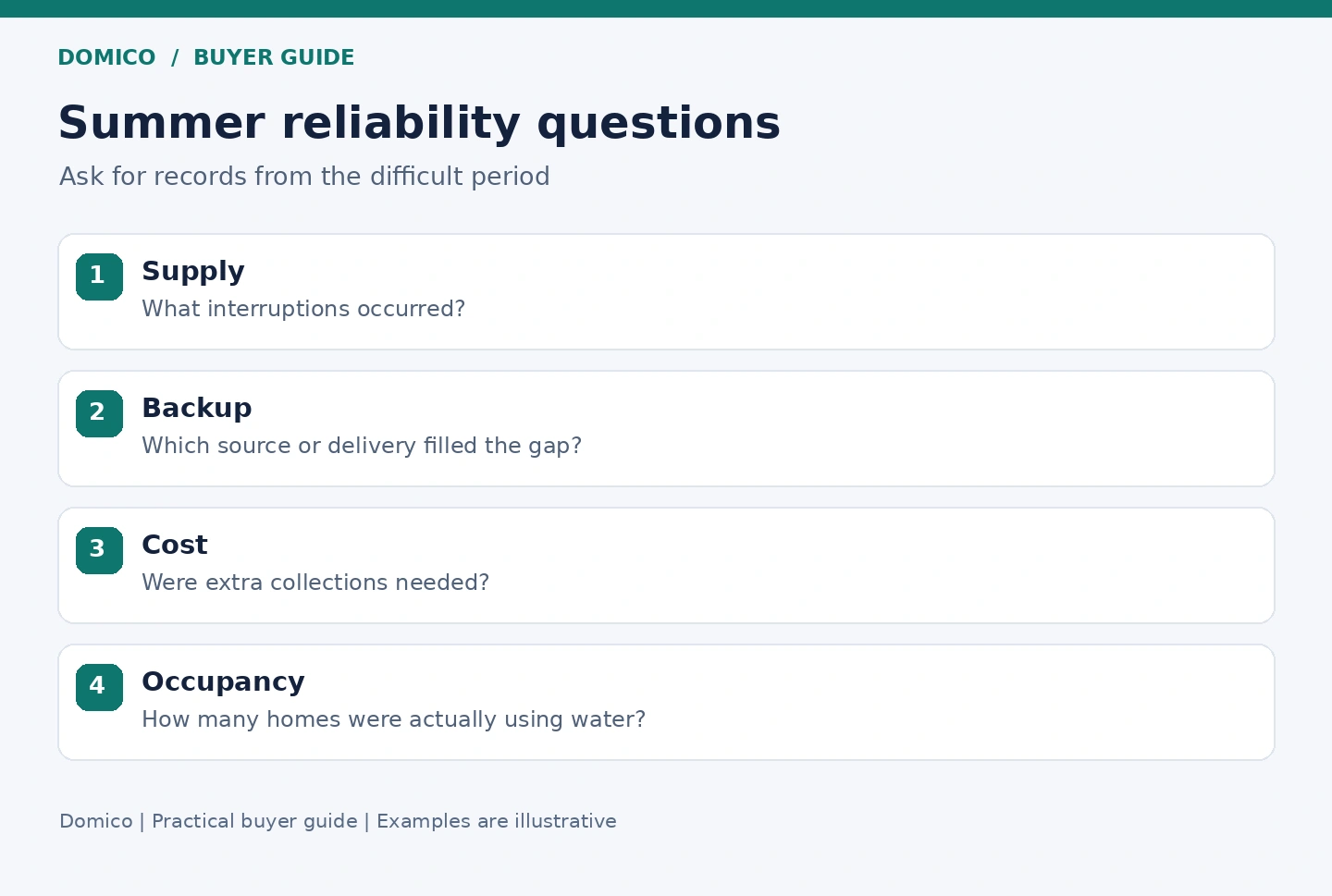
If buying in Indore during cooler weather or monsoon, ask specifically about the last summer. Request available tanker invoices, pumping records, shortage notices and association discussions through the authorised process.
A full year's data is more informative than one month's expense. Note occupancy levels, because a partly occupied project may have different demand from a fully occupied one. A low bill from an almost empty building is not a reliable estimate of your future share.
Ask how a failure of the main pump or a delayed tanker is managed. Multiple sources can improve resilience only if the equipment, contracts and operating practices support the plan.
Clear appearance and acceptable taste do not establish that water is suitable for a particular use. Ask for recent laboratory reports, sampling locations and the standards used to interpret the results. A report from a source point may not establish the condition at the kitchen tap after storage and distribution.
Check the report date, laboratory identity and whether the sample represents the supply now being used. If sources change seasonally, ask how testing reflects that change. Have a competent water-quality professional explain findings and any necessary treatment.
Do not use a handheld TDS reading as a complete drinking-water assessment. It does not answer every microbiological or chemical question. A domestic purifier should be selected for the actual water conditions, with proper maintenance, rather than treated as a universal fix.
Ask for tank-cleaning records, access controls and maintenance responsibilities. Observe accessible external conditions safely: damaged covers, leaks or visibly poor housekeeping are reasons to ask further questions. Do not climb into a tank or touch treatment chemicals.
Request the treatment system's service history and operating instructions where relevant. Equipment that exists but is not used or maintained should not be valued like a functioning system. Ask who checks it and what happens when it is out of service.
The MoHUA operation and maintenance manual hosted by MP PHED is a technical reference, not a substitute for the building's own records. Use qualified professionals to interpret actual treatment and distribution arrangements.
With permission, observe supply at the kitchen and bathrooms during normal use. Ask whether pressure differs at busy times or on upper floors. A short demonstration with the rest of the building quiet may miss peak-demand problems.
Check whether any private booster pump or modification has been installed and whether it is permitted and technically appropriate. An informal arrangement can affect neighbours or the common system. Do not assume that copying it will solve a pressure problem safely.
Look for leaks and ask how internal and shared repairs are allocated. A building with adequate source water can still deliver poor service through poorly maintained pipes or pumps.
Ask how water charges are allocated: included in maintenance, separately metered, divided under an authorised formula or collected through occasional demands. Understand treatment, pumping and tanker expenses separately where possible.
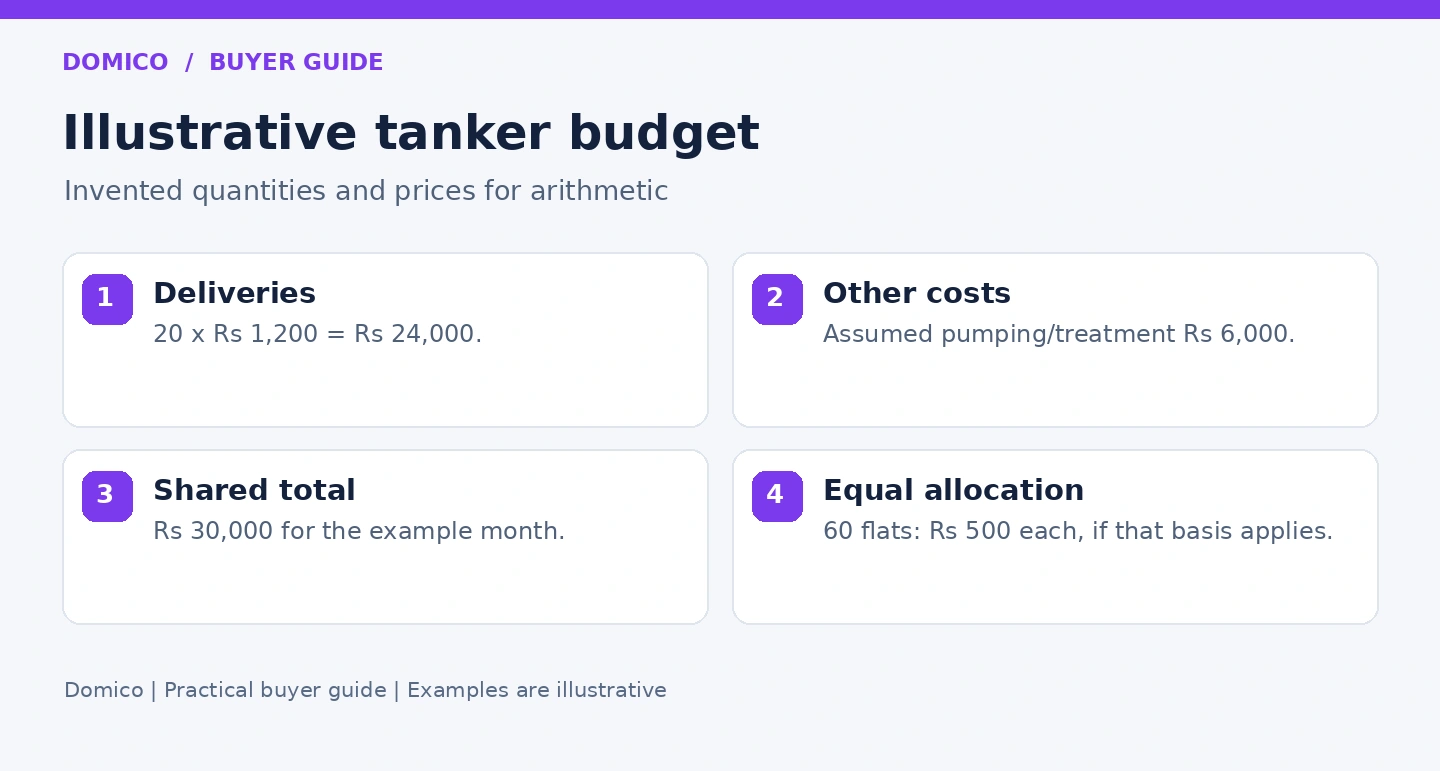
Here is an illustrative tanker-cost calculation. All quantities and prices are invented for explaining the method, not describing Indore supply rates or recommended water consumption.
| Assumed monthly item | Calculation | Example amount |
|---|---|---|
| Tanker deliveries | 20 deliveries x Rs 1,200 | Rs 24,000 |
| Pumping and treatment provision | Assumed monthly amount | Rs 6,000 |
| Total shared cost | Rs 24,000 + Rs 6,000 | Rs 30,000 |
| Equal share across 60 flats | Rs 30,000 / 60 | Rs 500 per flat |
A real building may use metering or another valid allocation. The Rs 500 figure is not a quoted maintenance charge. Also consider private purifier servicing or other household costs without double-counting amounts already included in maintenance.
Ask the authorised professional or authority about the permissions applicable to borewell extraction, connections, treatment or other arrangements. Do not infer legality from the fact that equipment is installed and operating.
For a large township, establish which phase controls the system and whether future phases will share the same capacity. A proposed extra source is not existing capacity. Ask who funds expansion and how the obligation is recorded.
Review the developer's commitments and the later association responsibilities with your lawyer where needed. A clear operating handover matters because good equipment can perform poorly without trained management and an adequate budget.
| Question before buying | Evidence to request | Follow-up if missing |
|---|---|---|
| Where does the water come from? | Connection records and source description | Clarify temporary and permanent arrangements |
| Is supply reliable in summer? | Seasonal records and resident experience | Seek a realistic contingency plan |
| Is quality checked? | Relevant dated laboratory reports | Arrange competent advice and testing |
| Are tanks and systems maintained? | Cleaning and service records | Identify the responsible operator |
| What will I pay? | Itemised bills and allocation basis | Reconcile maintenance and separate collections |
Before arranging new testing, agree with the competent laboratory or adviser which sample points and parameters address the actual question. A sample taken from one flat on one day has limits, especially when the source mix changes. Keep the original report with the date, location and interpretation rather than circulating only a cropped result that omits context.
Do not assume the entire building system is proven by the source label. Storage, distribution and household installations matter. Ask for relevant evidence and qualified interpretation of quality reports.
Its suitability depends on actual quality, intended use and appropriate treatment. Obtain relevant testing and professional advice rather than judging solely by source or taste.
No single device should be assumed suitable for all conditions. Understand the contaminants or issues being addressed and the equipment's maintenance and operating requirements.
Investigate quantity, source traceability, testing, cost and delivery reliability. Some buyers accept a documented arrangement; others need a different level of certainty. Make that choice with actual records.
Ask what happened during the latest shortage or pump failure, how long it lasted, what it cost and how management responded. Specific experience is more useful than a general assurance.
Buy the water service the building can demonstrate, including its difficult days. A promising source name should lead to records, not end the investigation.
Download the topic-specific review checklist. Use it to record evidence, unanswered questions and follow-up actions for the exact property.
Planning to buy or rent in Indore? Browse verified properties in Indore or read more Indore guides.
Check who owes the lender, how builder-paid interest works, when support ends and whether you can carry the loan if payments stop.



