Buying Guide
Home Loan Insurance: Mandatory Cover and Cost Checks
Compare loan-linked life cover, term insurance and building insurance, including financed-premium costs, reducing cover and lender requirements.
Updated 8 min read

Buying Guide
Compare loan-linked life cover, term insurance and building insurance, including financed-premium costs, reducing cover and lender requirements.
Protect the family, the loan and the building with the right cover for each risk.
A lender discusses insurance while you are finalising a home loan. The premium may appear as one more line in a large transaction, and it is tempting to accept it without asking what it covers. But home loan insurance, term life insurance and building insurance address different problems.
Before deciding, ask three questions: what event triggers payment, who receives the benefit and what happens if the loan changes? These answers matter more than a broad promise that the house will be protected.
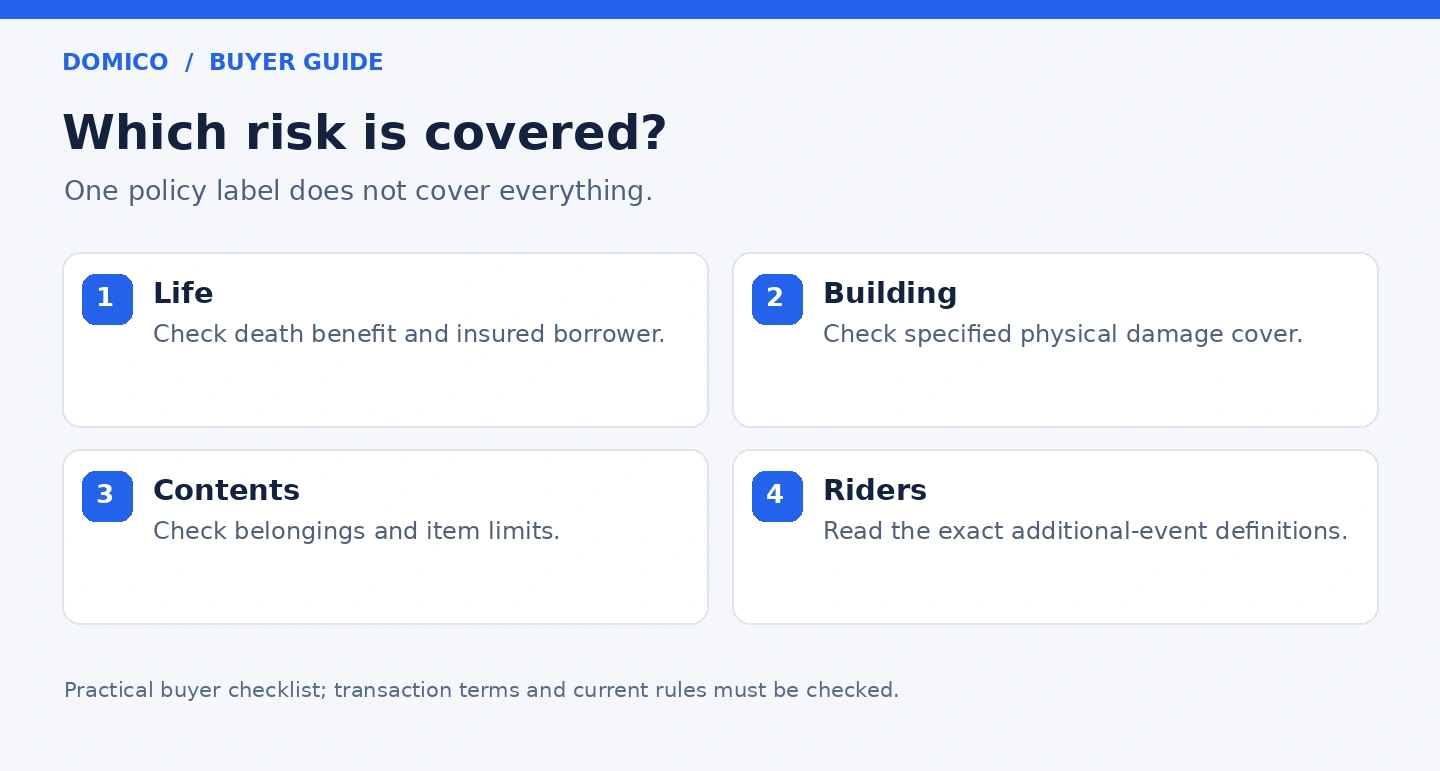
Loan-linked life cover is designed around an insured borrower's death and the policy's benefit structure. A term life policy generally pays its stated benefit when a covered death occurs, subject to the contract. Building insurance addresses specified damage to the physical structure. Contents cover concerns belongings and can have separate terms.
None should be assumed to cover unemployment, every illness, every construction defect or a decline in property value. Additional protections exist only where the policy actually provides them. Read the exclusions and conditions rather than treating the product name as the entire contract.
| Cover | Main question it addresses | What to verify |
|---|---|---|
| Loan-linked life cover | What happens to the insured debt exposure after a covered death? | Benefit schedule, insured borrower and beneficiary arrangement |
| Level term life cover | What money is available to dependants after a covered death? | Sum assured, term, disclosures and nomination |
| Building insurance | How is insured physical damage addressed? | Reinstatement basis, covered events and exclusions |
| Contents cover | What protection applies to belongings? | Limits, valuation and specified items |
| Optional riders | Which additional events are covered? | Exact definition, waiting periods and restrictions |
Do not accept the statement that every homebuyer is legally required to buy the lender's chosen life policy. RBI's insurance-agency guidance describes customer participation in insurance products as voluntary and addresses linkage with banking services. SBI's published home-loan terms also illustrate loan-linked life cover being described as optional.
At the same time, a lender may have contractual requirements to insure the mortgaged building against specified risks. Ask the lender to distinguish collateral insurance from life cover and identify the relevant condition in the sanction letter. Check whether suitable cover from another insurer is acceptable.
The right outcome is not automatically refusing insurance. It is understanding the requirement and selecting appropriate protection without being misled about the legal or contractual position.
Some loan-linked policies use a scheduled reducing benefit. That schedule may be based on assumed repayment and interest. Your actual outstanding balance can differ if rates rise, repayments are delayed, tenure changes or additional borrowing is added.
Ask for the policy's benefit table and compare it with the mortgage schedule. What happens if the insurance benefit is lower than the debt at the time of a claim? What happens if the benefit exceeds it? Who receives any balance? These are contract questions, not details to leave until a family needs the claim.
Where two people borrow, check who is insured and how the cover operates after one person's death. Two borrowers do not necessarily mean both lives are protected for the full outstanding amount. Obtain each insured person's schedule and the joint-life or separate-cover terms.
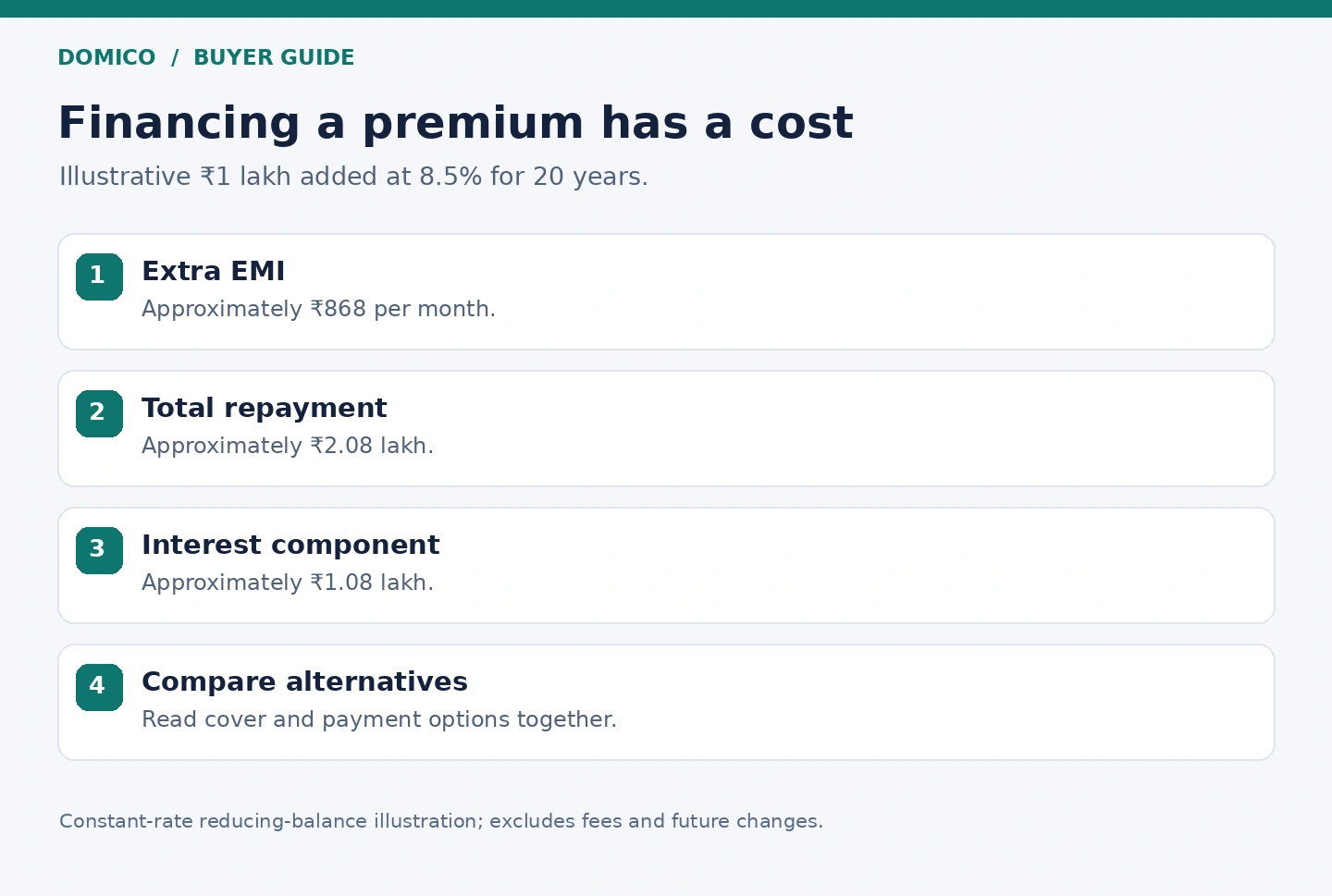
Suppose the home loan required for the purchase is ₹40 lakh and an illustrative single premium of ₹1 lakh is added to the debt. The starting financed amount becomes ₹41 lakh. The premium is not free because the bank spreads it across instalments.
At an illustrative constant 8.5% over twenty years, financing that extra ₹1 lakh creates an EMI of about ₹868 and total repayment of about ₹2.08 lakh. Roughly ₹1.08 lakh of that is interest on the financed premium. Actual loan terms, fees and rate changes alter the result.
| Illustrative premium choice | Immediate cash effect | Longer-term point |
|---|---|---|
| Pay ₹1 lakh separately | Uses ₹1 lakh of available cash | No mortgage interest on that premium amount |
| Finance ₹1 lakh for 20 years at 8.5% | About ₹868 extra EMI | About ₹2.08 lakh total repayment under fixed assumptions |
| Compare another suitable policy | Depends on quote and eligibility | Compare benefits, exclusions and total cost |
This calculation does not establish which policy you should buy. It shows why payment method belongs in the comparison. Preserving emergency cash can have value, but you should know the price of financing the premium.
Ask for written quotes with the same insured amount, age, term and relevant health information. Compare reducing and level cover carefully because they promise different benefit patterns. A low premium with a shorter term may leave the final loan years exposed.
Review exclusions, medical disclosures, waiting conditions where relevant, claim documentation and the insurer's grievance process. Answer proposal questions honestly. A convenient application with incomplete medical information can create a much larger problem at claim time.
Also check what happens after a part-prepayment, balance transfer or foreclosure. Does the policy continue, can it be reassigned, and is any refund available under the actual terms? Do not assume loan closure automatically produces a full premium refund.
A property's market price can include land, location and other factors that are not the cost of reconstructing the structure. Ask the insurer how the building sum insured is established and what the policy covers. The Bharat Griha Raksha policy wording is one primary example of a home-insurance contract to examine, not a recommendation of one insurer.
For an apartment, ask about the society's building policy and what remains your responsibility. Common-area cover does not automatically mean your interiors, contents or every liability is covered. Obtain the schedule and confirm the insured address and scope.
Do not confuse an insured event with ordinary maintenance. Dampness, ageing materials or defective work may not receive the same treatment as specified sudden damage. Read exclusions and ask for a written answer if a particular risk concerns you.
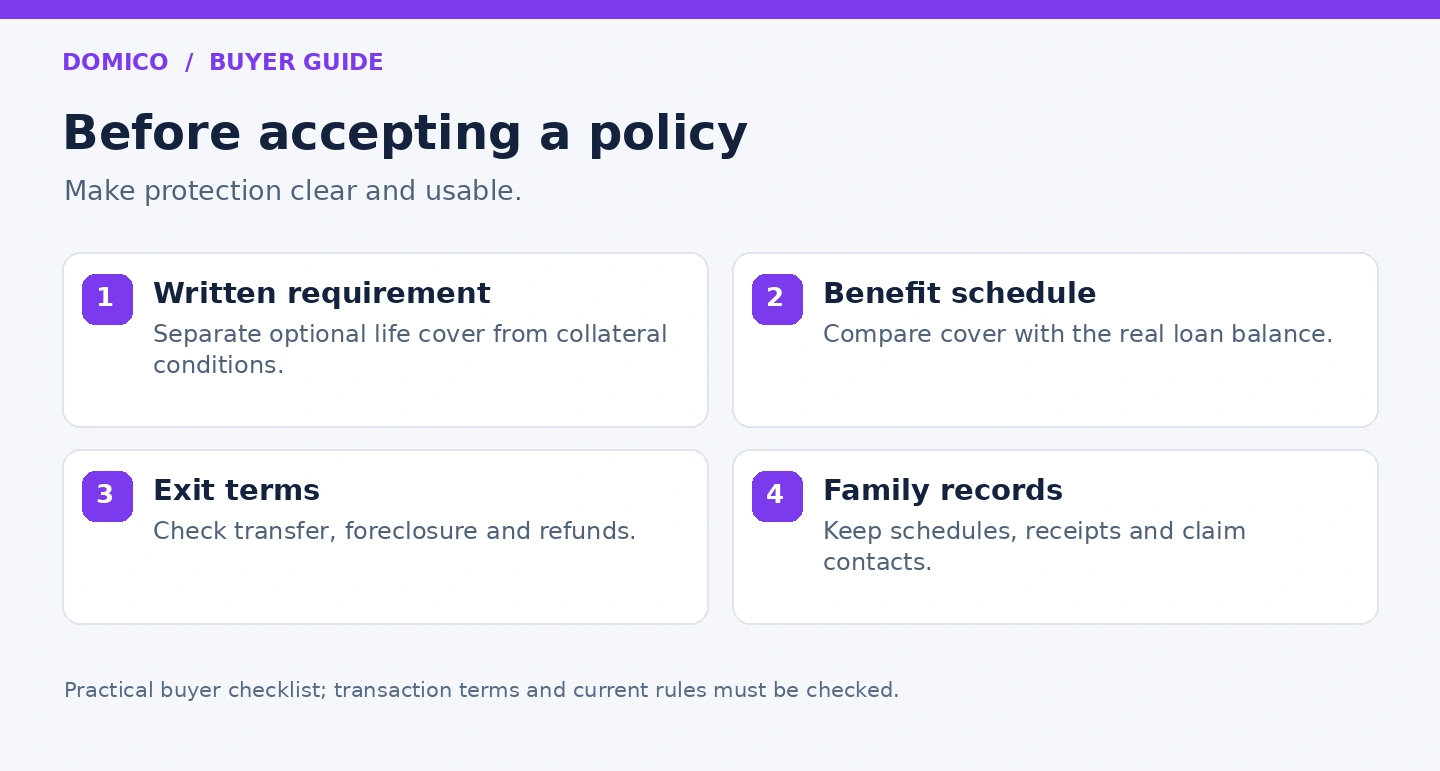
Keep policy numbers, schedules, premium receipts and insurer contact details where the family can find them. Check names, dates of birth, insured property and nomination or assignment details. An appropriate policy is less useful if no one knows it exists.
Explain the basic claim process to the person who may need it. Where a policy is assigned to the lender, ask what documents the insurer and bank require and how a loan settlement is confirmed. Keep the loan statement and policy benefit schedule together.
Review protection after major changes: another child, a larger loan, a balance transfer or a substantial prepayment. The family's income-replacement need may be larger than the mortgage, so a loan-only benefit should not automatically be treated as complete life protection.
| Check | Question to ask | Evidence |
|---|---|---|
| Purpose | Life, structure, contents or rider? | Policy wording and schedule |
| Amount | Level or reducing benefit? | Year-by-year benefit table |
| Cost | Premium paid separately or financed? | Quote and loan-cost illustration |
| Change | What happens after transfer or foreclosure? | Written continuation/refund terms |
| Claim | Who receives payment and how? | Nomination, assignment and claim guidance |
| Exclusions | Which important situations are outside cover? | Relevant clauses highlighted |
Check the answers submitted in your name before signing. Medical history, occupation, existing insurance and other material questions should be answered accurately. Do not allow an intermediary to leave important answers blank with a promise to complete them later.
After the policy arrives, compare the issued schedule with the cover you agreed to buy. Confirm the insured person, amount, term, premium and any assignment. Follow the applicable review or cancellation process promptly if the issued terms differ from what you requested; ask the insurer for the relevant period and permitted deductions.
Keep a copy of the proposal and supporting disclosures with the final policy. If a claim question arises years later, that record helps show what information was actually provided. The convenience of buying insurance alongside the loan should not reduce the care given to an important long-term contract.
Download the topic-specific review checklist. Use it to record evidence, unanswered questions and follow-up actions for the exact property.
Do not treat that as a blanket legal requirement. Ask for the exact written condition and distinguish optional loan-linked life cover from any contractual building-insurance requirement. Compare suitable alternatives where allowed.
Building or contents insurance generally addresses specified property risks. Death-related protection depends on a life policy and its terms. Check the actual policy rather than using the phrase home insurance loosely.
Financing changes the payment timing and can add years of interest. Compare the premium, benefits and total financed cost. A small additional EMI can still produce a substantial total outflow.
That depends on the contract and assignment arrangement. Ask about continuation, reassignment, surrender or any refund. Do not assume the same rule applies to every product.
Consider outstanding debt, dependants' living costs, future goals and existing protection. A loan balance alone may not represent the household's complete need. Obtain suitable regulated advice if the decision is significant.
Planning to buy or rent in Indore? Browse verified properties in Indore or read more Indore guides.
Check who owes the lender, how builder-paid interest works, when support ends and whether you can carry the loan if payments stop.



