Buying Guide
Compare Home Loans Using APR and the KFS
Learn to compare home loan APR, fees, insurance, usable disbursement and repayment terms using the Key Facts Statement and practical examples.

Table of contents
The cheapest-looking loan is not always the cheapest loan to use.
Two lenders offer the same interest rate. One asks for a substantial processing fee, adds a financed insurance premium and charges for certain services. The other has a slightly different fee structure. Comparing only the percentage printed in the advertisement leaves much of the decision unfinished.
The Key Facts Statement, or KFS, gives you a concise way to organise that comparison. Its Annual Percentage Rate, or APR, is designed to bring interest and relevant loan charges into a common annual cost measure. For a homebuyer managing several large payments at once, that is much more useful than collecting promotional screenshots.
Start with the actual offer, not the starting rate
A rate advertised as starting from a particular number may apply only to selected borrowers. Ask for the KFS for the loan amount, repayment term and borrower profile actually offered to you. Check the proposal number and make sure it belongs to the same offer as the sanction letter.
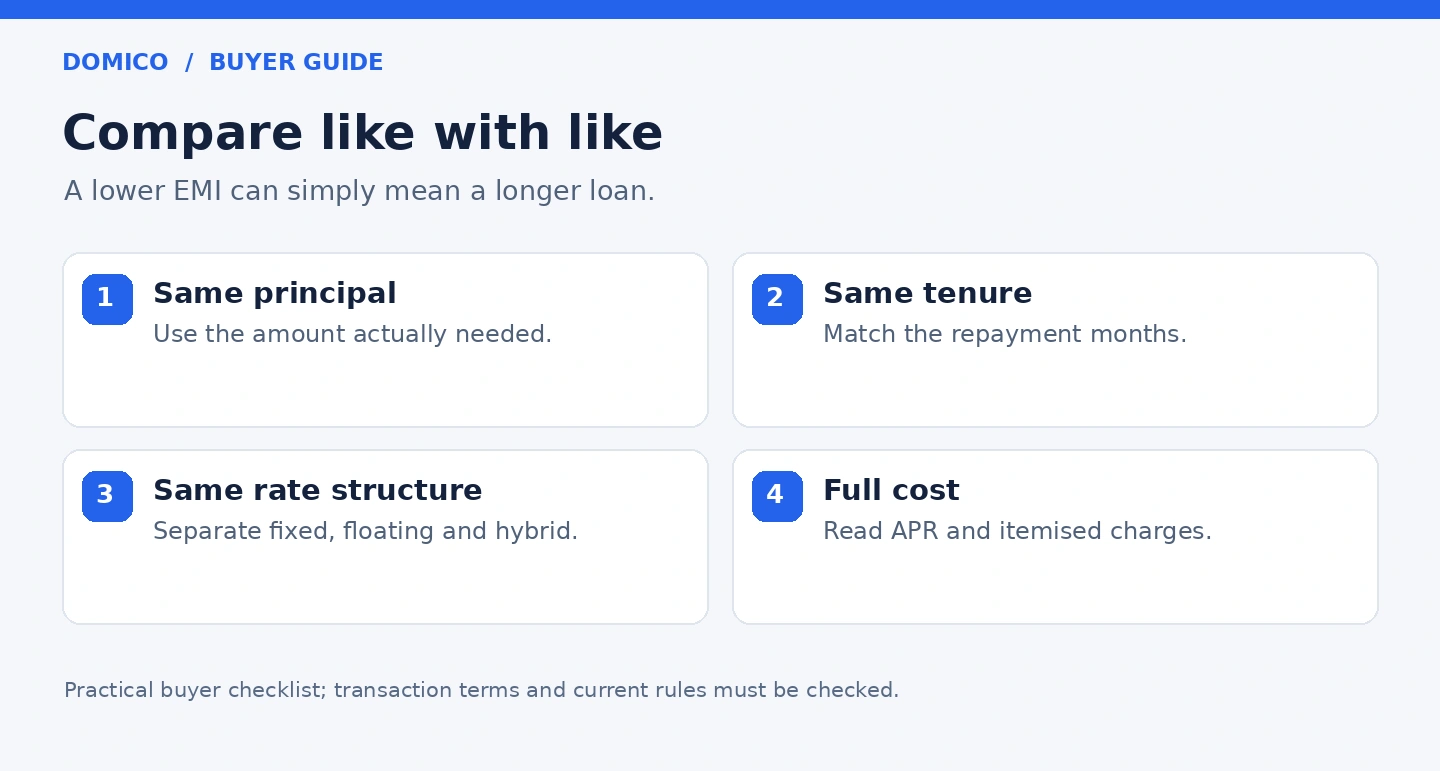
A quote for ₹30 lakh over twenty years should not be compared casually with one for ₹35 lakh over twenty-five years. The lower monthly payment may simply reflect a different principal or a much longer term. Standardise the inputs before deciding which lender is less expensive.
| Compare this | Keep it consistent | Common mistake |
|---|---|---|
| Principal | Same amount of usable borrowing | Comparing a loan including financed add-ons with one excluding them |
| Tenure | Same number of repayment months | Calling a longer loan cheaper because its EMI is lower |
| Rate type | Identify fixed, floating or hybrid | Comparing unlike reset risks |
| Fees | Record amount, tax and timing | Looking only at the processing-fee percentage |
| APR | Read with assumptions | Treating it as a forecast of future floating rates |
What the KFS is meant to show
The RBI KFS circular covers key loan terms, APR and an amortisation schedule for applicable retail term loans. It also addresses relevant third-party charges recovered through the lender and disclosure of fees. Ask the loan officer to walk through the statement in a language you understand rather than only pointing to the signature box.
Locate the amount sanctioned, repayment frequency, number of instalments, interest structure, charges and APR. Then identify conditions outside the headline cost: delayed-payment charges, conversion charges, prepayment treatment and the grievance contact. Contingent charges need separate attention because the cost of a future event is not the same as an unavoidable upfront fee.
For floating loans, read the benchmark and reset information. The APR at sanction uses stated assumptions; it does not guarantee the total cost if the reference rate changes later. You still need a repayment stress test.
APR is a comparison tool, not a replacement for reading
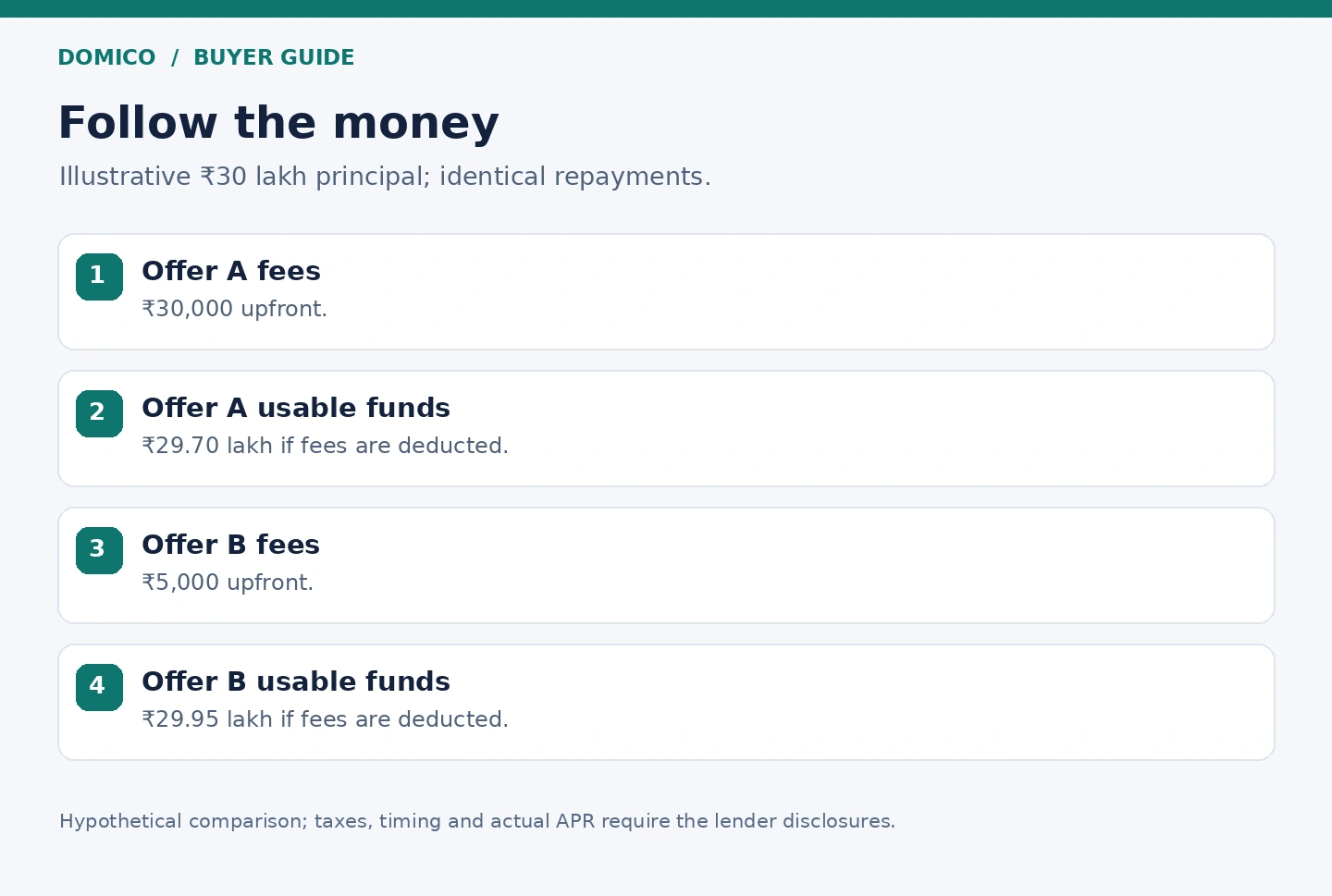
Consider a hypothetical ₹30 lakh loan. Lender A deducts ₹30,000 in upfront charges. Lender B deducts ₹5,000. If all other cash flows are identical, A provides less usable money at the beginning for the same repayment obligation. That makes the fees economically important even though both offers quote the same nominal interest rate.
Do not calculate APR simply by adding the fee percentage to the annual interest rate. Fees paid at the beginning affect a sequence of monthly cash flows over the relevant term. Ask for the lender's disclosed APR and repayment schedule. If you independently calculate it, use the full dates and amounts and reconcile any difference with the lender.
A small APR difference may be worth considering alongside service reliability, disbursement conditions and the cost of changing lenders. A loan that looks cheap but cannot release funds in time for a contractual deadline can create a different financial problem.
Build a comparison with cash amounts
| Illustrative offer detail | Lender A | Lender B |
|---|---|---|
| Loan principal | ₹30,00,000 | ₹30,00,000 |
| Stated tenure | 240 months | 240 months |
| Quoted nominal rate | Same rate for this example | Same rate for this example |
| Upfront charges paid by borrower | ₹30,000 | ₹5,000 |
| Usable amount after these charges, if deducted | ₹29,70,000 | ₹29,95,000 |
| Information still needed | APR, taxes, add-ons and conditions | APR, taxes, add-ons and conditions |
This table is an illustration of comparison method, not a lender ranking. In a real offer, check whether charges are paid separately, deducted from disbursement or financed. The answer changes the household's immediate cash requirement. It can also change the outstanding balance on which interest is charged.
Keep a separate column for refundable amounts. A non-refundable processing charge paid before the property passes legal review has a different risk from a charge payable only after approval. Ask what happens if the bank rejects the selected property or sanctions less than expected.
Do not let insurance disappear inside the loan amount
A premium financed through the loan is still a cost. Write down the insurance premium, what it covers, whether it is optional or a condition of the particular collateral arrangement, and the interest effect of financing it. Obtain the policy documents and distinguish life cover from building insurance.
For example, adding a hypothetical ₹80,000 premium to a ₹30 lakh borrowing requirement increases the financed principal to ₹30.80 lakh. The EMI difference may look small, but the added amount can accrue interest over many years. Compare paying an appropriate premium separately, financing it and choosing another suitable policy if permitted. Do not cancel necessary protection simply to make the APR look lower.
Review charges that depend on future events
A comparison should have one section for expected costs and another for conditional costs. Ask about late-payment charges, interest-rate conversion, document retrieval, account statements, cheque or mandate changes, balance transfer and foreclosure.
Applicable RBI protections may restrict certain charges. The 2025 prepayment directions should be checked against the sanction or renewal date, borrower and loan purpose. Do not accept a generic fee list as proof that every listed charge can lawfully apply to your particular loan.
At the same time, do not assume all loans have identical prepayment rules. Fixed, floating, business-purpose and older accounts can require different analysis. Ask the lender to identify the clause relevant to the offer you are accepting.
Check the repayment schedule for surprises
The amortisation schedule should let you see how payments are divided between interest and principal and how the balance changes. Read the opening months and a few later points. Confirm whether there is a moratorium, a period of interest-only payments, a balloon amount or a different first instalment.
A loan with a low initial payment may defer rather than remove cost. For an under-construction home, compare the schedule with the builder's demand milestones. The amount actually disbursed and its timing affect interest during construction. A clean KFS does not remove the need to understand staged funding.
Also compare the bank's sanctioned amount with what you will receive for the purchase. Some spending may remain outside the funded property cost, including transaction expenses and fit-out. Keep your purchase budget separate from the loan-cost comparison.
A five-step offer review
| Step | Action | Result to retain |
|---|---|---|
| 1 | Request like-for-like offers | Same principal, tenure and purpose |
| 2 | Read the KFS line by line | Marked copy with questions |
| 3 | Separate mandatory, optional and conditional costs | Itemised cash requirement |
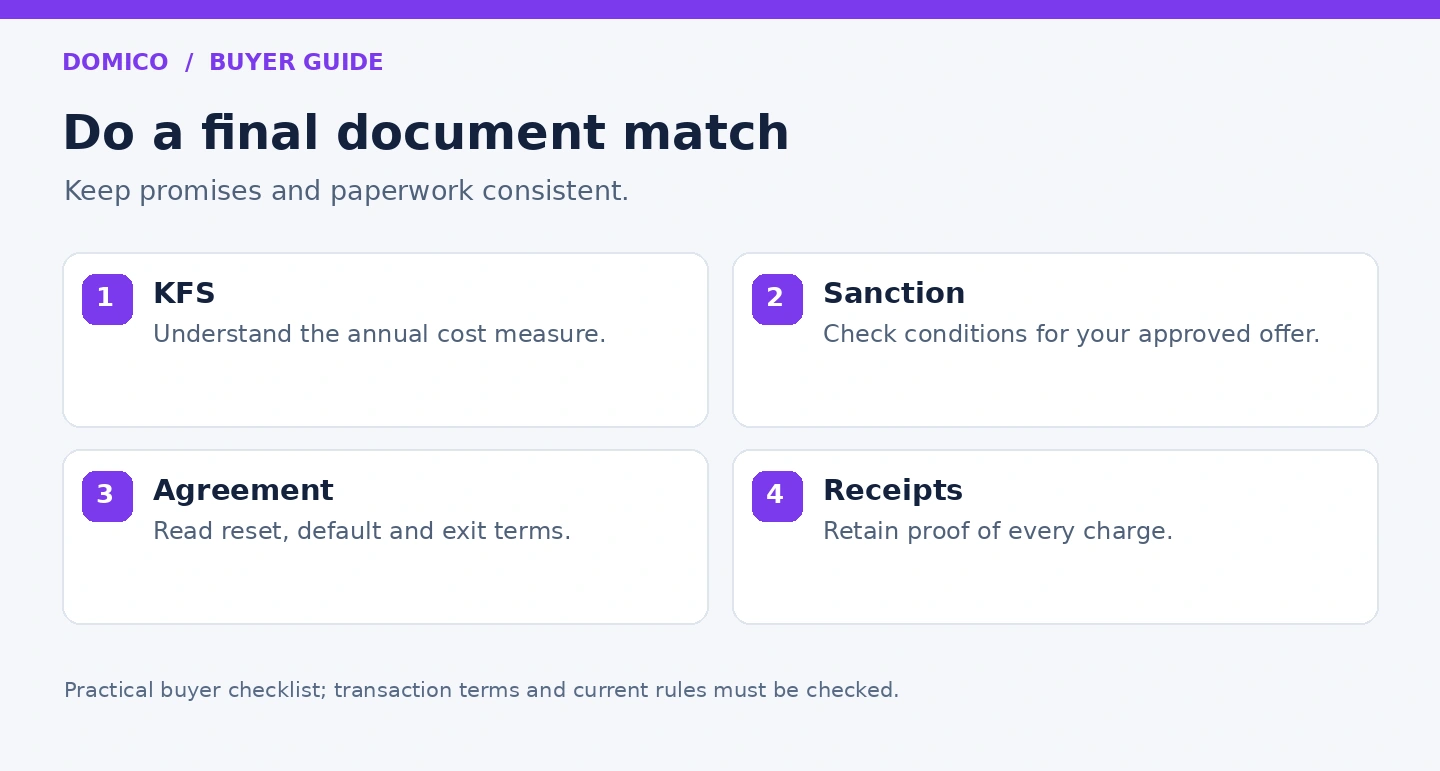
| 4 | Reconcile KFS with sanction and agreement | Written answers to inconsistencies |
| 5 | Save the accepted offer and payment receipts | A clear record for future review |
Give yourself enough time to do this before the seller's payment deadline. If you begin comparing loans only after a large non-refundable token has been paid, your freedom to reject a poor offer may already be limited.
Ask what happens if the purchase does not proceed
Before paying application charges, ask what happens if the seller withdraws, the property fails legal review or the sanctioned amount is lower than requested. Request the refund conditions and the stage at which each fee becomes non-refundable. This is especially useful when applying before the property documents are complete.
Keep the charge receipt separate from the seller's booking receipt. They concern different relationships and can have different refund terms. A bank's refusal to refund its processing charge does not establish whether the seller must return a token, and the reverse is also true.
If you compare several lenders, put these possible sunk costs beside the APR comparison. You do not need to assume every application will fail. You need to understand the amount genuinely at risk while the property and financing decisions are still unfinished.
Printable buyer worksheet
Download the topic-specific review checklist. Use it to record evidence, unanswered questions and follow-up actions for the exact property.
Frequently asked questions
Is APR the same as the home loan interest rate?
No. The nominal rate describes interest, while APR expresses the relevant overall borrowing cost using the disclosed cash flows and assumptions. Read which charges are included and which future events can create additional costs.
Will the lowest APR always be the right choice?
It is an important cost signal for comparable offers, but repayment risk, rate structure, disbursement conditions and service also matter. A small cost advantage cannot compensate for an unsuitable contract or unaffordable EMI.
Can I sign first and collect the KFS later?
Ask for it before accepting the offer so you can understand the terms while you still have a choice. Read the current RBI requirements and resolve missing or inconsistent disclosures with the lender before proceeding.
Does APR remain unchanged on a floating-rate loan?
A disclosed APR is based on the stated rate and assumptions at that point. Future rate resets can change your actual cost. Request an updated repayment illustration when the applicable rate changes.
What if an extra fee appears after I receive the statement?
Ask for the contractual basis, the relevant disclosure and any required consent. Keep the communication and escalate through the lender's grievance channel if the explanation does not resolve the issue.
Sources and related reading
- buyer-guide-100
- homebuyers
- home-loan-apr-kfs
- indore
Planning to buy or rent in Indore? Browse verified properties in Indore or read more Indore guides.



