Buying Guide
Higher Floor vs Lower Floor: A Homebuyer Comparison
Compare higher and lower floors using lift access, heat, noise, privacy, floor premiums and household needs before choosing an apartment.
Updated 8 min read

Buying Guide
Compare higher and lower floors using lift access, heat, noise, privacy, floor premiums and household needs before choosing an apartment.
A better view is valuable only if the home works when the lift does not.
Two flats can share the same layout and still feel like different homes. One looks over trees, another over a parking court. One is convenient for grandparents, another gives you more distance from the entrance gate. Choosing a higher floor or a lower floor means comparing these everyday differences, not following a rule that one level is always superior.
For an Indore buyer, the useful question is specific: how does this particular floor perform in this particular building? The answer depends on surrounding construction, the roof, lifts, backup power, window design and your household. Treat a floor-rise premium as a price to investigate, rather than evidence of better living.
Before comparing levels, establish how many homes use each lift, which lift operates during an outage, and whether the building has dependable maintenance. Ask to see the approved floor plans and the actual unit. A model apartment on the first floor cannot demonstrate conditions on the fourteenth.
The National Building Code overview identifies separate building-service disciplines for lifts, ventilation, acoustics and fire safety. That is a helpful reminder: floor choice combines several systems. No single brochure label settles the decision, and requirements must be checked against the applicable local approvals.
| Consideration | A lower floor may offer | A higher floor may offer |
|---|---|---|
| Daily access | Shorter stair journey and easier deliveries | Greater dependence on working lifts |
| Outlook | Trees or an intimate courtyard view | A wider outlook where surrounding buildings allow |
| Street activity | More immediate exposure to entry and parking activity | Different exposure to distant roads and equipment |
| Household needs | Easier movement for some elderly residents | More separation from ground-level activity |
| Price | Sometimes a smaller floor premium | Sometimes an added floor-rise charge |
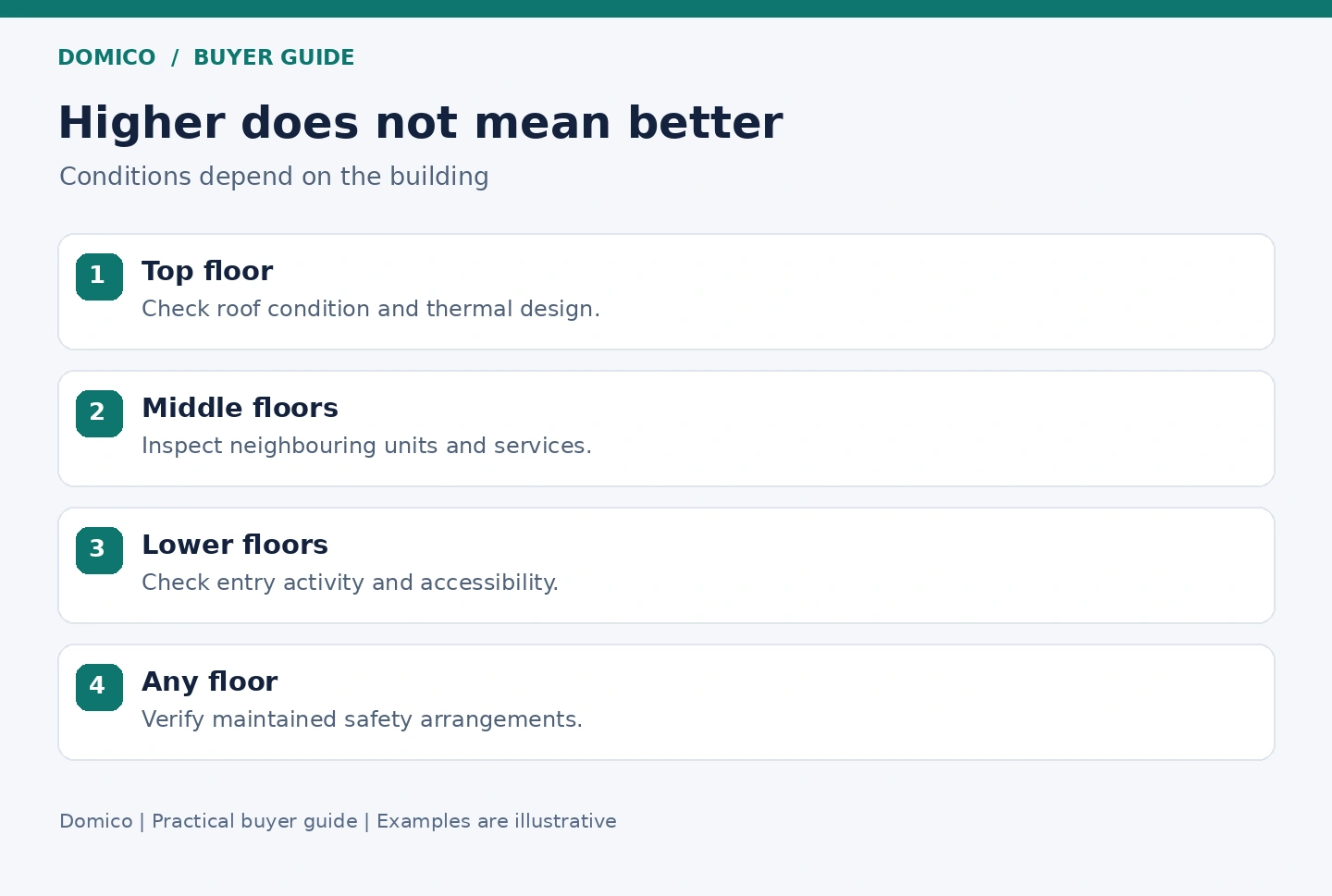
These are possibilities, not guarantees. A first-floor home above a generator can be inconvenient, while a well-managed upper-floor home can function comfortably. Compare actual conditions rather than the floor number alone.
Being high in the building and being directly below the roof are different conditions. An intermediate upper-floor apartment has another dwelling above it. A top-floor apartment has a roof assembly between its ceiling and the weather.
Ask what the roof construction, insulation and waterproofing specification is. Inspect the roof only with permission and safe access. Look for evidence of repairs, ponding or poorly maintained service areas. A freshly painted ceiling tells you little about how the roof performs through summer and monsoon.
The Bureau of Energy Efficiency's residential resources provide a useful design framework for evaluating the building envelope. Buyers should request the architect's explanation for their own building rather than assume every top floor is hot or every lower floor stays cool.
For a resale home, ask for monthly electricity bills with the resident's personal details masked. Compare occupancy, air-conditioner use and appliance patterns before drawing conclusions. A vacant flat's low bill is not a fair indication of what a family will spend.
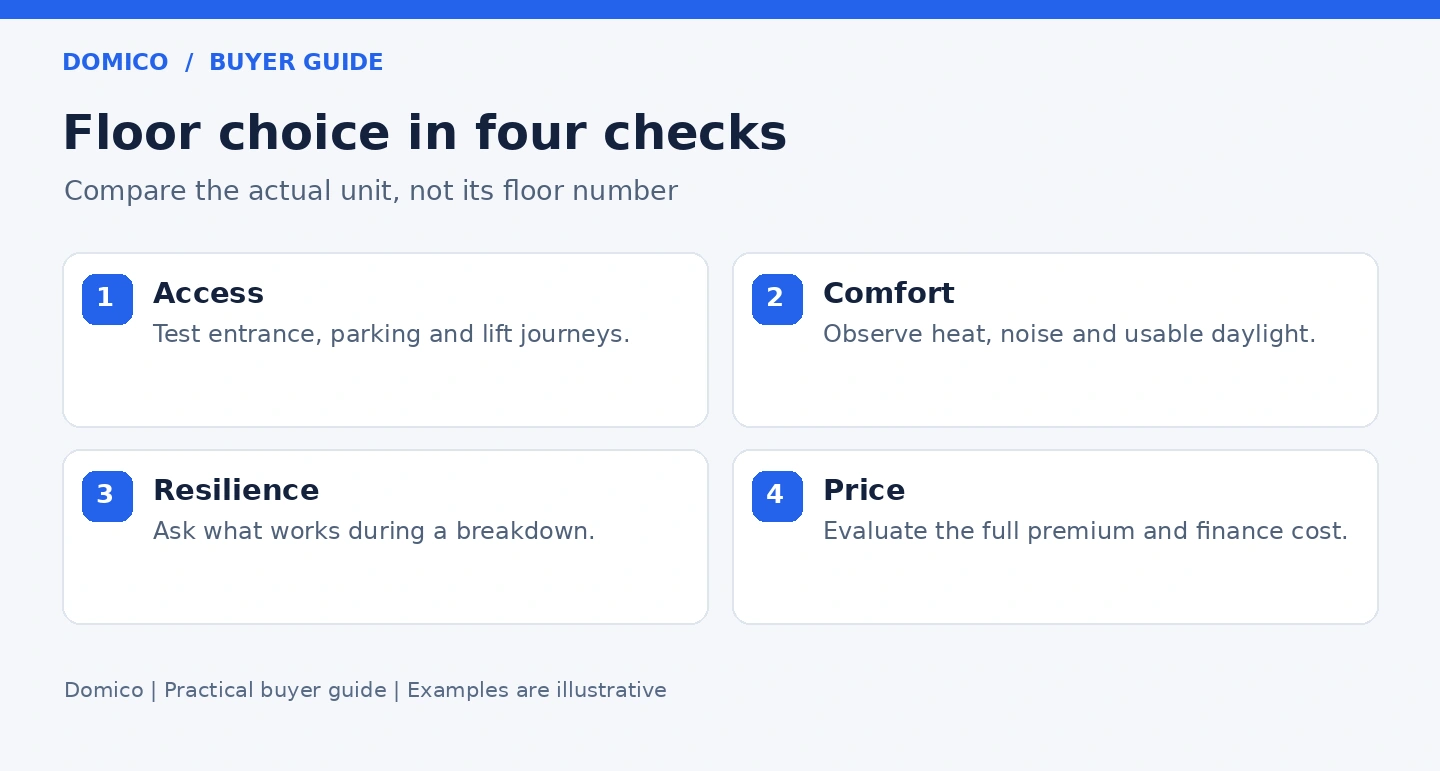
A lower floor may hear vehicles entering a basement, a security whistle or people gathering near the clubhouse. A higher floor may have an unobstructed sound path from a flyover, railway or rooftop plant. Distance from the ground is only one part of the acoustic picture.
Visit the exact bedroom during the hours you expect to sleep or work. Listen with windows both open and closed. Note sudden horns and machinery cycles as well as steady background sound. A ten-minute Sunday visit can miss weekday deliveries, school traffic and evening events.
Ask where the pumps, generator, exhaust outlets and outdoor air-conditioning units are located. If an agent says that a sound will disappear after possession, request the documented relocation or operating plan. Budgeting for better windows without understanding ventilation can create a second problem while solving the first.
Ride from the main entrance to the unit, then make the same journey from parking. Record how long it takes during a busy period. Repeat with a shopping bag or pram if relevant. Waiting time matters more than the manufacturer's name on the lift door.
Ask the manager to explain the authorised power-backup arrangement. Does one lift run during a failure? Is there a changeover delay? What is the plan when the lift is out for servicing? Buyers should observe a planned demonstration by authorised staff rather than interfere with controls or create a fault.
For an elderly household, the issue is not whether a parent can climb the stairs once. It is whether access remains manageable during illness, an appointment or a prolonged outage. A low floor can still be difficult if the entrance has several steps and no usable ramp.
Photograph the outlook and identify what lies beyond the boundary. A vacant plot opposite the balcony should not be treated as permanent open space. Ask about the planning status and approved development of surrounding land, and have an independent professional interpret any uncertainty.
The same caution applies to privacy. Higher floors can be overlooked by another tower, while a lower floor can be screened by mature landscaping. Look from the sofa and bed positions, not only from the balcony railing.
Avoid paying a large premium for a promised future view that is missing from the contract. The purchase agreement should clearly identify the unit, floor and any relevant location-related charges.
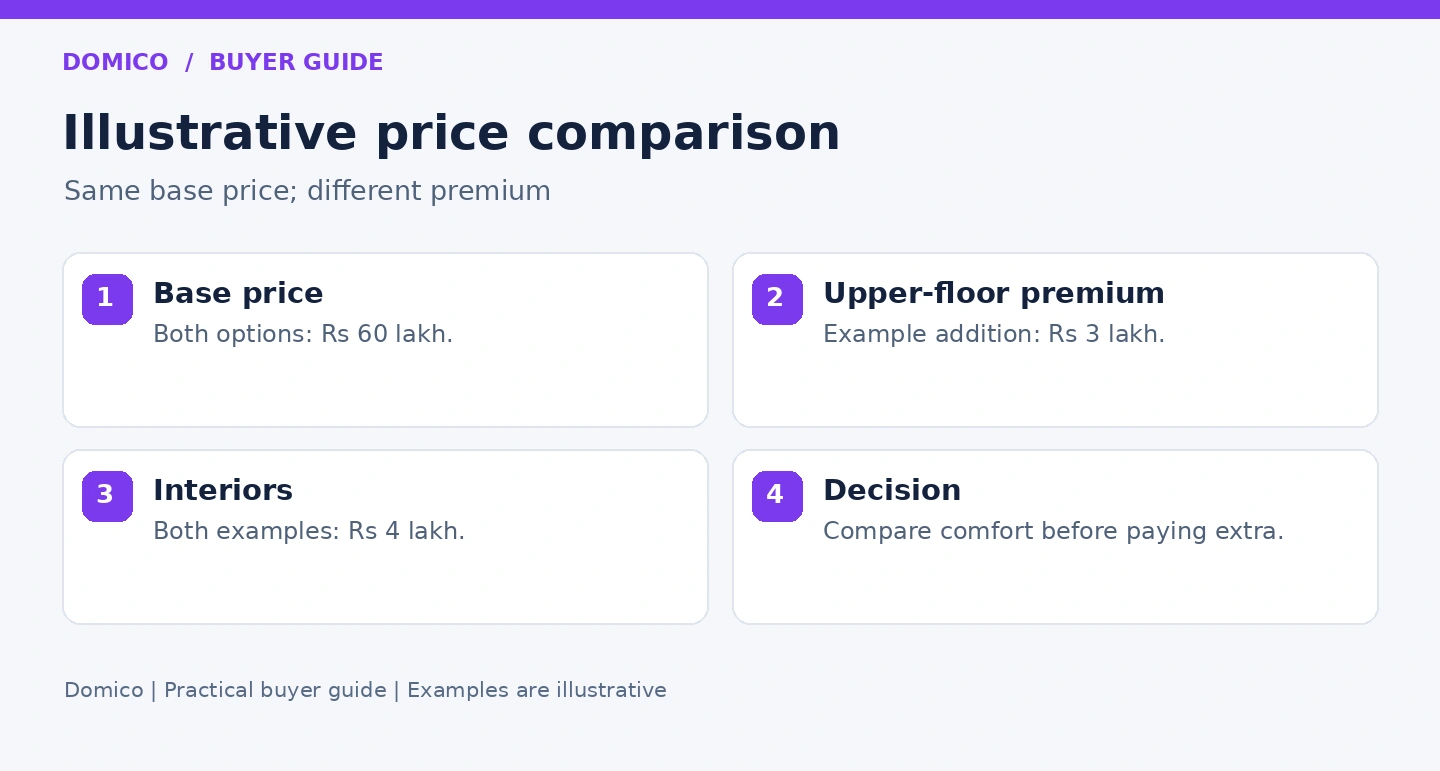
Consider this purely illustrative comparison between two otherwise similar flats. These are assumptions, not Indore market quotations or a prediction of resale performance.
| Item | Lower-floor option | Higher-floor option |
|---|---|---|
| Base price | Rs 60,00,000 | Rs 60,00,000 |
| Location/floor premium | Rs 0 | Rs 3,00,000 |
| Planned immediate interiors | Rs 4,00,000 | Rs 4,00,000 |
| Subtotal before applicable transaction and finance costs | Rs 64,00,000 | Rs 67,00,000 |
The Rs 3 lakh difference deserves the same care as any other purchase expense. Ask whether you would still value the upper floor if the open land nearby were developed, the lift were temporarily unavailable, or the resale market did not recover the premium.
If financing the difference, obtain an actual lender calculation. Do not compare only the additional EMI while ignoring the interest and opportunity cost. Equally, do not dismiss a genuinely useful improvement in privacy or daylight if it matters to your family every day.
A compact evidence sheet helps two family members compare observations without turning the decision into a debate about preferences. Use dated notes from the same rooms and similar times where possible.
| Check | Evidence to collect | Decision question |
|---|---|---|
| Lift reliability | Service history and residents' experience | Can the household manage an interruption? |
| Thermal comfort | Afternoon visit, roof details, occupancy-adjusted bills | Is heat exposure acceptable? |
| Night-time noise | Bedroom observation during likely sleeping hours | Can you rest with your preferred window setting? |
| Privacy | Views from normal seating and sleeping positions | Are nearby units intrusive? |
| Safety management | Approved arrangements and maintenance records | Is there a credible operating system? |
Ask existing residents for specific examples: the last outage, the last breakdown, or the busiest lift period. General praise such as “no issues” is less useful than a clear description of how a problem was handled.
Neither a low floor nor a high floor excuses missing safety systems. Have applicable fire and occupancy documents reviewed, check that exits remain usable, and ask how the building manages emergency assistance. A buyer should not conduct an unannounced alarm test or use ordinary passenger lifts during an emergency contrary to the building's authorised plan.
A family with mobility needs should discuss realistic evacuation arrangements with the building manager and a competent safety professional. The right result is a workable plan supported by maintained systems, rather than a reassuring statement that the staircase is nearby.
Download the topic-specific review checklist. Use it to record evidence, unanswered questions and follow-up actions for the exact property.
No. Roof design, maintenance, shading, ventilation and your preferences matter. Examine the actual roof and flat through appropriate professionals. Price the documented condition rather than a general reputation attached to top floors.
Do not assume so. Construction, nearby roads, wind, window seals and household ventilation affect conditions. Observe the site and ask residents about cleaning patterns, while treating their experience as property-specific information.
Consider the full accessible route, security, moisture, privacy and lift arrangements. A nominally low-floor flat can have difficult steps at the entrance. Choose the route your parents can actually use.
That is uncertain. Demand depends on the building, local competition, condition and buyer preferences at the time of sale. Avoid treating the premium as a guaranteed investment return.
Keep the decision provisional. Request access to the exact unit before committing, and document any conditions or inspection rights in writing. A substitute unit can explain the layout, but cannot prove the view, noise or heat conditions of the one you are purchasing.
Choose the floor that fits your household on an ordinary Tuesday and during a disrupted evening. The view should improve that decision, not replace it.
Planning to buy or rent in Indore? Browse verified properties in Indore or read more Indore guides.
Check who owes the lender, how builder-paid interest works, when support ends and whether you can carry the loan if payments stop.



