Buying Guide
Gated Community vs Standalone Building: Buyer Comparison
Compare gated communities and standalone buildings through security processes, service reliability, annual costs, location, governance and daily life.
Updated 8 min read

Buying Guide
Compare gated communities and standalone buildings through security processes, service reliability, annual costs, location, governance and daily life.
A gate can control an entrance. It cannot replace good management inside the boundary.
A gated community may offer shared grounds, staffed entry and several facilities. A standalone building may offer a smaller resident group, a simpler service structure and a location closer to daily destinations. Neither format is automatically safer, cheaper or better maintained.
For a buyer, the useful comparison is the complete living arrangement. Who manages services? What does the household pay? How are decisions made? What happens when equipment fails or a resident raises a concern? This guide helps you compare those operating realities rather than choose by project size alone.
“Gated community” can describe a large township, a cluster of towers or a small enclosed development. “Standalone building” can describe anything from a few apartments to a substantial tower. Ask for the actual unit count, boundaries, shared services and management arrangements.
A large project may contain separately managed phases, while a single building may depend on common external infrastructure. The brochure's category does not tell you the legal or financial structure.
Identify which entity owns, maintains or operates the relevant shared facilities and how owners participate in decisions. The RERA Act provides relevant project and common-area concepts, but the particular agreement and governing documents must explain your rights and obligations.
| Comparison area | Gated development: investigate | Standalone building: investigate |
|---|---|---|
| Entry management | Staffing, visitor process and multiple gates | Actual door control and visitor arrangements |
| Shared services | Scale, contracts and phase allocation | Responsibility when a key person is absent |
| Facilities | Availability, access rights and upkeep | Nearby alternatives and their cost |
| Decisions | Representation and management transparency | Informal practices versus documented decisions |
| Expenses | Full budget across many services | Fixed costs spread over fewer homes |
Ask how visitors, deliveries, contractors and vehicles enter. Observe whether the stated process is used consistently. A uniformed guard and a camera at the gate do not by themselves establish that the system works.
For a standalone building, check the entrance lock, intercom, lighting, access to parking and how residents respond to problems. A small building can have a clear process, while a large one can have weak follow-through.
Do not assume that either format prevents crime. Ask about documented procedures, incident reporting and maintenance of access equipment. Avoid requesting private footage or personal details of residents when a general explanation of the process is sufficient.
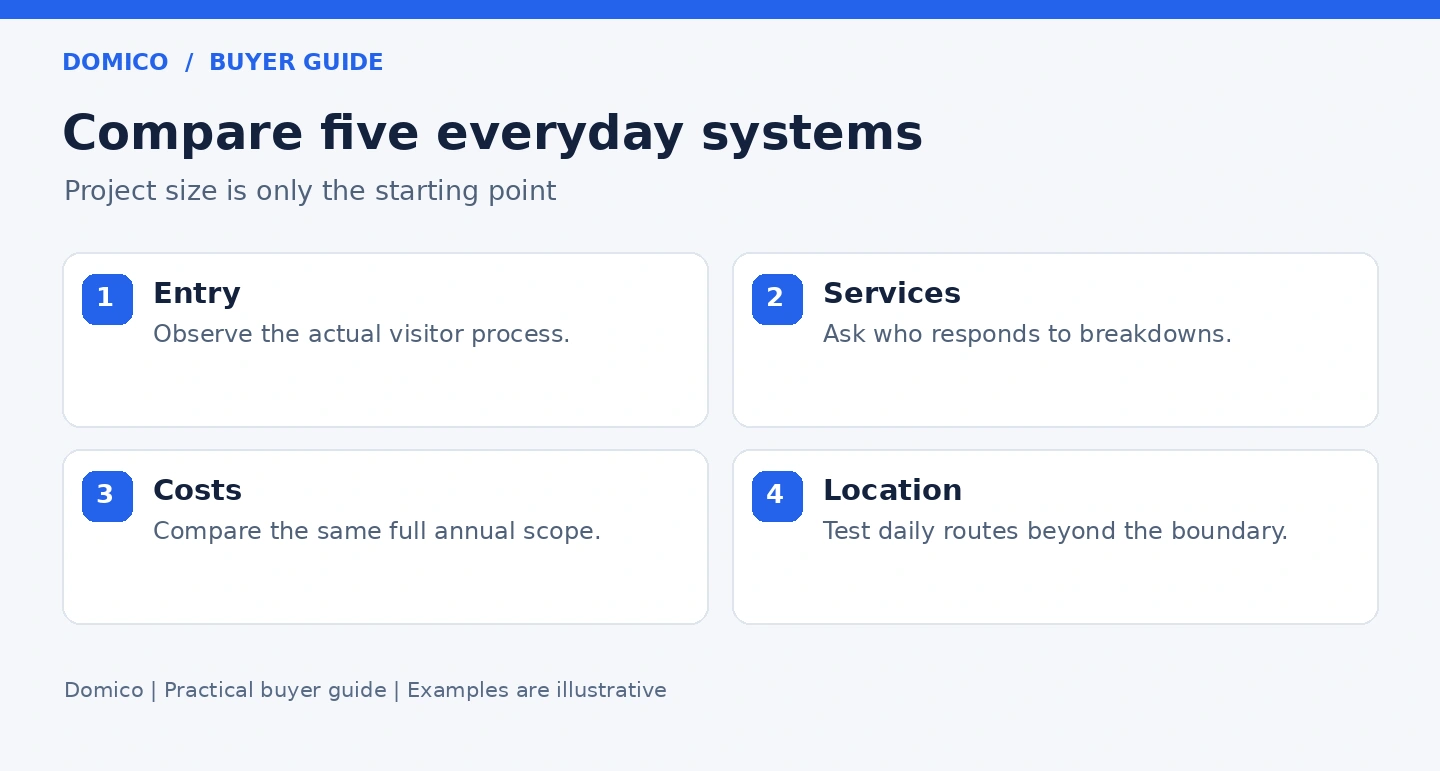
A large community may have dedicated facility personnel, but buyers should ask what the service contract includes and how performance is monitored. A smaller building may rely on a caretaker or a resident volunteer, making succession and emergency coverage important.
Ask who handles a water-pump failure late in the evening, a lift breakdown or an electrical fault. Obtain the complaint channel and the escalation process. Specific examples of recent responses help you judge whether the arrangement is organised.
A friendly current secretary is valuable, but the building should have a system that survives a change of office-bearers. Review records, responsibilities and available service contracts rather than relying only on personal enthusiasm.
For the gated option, visit the gym, pool, garden and common rooms that matter to you. Check opening hours, condition, booking rules and whether access is included in ordinary charges. A proposed facility in a later phase should be treated differently from an open one.
For the standalone option, map realistic nearby alternatives. A public park or paid gym can meet a household need, but include travel, opening hours and actual willingness to use it. A facility that is theoretically nearby may be inconvenient across a busy road.
Do not add every amenity to the value calculation. Identify which household member would use it, how often and at what time. This turns a long brochure list into a practical comparison.
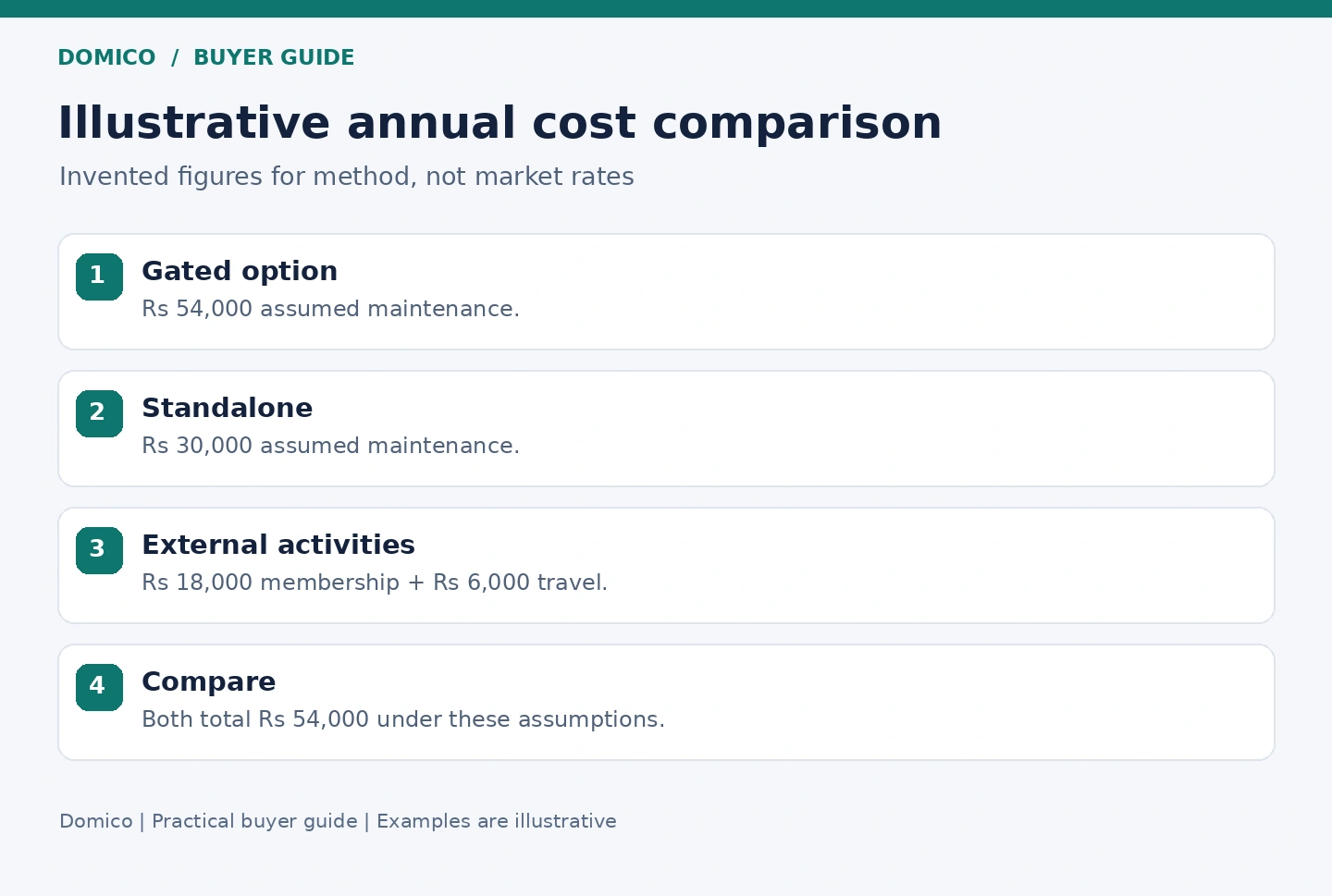
Ask both properties for a complete annual cost picture. Include maintenance, separate water collections, parking charges where applicable, backup power, reserve contributions and known special assessments. Avoid comparing an all-inclusive number with a rate that excludes important services.
A standalone building is not automatically cheaper. Lifts, pumps and security can create fixed costs shared among fewer homes. A large development may have more facilities and staff, which can increase the total. The actual budget decides the comparison.
Consider the following illustrative household example. These invented figures are not Indore market rates or a forecast of either building type.
| Assumed annual cost | Gated option | Standalone option |
|---|---|---|
| Maintenance and routine shared services | Rs 54,000 | Rs 30,000 |
| External gym or activity membership | Rs 0 | Rs 18,000 |
| Extra transport to those activities | Rs 0 | Rs 6,000 |
| Simple annual total | Rs 54,000 | Rs 54,000 |
The equal result does not make the options equivalent. One family may value the onsite convenience; another may prefer an external gym it actually uses. Compare service quality and personal fit alongside cost.
A campus can feel calm inside while the external approach is difficult. Drive the route to work, school, shops and medical care at relevant times. Check pedestrian access, public transport and the route used after dark.
A centrally located standalone building can save travel time but may have less private open space or more street activity. The right trade-off depends on your routine. Write down the actual travel burden rather than assuming a project with more land provides a better lifestyle.
For a new township, distinguish existing services from proposed ones. A future commercial centre or school should not be counted as current convenience unless its operational status is verified.
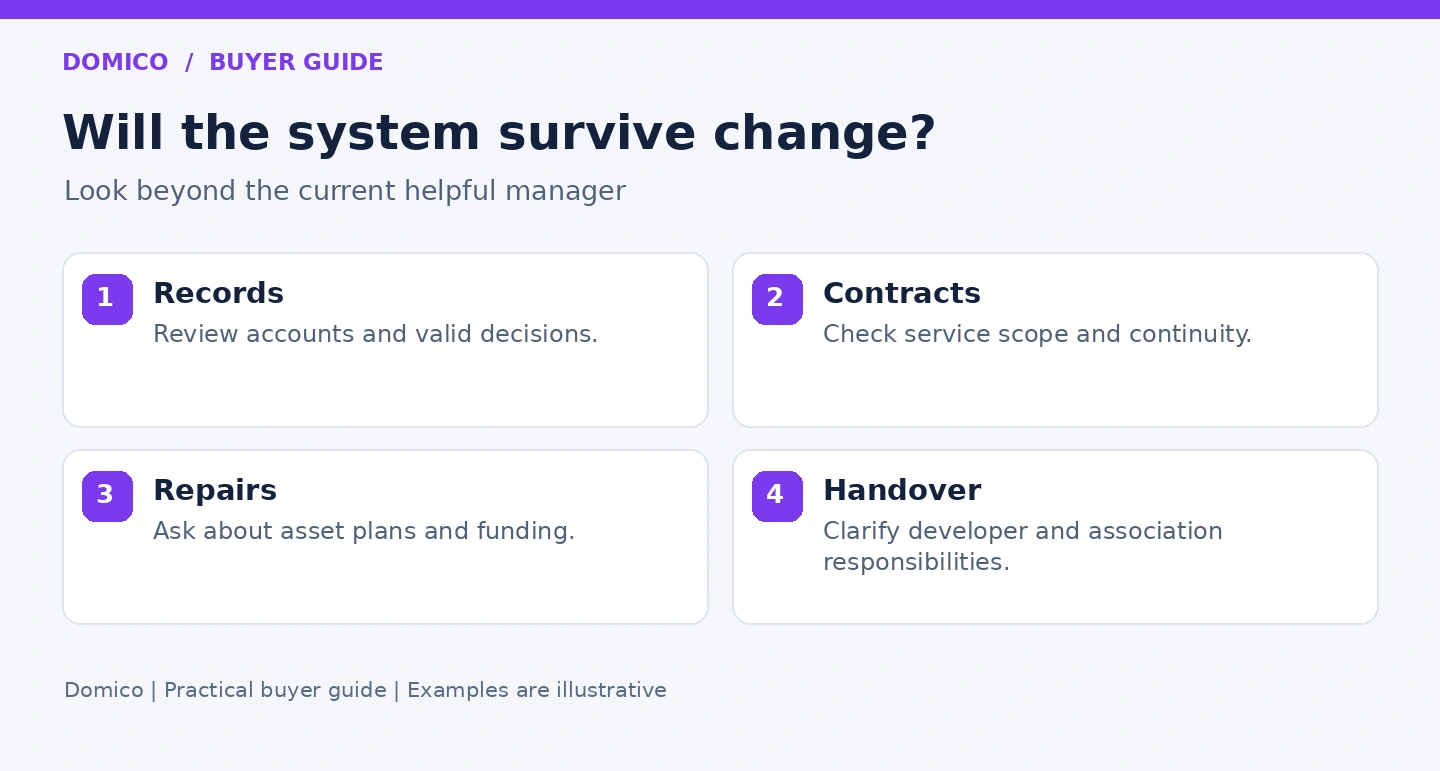
Ask for the applicable association documents, current charges and relevant rules. These may cover renovation hours, facility bookings, visitor access and use of shared spaces. Have legal questions reviewed rather than assuming every rule is valid simply because it appears on a noticeboard.
A large community can offer formal processes but involve more complex decisions. A small building can reach agreement quickly, or become difficult if a few owners disagree. Ask about actual meeting records, accounts and pending disputes through the authorised process.
For resale, check outstanding dues and planned major work. For a new development, clarify management before and after association handover. Your purchase should not depend on an informal promise that all residents will agree later.
Some families enjoy active shared spaces and frequent community events. Others prefer fewer encounters and a quieter daily pattern. Visit the property during ordinary occupied hours, not only during a sales event.
Look at how balconies, corridors and recreation areas relate to the flat. A home beside a lively clubhouse may not suit someone who works in silence. A standalone flat facing a busy lane may create a different form of interruption.
Speak with residents respectfully about everyday life without treating one person's preference as a universal verdict. Ask what they use, what they avoid and what they wish they had understood before moving in.
The National Building Code overview includes asset and facility management, which is relevant to both formats. Ask how the building plans for future equipment replacement and major repairs.
A large community may have several expensive assets reaching replacement age together. A small building may have limited reserves for a single major lift or facade expense. Review the asset plan and funding rather than infer financial strength from the number of apartments.
| Decision test | Evidence to collect | Household question |
|---|---|---|
| Entry and security | Current process observed on site | Is it practical and consistently used? |
| Service reliability | Contracts and recent response examples | Who acts when something fails? |
| Cost | Comparable annual itemised budget | Can we afford normal and stressed costs? |
| Location | Actual route checks | Does the daily travel suit us? |
| Community | Rules and ordinary resident activity | Will this living pattern feel comfortable? |
No such guarantee follows from a gate. Assess access procedures, maintenance, lighting, staffing and the broader context. A consistent operating system matters more than the label.
Not necessarily. Fixed costs can be spread across fewer homes, and special repairs may be significant. Compare actual accounts and the complete service scope.
Do not assume so. Review the agreement, facility rules and phase arrangements. Confirm access, charges and what is already operational.
Compare the exact accessible route, lift reliability, medical access, social preferences and assistance arrangements. Either format can work well or poorly depending on the property.
Review local tenant demand, net costs, vacancy, service quality and actual comparable evidence. A larger amenity list does not automatically create a proportionate rental premium.
Choose the management, location and daily routine you can verify. The boundary wall is only one part of the home you are buying.
Download the topic-specific review checklist. Use it to record evidence, unanswered questions and follow-up actions for the exact property.
Planning to buy or rent in Indore? Browse verified properties in Indore or read more Indore guides.
Check who owes the lender, how builder-paid interest works, when support ends and whether you can carry the loan if payments stop.



