Buying Guide
Freehold vs Leasehold Property: A Buyer’s Comparison
Compare freehold and leasehold property through remaining tenure, transfer conditions, dues, financing and conversion checks before you buy.

Table of contents
A long lease can feel permanent. Read what actually transfers.
Two similar homes can offer different ownership interests. One sale transfers freehold ownership. Another transfers the seller's remaining leasehold interest, subject to a lease and the lessor's conditions. The rooms may look identical, but renewal, transfer, finance and future development questions can differ.
Freehold is not a certificate that a property has perfect title. Leasehold is not automatically a bad purchase. The useful comparison starts with the underlying documents, the remaining rights, the obligations and the price you are paying for them.
For buyers in Indore, this matters when considering authority-allotted properties as well as private developments. A seller's description of a house as “registry property” does not settle whether the land is freehold or leasehold.
What the two terms mean
In a freehold purchase, you acquire the ownership interest described in the conveyance, subject to applicable law and any valid encumbrances, restrictions or shared rights. Ownership does not remove planning controls, easements or the need for lawful construction approvals.
In a leasehold purchase, the relevant interest comes through a lease. The Transfer of Property Act's lease provisions describe a lease as a transfer of the right to enjoy property for the relevant term and consideration. A buyer must examine the actual lease and the law governing that arrangement.
A lease may have a long original term, but the original term and the term remaining today are different numbers. Advertising a “99-year lease” without stating its commencement date leaves out information essential to valuation.
| Question | Freehold purchase | Leasehold purchase |
|---|---|---|
| What interest transfers? | Ownership stated in the conveyance | Leasehold rights within the lease and applicable law |
| Is there a remaining lease term? | Usually not the central tenure issue | A key document and valuation issue |
| Can permission affect transfer? | Check specific restrictions | Read consent and transfer conditions carefully |
| What recurring dues may apply? | Taxes and property-specific outgoings | These plus lease-related dues where applicable |
| Can the property be financed? | Subject to lender and property review | Also depends on lease terms and lender acceptance |
Start with the first title document
Ask for the original allotment or acquisition record, the executed lease if any, and each later transfer. Follow the chain to the present seller. A recent sale deed does not erase restrictions that continue through an underlying lease.
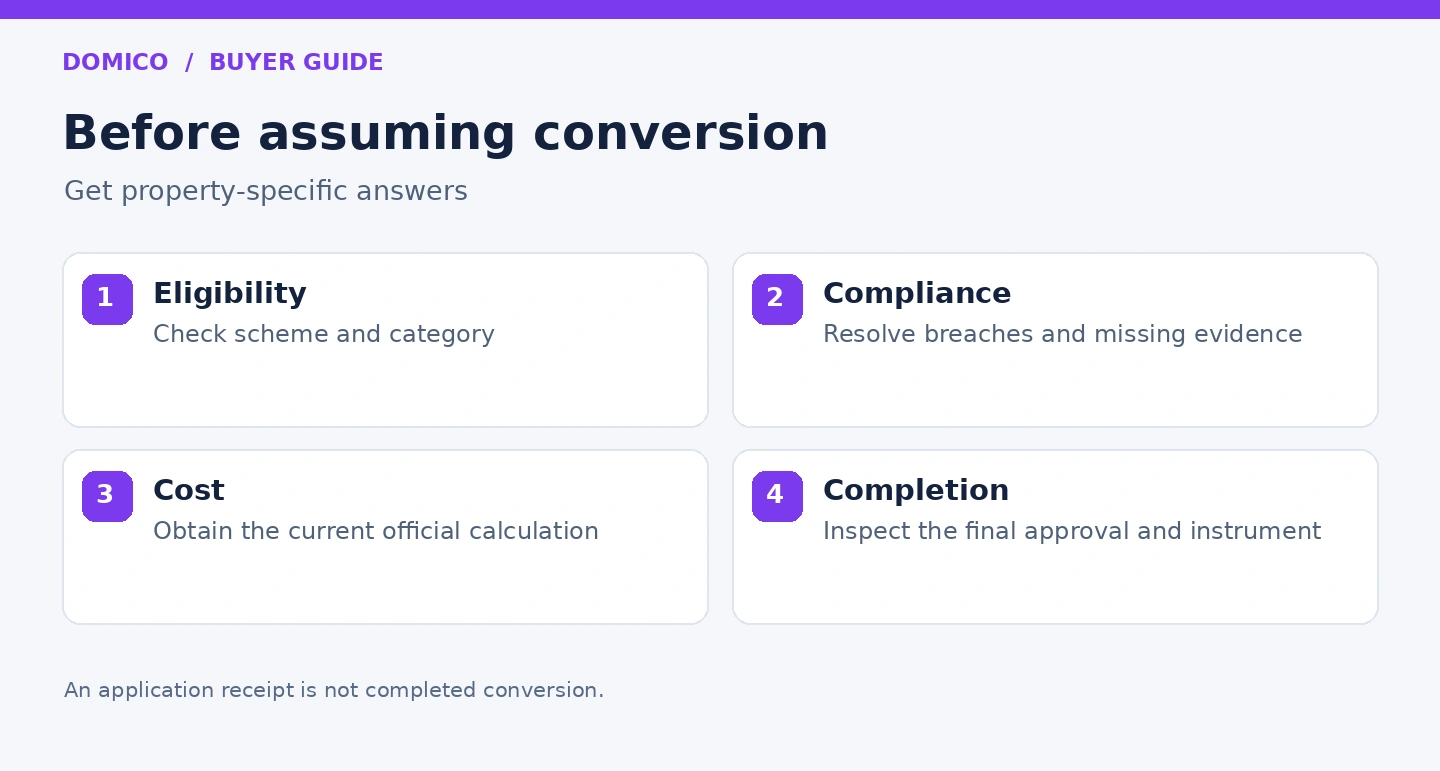
If the seller says the property was converted to freehold, ask for the conversion approval, the executed and registered instrument required for that conversion, and the updated authority record. An application receipt establishes that an application was made; it does not prove the requested conversion was completed.
Have your lawyer identify whether you are buying land with a building, an apartment with common rights, or an assignment of a leasehold interest. These descriptions can overlap physically but involve different documents.
Read the lease as a set of working conditions
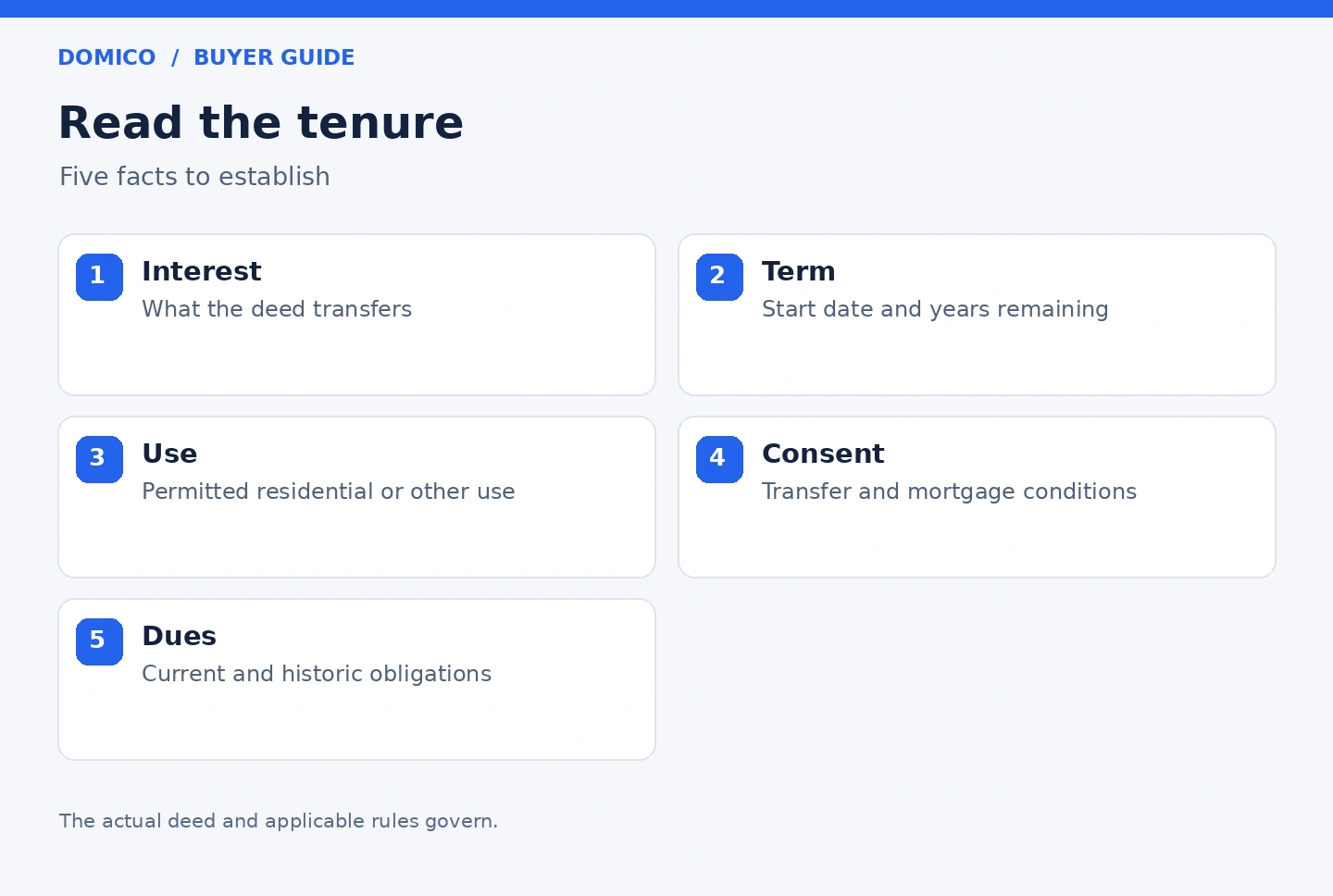
Do not stop at the cover page. Mark the commencement date, term, permitted use, annual or periodic payments, renewal provisions and transfer conditions. Look for construction deadlines, restrictions on subdivision, mortgage permission and consequences of breach.
Ask who can waive or vary a condition and what evidence records that decision. A broker cannot convert an authority's condition into an optional formality. Where the property has been used differently from the lease purpose, investigate the status and remedy before calculating its value as a lawful residential home.
Distinguish a renewal option from an expectation. A clause can require an application, payments or compliance before renewal. The exact wording and governing rules matter. Avoid valuing an uncertain future term as though it has already been granted.
Calculate the remaining term correctly
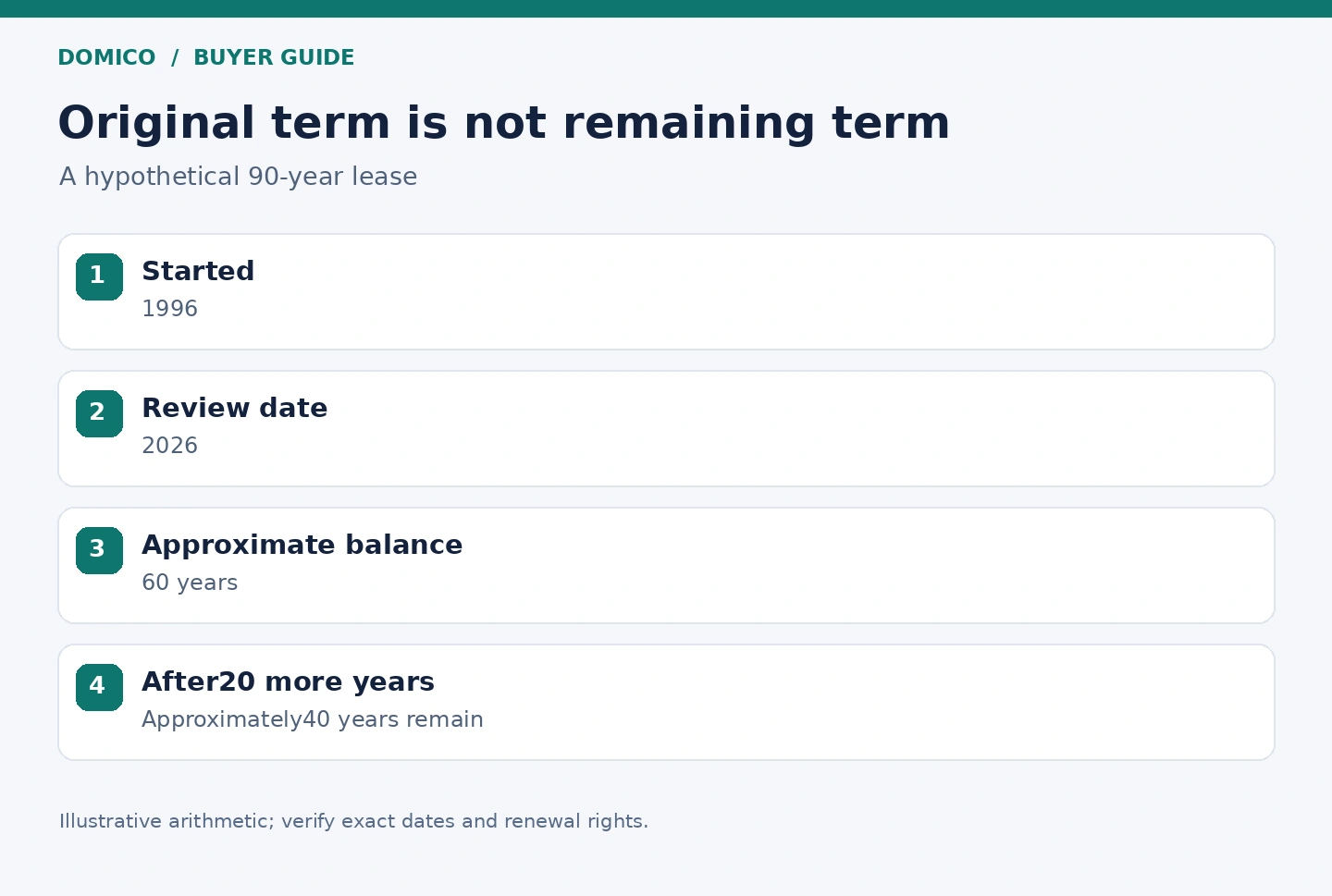
Consider an illustrative lease that commenced in 1996 for 90 years. In 2026, approximately 60 years remain, depending on the exact dates. A seller may still refer to the original 90-year term. Your comparison should use the unexpired period and the conditions governing it.
Now consider your intended holding period. If you expect to live there for 20 years, ask what a future buyer and lender will be reviewing at the end of that period. This is a question about future marketability, not a prediction that the property will become unsaleable.
| Illustrative checkpoint | Amount or period |
|---|---|
| Original lease term | 90 years |
| Time elapsed | Approximately 30 years |
| Remaining term today | Approximately 60 years |
| Planned holding period | 20 years |
| Approximate term at planned resale | 40 years |
The arithmetic is simple. The legal and valuation consequences need property-specific advice. Do not use an assumed renewal period to improve the numbers unless the relevant right is supported by the documents.
Ask the lender before paying a large token
A lender may have requirements about the unexpired term, the proposed loan tenure, mortgage consent, authority dues and the form of transfer. Those policies can differ. A loan on another property in the same colony does not guarantee approval for yours.
Send the actual lease and title chain for preliminary review. Ask the lender which conditions must be satisfied before sanction and which before disbursement. Also ask whether its proposed valuation reflects the leasehold position.
If the seller expects your bank to pay before a transfer permission is obtained, clarify whether the bank accepts that sequence. Conflicting assumptions between a seller, authority and lender can delay an otherwise straightforward purchase.
Compare the complete acquisition cost
An apparently lower asking price may be attractive, but assemble the other costs before comparing. Relevant items can include transfer-related payments, unpaid lease dues, premium demands, application charges, professional review, stamp duty and registration. Applicability must be confirmed for the particular property.
For illustration, suppose Home A costs Rs 70 lakh and Home B costs Rs 66 lakh. If Home B needs Rs 2 lakh of documented transfer-related payments and Rs 1 lakh of outstanding dues, the initial Rs 4 lakh price gap reduces to Rs 1 lakh before other costs. That does not decide the purchase; it makes the price comparison more honest.
Ask which party is responsible for each payment. Historic dues should not silently become a buyer contribution simply because the authority requires clearance before processing the transfer.
Treat freehold conversion as a separate project
Some authorities provide leasehold-to-freehold services for eligible properties. The Indore Development Authority's online service list includes leasehold-to-freehold and related property services. The presence of a service does not establish that every IDA property qualifies or that a particular conversion will be approved.
Obtain the current conditions directly from the authority for the scheme, property category and file concerned. Ask whether there are unresolved breaches, missing construction evidence, dues or succession issues. Calculate the conversion cost only after identifying the applicable policy.
If conversion is essential to your decision, consider making completion evidence a transaction condition rather than accepting a promise that you can handle it later. Your lawyer should decide how that condition works in the agreement.
Look beyond tenure to the property itself
A freehold property can still have title disputes, unauthorised construction, poor access or an existing mortgage. A leasehold property can be well documented, compliant and suitable for the buyer's needs. Tenure is one important part of diligence.
Inspect the approved use, building permissions, boundaries, access, tax records and physical condition. Match the seller's authority with the proposed transfer. For an apartment, examine the project's land tenure as well as the individual unit documents.
| Claim made during the sale | Better follow-up question |
|---|---|
| “It has a registry” | What interest and underlying tenure does the instrument transfer? |
| “The lease is very long” | When did it start and how much remains? |
| “Conversion is easy” | Is this property eligible, and what approval is already issued? |
| “Permission is routine” | Which authority issues it and at what stage? |
| “Banks fund this colony” | Has my lender reviewed this property's file? |
Printable buyer worksheet
Download the topic-specific review checklist. Use it to record evidence, unanswered questions and follow-up actions for the exact property.
Frequently asked questions
Is freehold always more valuable than leasehold?
There is no useful universal price rule. Compare location, condition, lawful use, remaining lease rights, obligations, finance and comparable transactions. A label alone cannot establish fair market value.
Can leasehold property be sold?
The transferable interest, consent requirements and conditions depend on the lease and applicable law. Ask for the required transfer route before accepting a sale promise or paying a non-refundable amount.
Does leasehold mean I am only renting a flat?
A long leasehold acquisition can be quite different from an ordinary residential tenancy. Read the precise rights and obligations being assigned. Avoid assuming either complete ownership or a simple monthly rental arrangement.
Will lease rent remain the same forever?
That depends on the lease and applicable policy. Check escalation, revision, renewal and arrears provisions. Budget from the actual documents rather than a current receipt alone.
Should I insist on conversion before purchasing?
If completed conversion is necessary for your financing, intended use or valuation, make that clear early. Whether to proceed before conversion depends on eligibility, documentary status, cost and your lawyer's assessment.
Before you decide
Write a one-page tenure summary: what transfers, remaining term, permitted use, recurring dues, transfer permissions, finance conditions and unresolved obligations. Once those points are evidenced, compare the property with alternatives on its real terms.
Sources and related guides
- buyer-guide-100
- homebuyers
- freehold-leasehold
- indore
Planning to buy or rent in Indore? Browse verified properties in Indore or read more Indore guides.



