Buying Guide
Fixed vs Floating Home Loan: A Practical Buyer Guide
Compare fixed, floating and hybrid home loans using reset rules, EMI stress tests, prepayment terms and clear household budget examples.

Table of contents
Choose a repayment plan you can live with when rates move.
A home loan can look affordable on the day you sign and feel very different a few years later. Your income may change, school fees may rise and the lender's benchmark may move. The choice between a fixed and floating home loan should therefore begin with a household question: how much uncertainty can your monthly budget absorb?
A lower starting rate is useful, but it is only one part of the decision. The duration of the fixed period, reset rules, spread, conversion costs and early repayment conditions can matter just as much over a long loan.
The difference in plain English
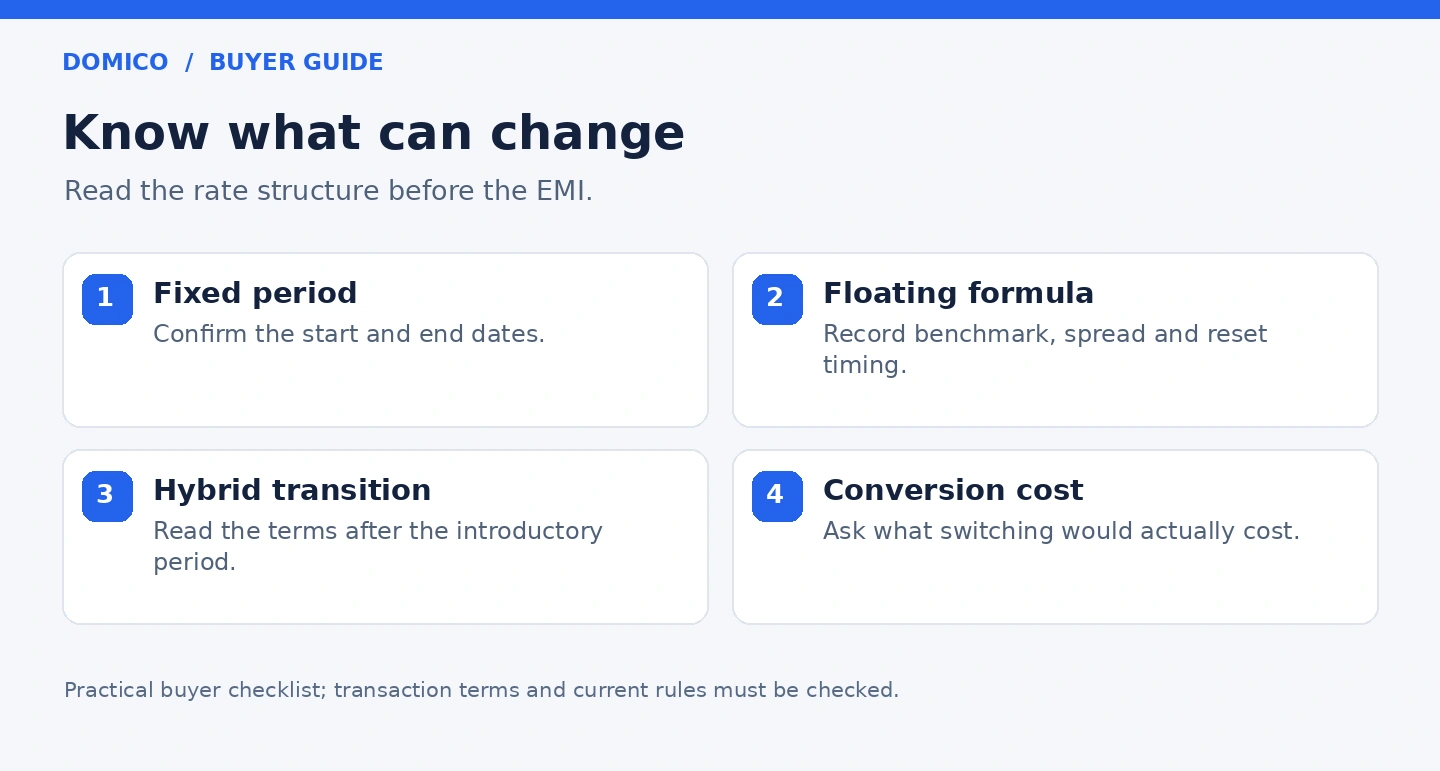
In a genuinely fixed-rate period, the agreed interest rate remains unchanged for that period under the contract. In a floating-rate loan, the rate changes according to the relevant benchmark and contractual spread and reset provisions. A hybrid offer combines periods, usually beginning with a fixed phase before moving to floating terms.
Do not assume a product described as fixed stays fixed for the entire loan. Read the sanction letter and agreement for any reset clause. Ask the lender to show the exact paragraph explaining when the rate can change and what happens afterward.
| Feature | Fixed-rate period | Floating-rate arrangement |
|---|---|---|
| Rate movement | Governed by the fixed-period promise and exceptions | Linked to contractual benchmark and reset rules |
| Budget visibility | Easier during the genuinely fixed period | Requires room for rate changes |
| Benefit when market rates fall | May require switching or another contractual route | Depends on benchmark movement and reset timing |
| Early repayment | Check product-specific terms and applicable rules | Check current RBI protection and loan eligibility |
| Main document question | How long is the rate actually fixed? | Which benchmark, spread and reset date apply? |
Read the rate as a formula
For a floating offer, write the reference benchmark, the spread added to it, the current final rate and the reset frequency on one line. Also ask what can change the spread. Two loans with the same final rate today may behave differently if their benchmark or repricing conditions differ.
The reset date matters. A public announcement about interest rates does not tell you the exact day your EMI will change. Your account operates under its own contractual schedule. Keep the lender's notice and compare the revised rate with the next statement rather than relying on a news headline.
For a fixed offer, write the fixed-period end date. If it is three years rather than twenty, compare the terms after year three. A low introductory period followed by an uncertain reset needs a different budget from a rate fixed for the whole repayment term.
A worked comparison: what does a rate increase do?
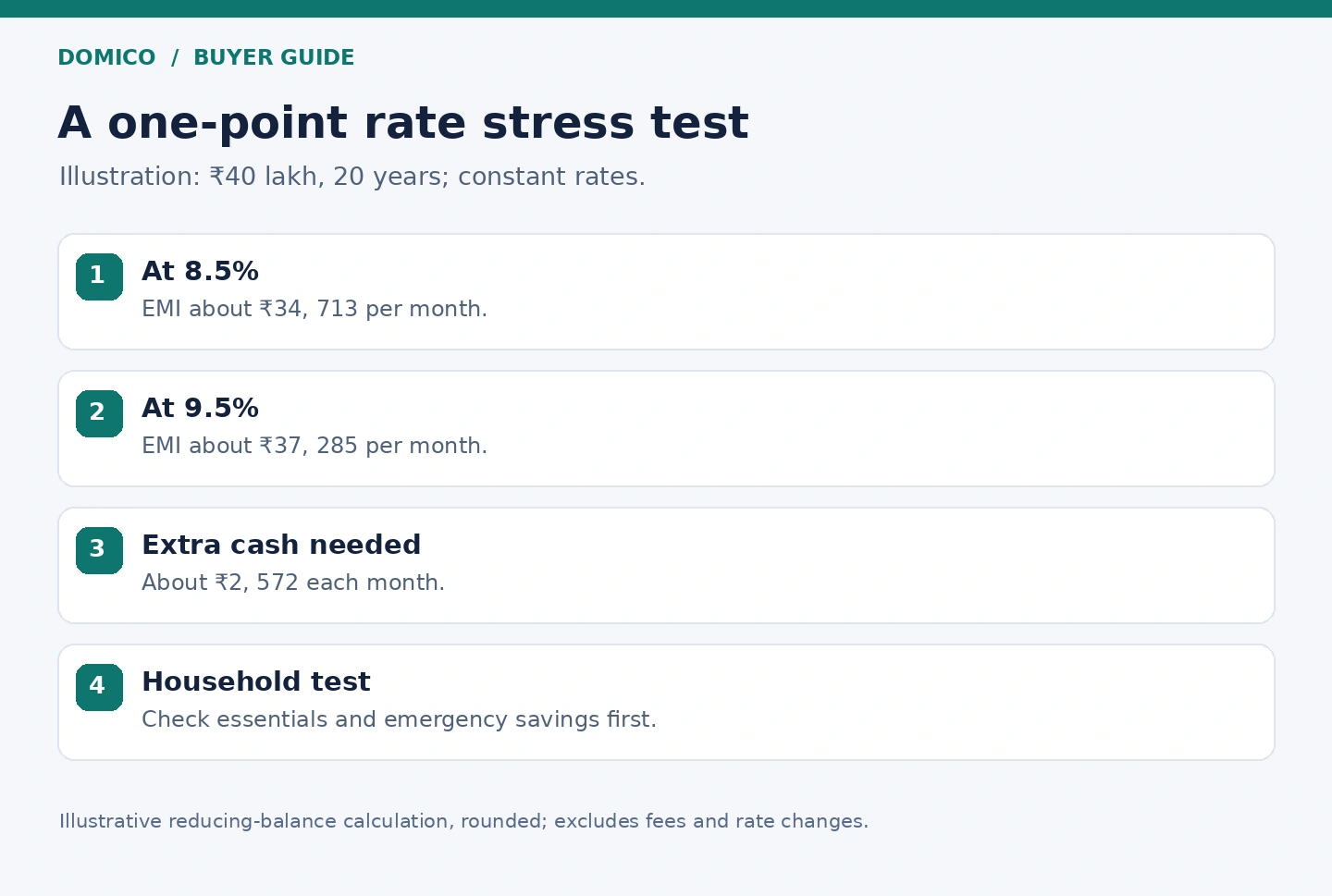
The following is an illustrative calculation, not a current lender offer. Suppose the loan is ₹40 lakh for twenty years. At an unchanged 8.5% annual rate, the monthly reducing-balance EMI is approximately ₹34,713. At 9.5% for the same starting principal and tenure, it is approximately ₹37,285.
That is an extra ₹2,572 a month, or about ₹30,864 over twelve months. The comparison assumes each rate applies from the start for the full term; it is not a prediction of a real mid-loan reset. An actual change depends on the outstanding balance, months remaining and lender's treatment of the EMI and tenure.
| Illustrative starting scenario | Monthly EMI | Approximate total interest over 20 years |
|---|---|---|
| ₹40 lakh at 8.5% | ₹34,713 | ₹43.31 lakh |
| ₹40 lakh at 9.5% | ₹37,285 | ₹49.48 lakh |
| Difference | ₹2,572 | ₹6.17 lakh |
Now test the higher EMI against your own budget. If your monthly surplus after essentials is ₹8,000, the increase consumes a substantial part of that cushion. If your surplus is ₹30,000 and you hold an emergency fund, the same increase may be manageable. The appropriate structure depends on the household, not only the rate.
What happens when floating rates rise?
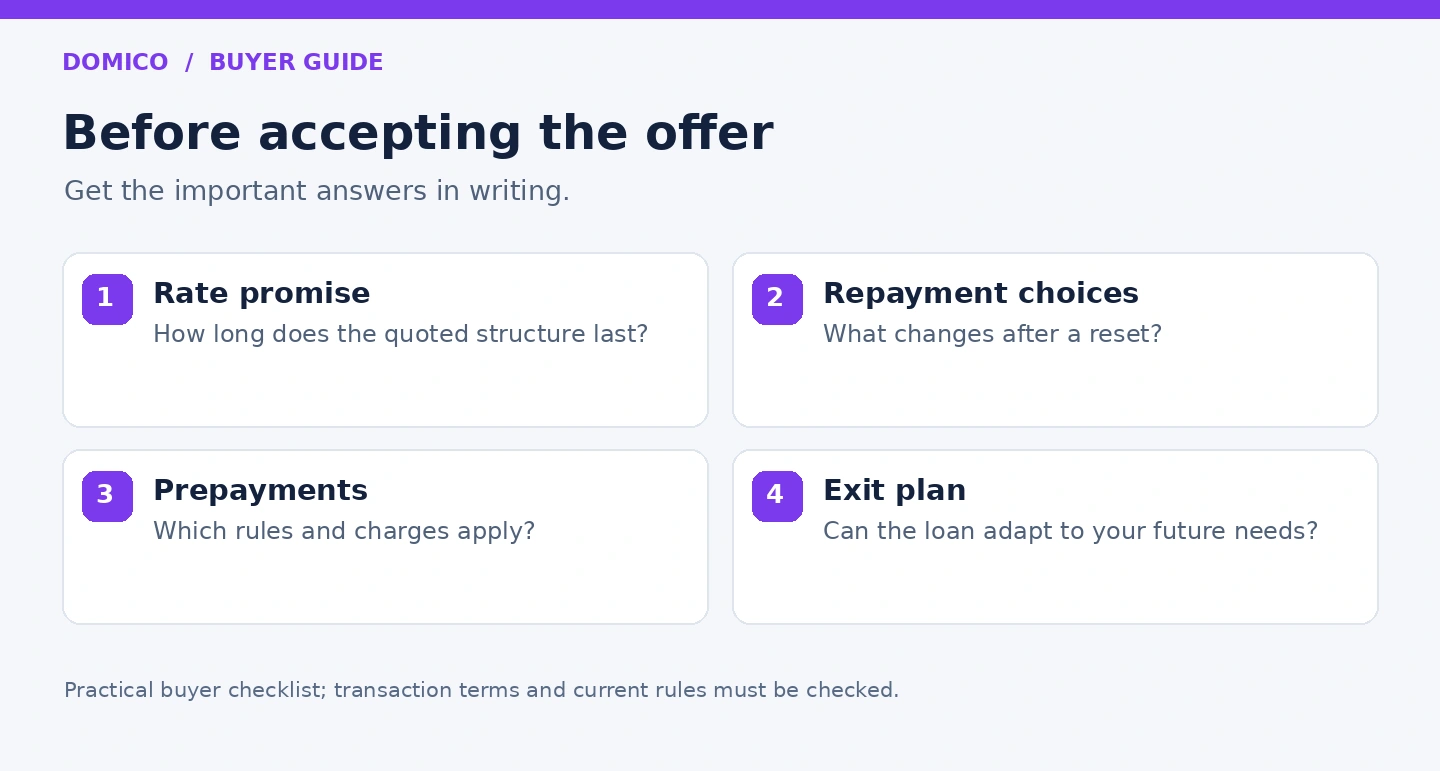
Ask whether the lender will increase the instalment, extend the repayment period or offer a combination. A longer term can keep the monthly payment comfortable while increasing lifetime interest. A higher EMI may contain that interest but place pressure on current spending.
RBI's floating-rate reset framework addresses borrower communication and repayment choices. Its September 2025 amendment makes the fixed-rate switch relevant where the lender provides that option. Do not assume every lender must offer a fixed product. Obtain the choices and applicable charges for your particular account in writing.
Keep an eye on the revised closing date after a reset. A repayment period moving beyond your expected retirement needs attention even when the EMI has not changed. Ask for the updated amortisation schedule and check both the new final month and outstanding principal.
Compare the full fixed-rate premium
Suppose a fixed offer costs more each month than a floating alternative. Treat the difference as the price of the particular certainty offered, then ask whether it is worth it to your household. A borrower with predictable income but little spare cash may value certainty differently from someone expecting substantial prepayments.
Do not compare a three-year fixed introductory offer with a fully floating twenty-year illustration as though both provide the same protection. Identify the period covered, the rate after it and the cost of leaving. A clear comparison may require the lender to provide a written scenario for year four rather than another sales quotation for month one.
Also look for conversion fees, administrative fees and differences in prepayment conditions. The cheaper headline rate may lose its advantage if the loan is expensive to restructure when your needs change.
Prepayment plans change the choice
If you expect annual bonuses, business receipts or proceeds from another asset, discuss partial prepayment before selecting the product. Ask how payments reduce principal and whether you can choose a shorter tenure instead of a lower EMI.
The RBI Pre-payment Charges on Loans Directions, 2025 apply to loans sanctioned or renewed from 1 January 2026 and include protections for qualifying floating-rate loans to individuals for non-business purposes. Check the scope, loan date and rate type. Do not extend a floating-rate protection automatically to a fixed-rate period or a business-purpose loan.
Your plan should also allow for bonuses not arriving. Optional prepayments are helpful; a compulsory EMI must be affordable from dependable income. Avoid selecting a demanding instalment on the assumption that an uncertain commission will always cover it.
Five documents to compare before choosing
| Document or detail | What to extract | Why it helps |
|---|---|---|
| Key Facts Statement | APR, instalments and charges | Places cost alongside the headline rate |
| Sanction letter | Rate type and conditions | Identifies the offer actually approved |
| Loan agreement | Reset and conversion clauses | Explains future changes |
| Repayment illustration | Principal, interest and end date | Shows the long-term effect |
| Prepayment terms | Charges, eligibility and process | Tests whether the loan fits your plans |
Read the documents together. If a salesperson promises no conversion charge but the written terms contain one, ask for a corrected document before agreeing. A helpful verbal explanation does not remove an inconsistent clause.
A practical way to make the decision
Start with a comfortable EMI at the quoted rate. Repeat the budget at a higher illustrative rate and with one temporary income reduction. Decide how much emergency cash you need after paying the down payment and purchase costs. Then compare fixed, floating and hybrid offers against those limits.
Ask each lender the same questions: when can the rate change, how will I be told, what choices will I have, what does switching cost, and what happens if I prepay? Save the replies beside the offer. This makes the decision easier to revisit later if rates or your family circumstances change.
If the fixed offer is unclear about its duration, do not use the word fixed as a reason to stop reading. If the floating offer leaves your budget with no spare room, do not use an expected rate cut as the solution. Choose using what is documented and affordable today.
Printable buyer worksheet
Download the topic-specific review checklist. Use it to record evidence, unanswered questions and follow-up actions for the exact property.
Frequently asked questions
Is a floating home loan always cheaper?
No. It can benefit from favourable benchmark movements, but future rates are unknown. Total cost also depends on fees, resets, prepayments and tenure. Compare documented offers and scenarios rather than assuming one rate type always wins.
Does fixed mean the EMI cannot change for twenty years?
Only if the contract genuinely provides that arrangement without a relevant exception. Some offers fix the rate for a shorter introductory period. Check the exact fixed duration and what follows it.
Can I switch a floating loan to fixed?
Ask whether your lender offers that option and obtain the conversion rate, fee and revised conditions. The current RBI framework should not be read as a promise that every lender provides a fixed-rate product.
Should I lower the EMI after a rate cut?
A lower EMI improves monthly cash flow, while maintaining the payment can reduce the remaining term if the lender applies the account accordingly. Request both illustrations and choose based on your household needs.
How often should I review the loan?
Review it when the rate resets, when you make a substantial prepayment or when your income changes. Check the statement for the current rate, outstanding principal, EMI and remaining months rather than reviewing only the amount debited.
Sources and related reading
- buyer-guide-100
- homebuyers
- fixed-floating-home-loan
- indore
Planning to buy or rent in Indore? Browse verified properties in Indore or read more Indore guides.



