Buying Guide
Buying Property With an Existing Home Loan: Safe Steps
Learn how to coordinate the seller’s mortgage closure, lender payments, original documents, registration and possession before buying a resale home.

Table of contents
The seller's loan can be closed. Your payment trail must stay clear.
Finding out that a resale home still has a loan does not automatically end the deal. Many owners sell before completing their repayment. The important question is how the mortgage will be cleared, how the original papers will move, and when the buyer will receive an enforceable transfer and possession.
A rushed arrangement can put a large payment between two unfinished processes. The seller may have received money, but the bank may still hold the documents. Or the old loan may be closed, while the new lender is waiting for a release record before disbursing. Plan those links before booking a registration appointment.
This guide focuses on the seller's outstanding loan. For your own borrowing capacity, read Domico's home loan eligibility guide.
First establish which loan is attached to the property
Ask for the lender's name, loan account details through a secure channel, a recent statement, and the list of original documents held as security. The seller should authorise the lender to provide transaction-relevant confirmation to the buyer, the buyer's lender or their lawyers. A photograph of a banking app is not a closure plan.
Check whether the security relates only to this home. A property can support a business borrowing, a top-up facility or obligations involving another borrower. Those arrangements need their own release conditions. Do not assume that the number labelled outstanding principal is the full sum required to release the property.
Ask the bank to identify the borrower, the secured property and the conditions under which it will release the security. Compare that description with the proposed sale deed. A home address used for correspondence may not be a complete description of the mortgaged asset.
Obtain a dated foreclosure quotation
A foreclosure quotation states the amount required to close the account on a specified basis. It can include accrued interest and applicable charges. Its validity matters because interest can continue while the parties arrange documents.
Request a written response explaining the payment mode, beneficiary details, reference information and how any excess or shortfall will be handled. Verify those details directly with the lender using an independently obtained contact channel. An emailed change of bank account deserves a fresh verification call.
| Record | What to confirm | Why it matters |
|---|---|---|
| Foreclosure quotation | Amount, calculation date and validity | Avoids closing with a short payment |
| Original-document list | Each deed, plan or supporting original held | Creates an inventory for later handover |
| Release procedure | Office, responsible team and expected steps | Helps sequence the transfer |
| Security details | Mortgage, related facilities and other conditions | Shows what must actually be discharged |
| Payment instructions | Verified lender beneficiary and reference | Reduces diversion and identification errors |
Keep the quotation with the transaction papers. If the registration date changes, ask whether an updated quotation is required rather than relying on the old figure.
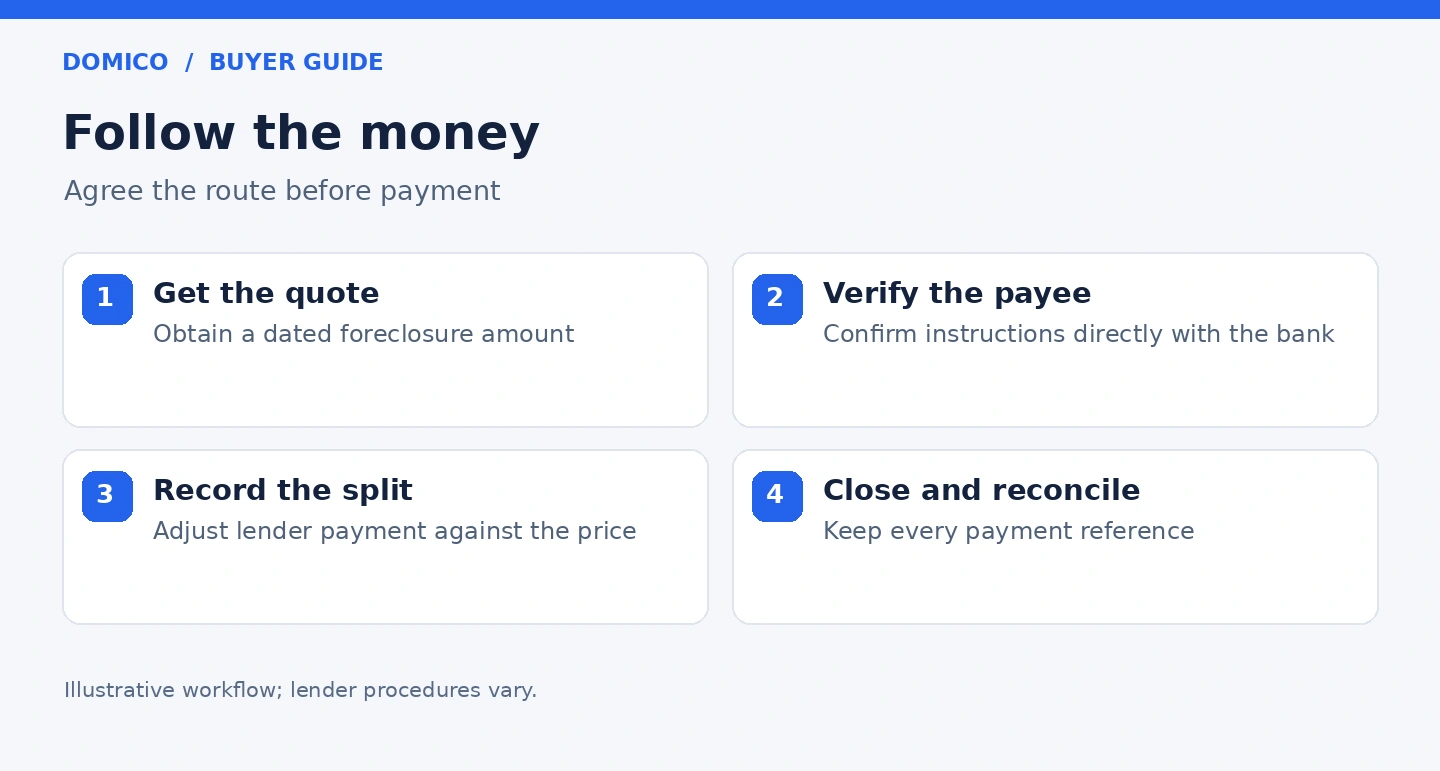
Have both lenders agree on the route
There are several workable transaction structures. The seller might close the loan from independent funds before selling. The buyer's bank might pay the seller's lender directly. In some cases the transaction is coordinated within the same lender. The right route depends on the title, security, funding and lender policies.
The useful question is not which route sounds quickest. Ask each institution what it requires before releasing money or documents. A salesperson's verbal assurance cannot bind the bank's legal or operations team.
HDFC Bank's published home-loan process separates credit sanction from property-document assessment and disbursement. Use that distinction when coordinating a resale purchase: an approved buyer still needs a property and payment route the lender accepts.
Ask for a single transaction note naming the amount going to the existing lender, the amount payable to the seller, the person collecting originals, the release evidence required, and the registration and possession conditions. Each party should understand the same sequence.
Put the payment split in the agreement
If part of your purchase price will close the seller's loan, record that it is paid on the seller's behalf and adjusted against the agreed consideration. Describe what happens if the foreclosure amount changes. Do not pay the full price to the seller and separately treat the lender payment as an informal favour.
The agreement should allocate responsibility for unpaid interest, old dues, document recovery and the mortgage release. It should also set a clear response when the bank cannot release the property as expected. Your lawyer can frame deadlines, extensions, refund obligations and any retention appropriate to the deal.
There is no universal retention percentage that makes every purchase safe. A holdback that the seller accepts may still be too small to resolve the actual problem. Its amount and release trigger should follow the identified risk.
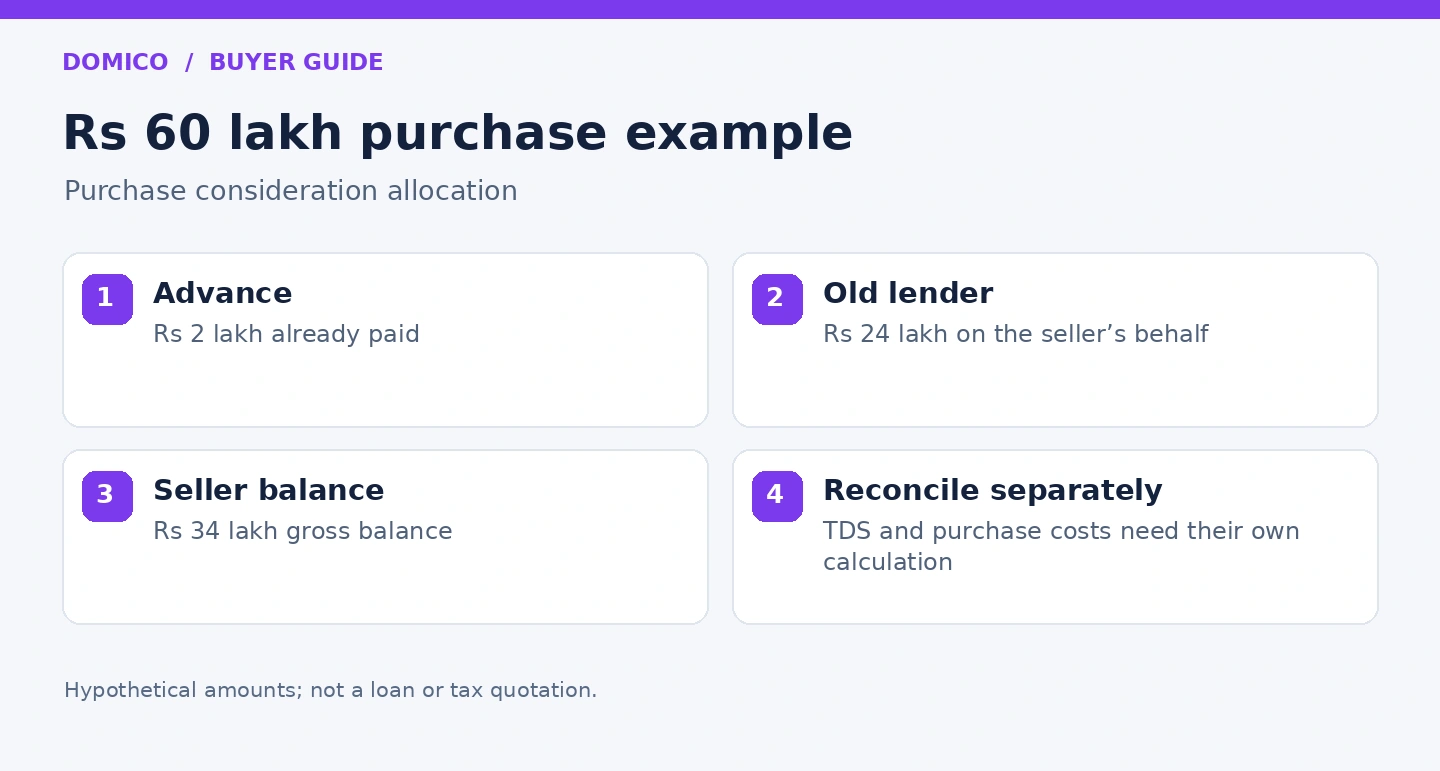
A worked payment example
Consider an illustrative purchase priced at Rs 60 lakh. The seller's bank issues a valid closure quotation for Rs 24 lakh. The buyer has already paid a documented Rs 2 lakh advance. The remaining consideration is Rs 58 lakh.
| Purchase consideration allocation | Illustrative amount |
|---|---|
| Documented advance already paid | Rs 2 lakh |
| Payment to existing lender on seller's behalf | Rs 24 lakh |
| Remaining amount payable to seller | Rs 34 lakh |
| Total purchase consideration | Rs 60 lakh |
This is a consideration reconciliation, not a complete tax or funding calculation. Applicable TDS, registration costs, the buyer's own contribution and the buyer's loan disbursement must be reconciled separately. If TDS applies, the seller's net receipt will differ from the gross consideration allocation above.
Now suppose the closure quotation expires and the revised amount is Rs 24.10 lakh. The parties need a documented adjustment. Silently sending the extra Rs 10,000 from the buyer's pocket can create disagreement about whether the total price increased or the seller's balance should reduce.
Check originals when they are released
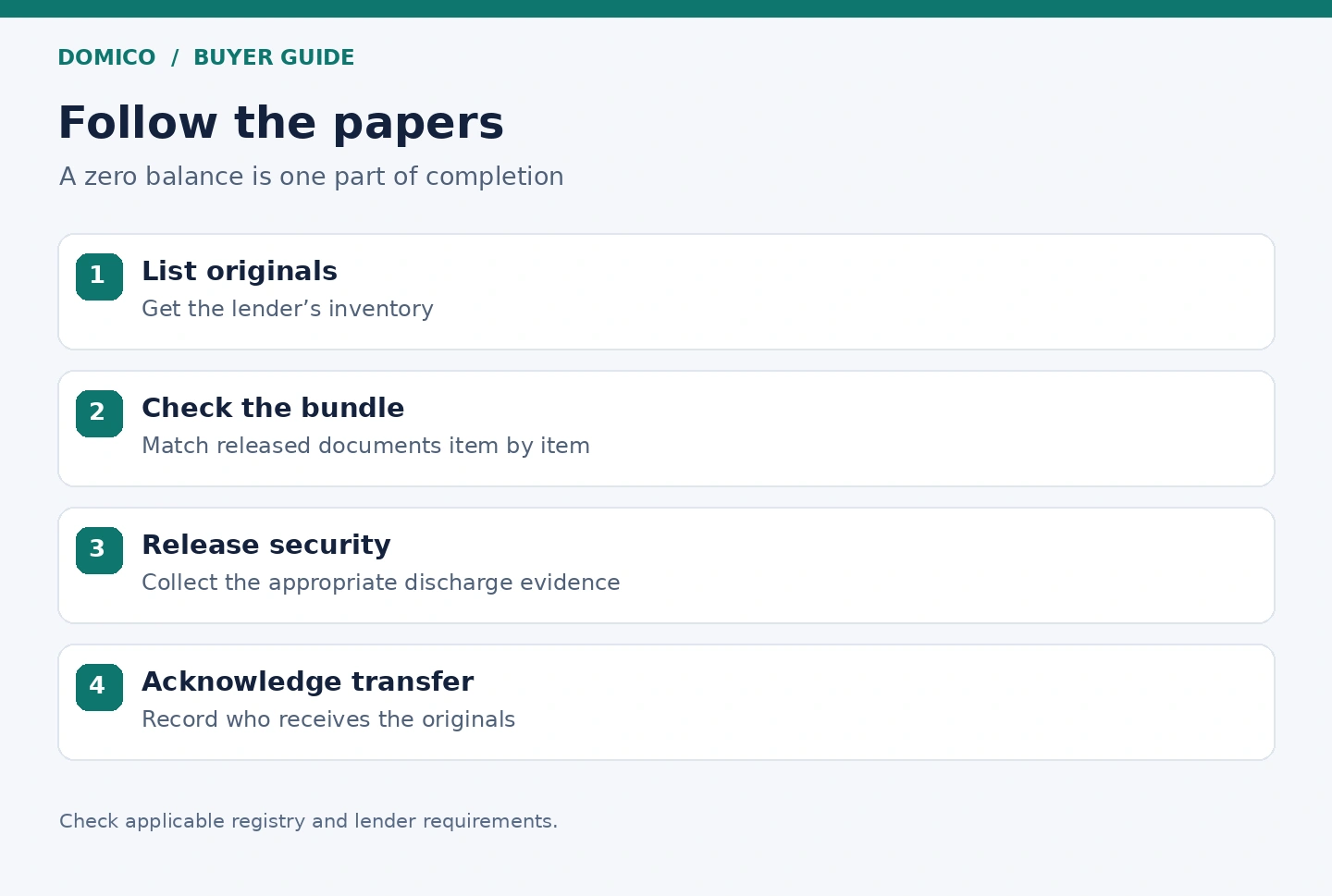
Compare the released bundle against the lender's document inventory. Record missing items, damaged pages and differences in document descriptions immediately. Check that you have the correct originals for this property rather than accepting a sealed packet without an inventory.
RBI's directions on release of property documents require covered regulated lenders to release originals and remove registered charges within 30 days after full repayment or settlement of the personal-loan account. The directions have defined coverage and provisions addressing delay. That regulatory period should not be mistaken for a promise that every resale transaction can register on the day the old loan is paid.
Agree where the papers will go next. If your lender needs to hold them as security for your new home loan, obtain an acknowledgement identifying the documents received. Keep readable copies and the complete transfer trail.
Closing an account and releasing security are separate checks
A zero loan balance helps, but it is not the whole record. Ask for the closure letter or no-dues confirmation and the evidence required to discharge the mortgage or registered charge. The form of release depends on how the security was created and recorded.
Have the lawyer check the relevant searches again when appropriate. The bank's release letter, registration records and any other security records should be considered together. Avoid describing a property as completely clear merely because one online search shows no entry.
| Before final completion | Evidence to organise |
|---|---|
| Old account fully discharged | Closure or no-dues confirmation |
| Relevant security released | Appropriate release and registry evidence |
| Originals accounted for | Signed document inventory and receipt |
| Buyer funding completed | Payment references and lender records |
| Transfer executed | Registered conveyance and transaction receipts |
| Possession delivered | Handover record, keys and meter readings |
Keep possession in the same plan
The seller may need time to move after the financial closing. Record that arrangement explicitly. State when vacant possession will be delivered, which fixtures remain, who pays outgoings until handover and what happens if the date slips.
Visit the home again near closing. A mortgage repayment does not establish that the flat is vacant, that a tenant has left or that the agreed fixtures remain. Financial clearance and physical handover solve different problems.
Watch for urgency that removes reasonable checks: a request to pay the seller privately before the bank confirms the figure, an unexplained extra loan, refusal to provide the original-document list, or a promise that missing release paperwork will be handled after an unconditional final payment.
Questions buyers often ask
Can I buy a home while the seller's home loan is running?
Potentially, yes. The lender's security must be addressed through an agreed closure and release route. The lender, seller, buyer and any new lender should confirm the sequence before significant money changes hands.
Should I pay the seller or the bank?
Use the verified structure recorded in the agreement and approved by the lenders involved. Where your money is intended to close the seller's account, a direct, properly referenced payment to that lender can create a clearer trail. It still needs documented adjustment against the purchase price.
Will using the same bank make everything automatic?
No. It may simplify coordination, but the new loan, transfer documents, security release and possession remain separate tasks. Ask the bank which steps it will coordinate and what each party must supply.
Can the old sanction letter replace the original papers?
No. A sanction letter records a lending decision. It does not replace the title deeds, establish the complete ownership chain or prove that all security over the property has been released.
What if a released original is missing?
Record the gap immediately and obtain the lender's written account. Ask your lawyer and new lender what reconstruction, certified copies, searches or other action is necessary before proceeding. A general indemnity should not be accepted as a universal cure.
Your practical next step
Before paying another instalment, ask for one signed-off sequence covering closure amount, verified payee, document release, security discharge, registration and possession. A property with an existing loan can be manageable when the money and papers move through a plan everyone understands.
Sources and further reading
- Reserve Bank of India: release of property documents after repayment or settlement.
- HDFC Bank: home-loan application, sanction and disbursement process.
- Domico: property documents buyer checklist.
Printable buyer worksheet
Download the topic-specific review checklist. Use it to record evidence, unanswered questions and follow-up actions for the exact property.
- buyer-guide-100
- homebuyers
- existing-home-loan-property
- indore
Planning to buy or rent in Indore? Browse verified properties in Indore or read more Indore guides.



