Buying Guide
Corpus Fund vs Sinking Fund: Apartment Buyer Guide
Understand corpus, sinking funds and advance maintenance, then check collection authority, accounts, repair planning and resale treatment.
Updated 8 min read

Buying Guide
Understand corpus, sinking funds and advance maintenance, then check collection authority, accounts, repair planning and resale treatment.
A building needs money for this month's cleaning and for the lift it may replace years later. Those are different jobs.
Corpus fund, sinking fund, repair fund and advance maintenance often appear together on an apartment demand letter. Buyers understandably ask whether these are separate legitimate amounts or several names for the same charge. The answer comes from the documents, purpose and accounting, not from the label alone.
Terminology and legal treatment vary. This guide explains the financial ideas, the evidence a buyer should request and the mistakes to avoid. It does not prescribe a nationwide contribution rate or assume that every association uses these terms in the same way.
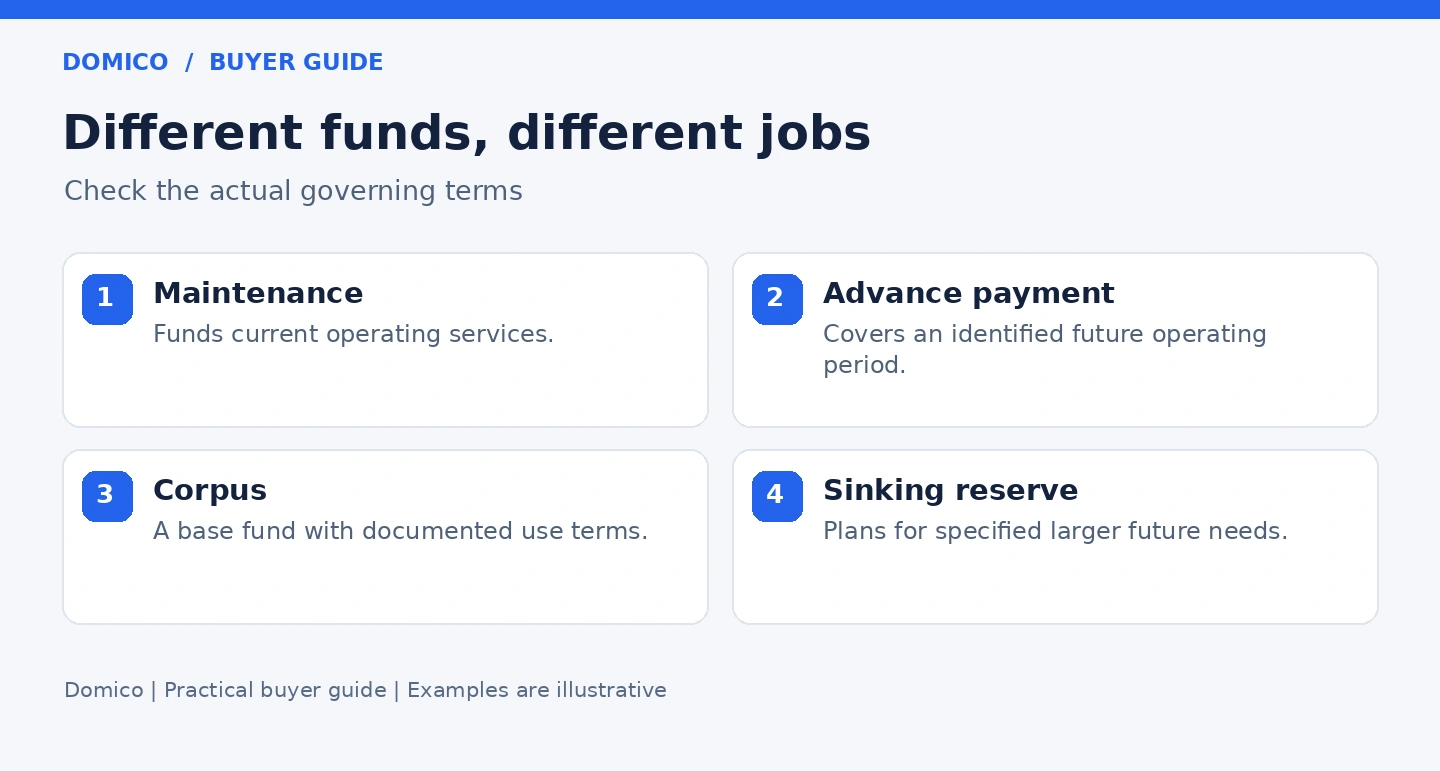
In common financial usage, a corpus is a base pool of funds set aside under defined terms. A sinking fund is generally built toward future capital or major replacement needs. A routine maintenance account pays for ongoing operations. The actual governing documents determine how those ideas apply in a particular society.
A developer may use “corpus” for an initial collection, while an association may use another term for its long-term reserves. Ask what the money may be spent on, who controls it, whether principal may be used and what reporting is required.
Do not assume that a corpus must always remain untouched or that every sinking fund can be used freely. The agreement, applicable law and valid association decisions must support the answer.
| Label commonly used | Financial purpose to investigate | Key buyer question |
|---|---|---|
| Routine maintenance | Current staffing, utilities and small operating costs | What period and services does the payment cover? |
| Advance maintenance | Prepayment toward an identified operating period | How is it adjusted and what balance remains? |
| Corpus or capital reserve | A base fund under specified restrictions | Who holds it and how may principal or income be used? |
| Sinking or replacement fund | Funding planned larger future work | Is there an asset plan behind the contribution? |
| Special assessment | A specific approved collection | What work, allocation and timing authorise it? |
For a new apartment, locate the relevant clause in the agreement and the itemised payment schedule. For resale, obtain the association's governing documents and applicable resolutions. Ask whether the demand is already due, proposed or disputed.
Have a local lawyer or appropriate professional review legal questions. The RERA Act provides a wider framework for promoter responsibilities and association-related matters, but a buyer should not infer a fixed corpus percentage from it.
If the charge is per square foot, identify the area definition and rate. If it is equal per apartment, verify the basis. A multiplication that is arithmetically correct can still rest on an unexplained charging method.
A seller may show an original receipt for Rs 1 lakh paid into a fund. That proves a payment, subject to verifying the document. It does not establish the society's present bank balance or the share of future expenses already funded.
Request the current accounts, bank reconciliation and fund movement where available through the authorised process. Ask about unpaid bills, committed work and amounts due from owners. A fund's name in a ledger is not necessarily the same as free cash ready for use.
For developer-to-association transition, seek a clear reconciliation of relevant collections, authorised expenditure and balances. Have professionals review the applicable handover obligations instead of relying on a generic online checklist that may quote another State's rules.
A meaningful replacement reserve begins with the assets and their condition. Lifts, pumps, waterproofing, electrical systems and other shared equipment have maintenance and eventual replacement needs. The timing and cost require professional estimates, not a fixed guess based on the number of flats.
Ask whether the association has an asset register, recent condition reviews and a phased expenditure plan. The National Building Code overview includes asset and facility management, which is a useful reminder to connect financial planning to the building's actual systems.
A large pool of money can be inadequate if several major items need work soon. A smaller balance can be reasonable in a newer building with a funded plan. The balance should be read against liabilities and expected needs.
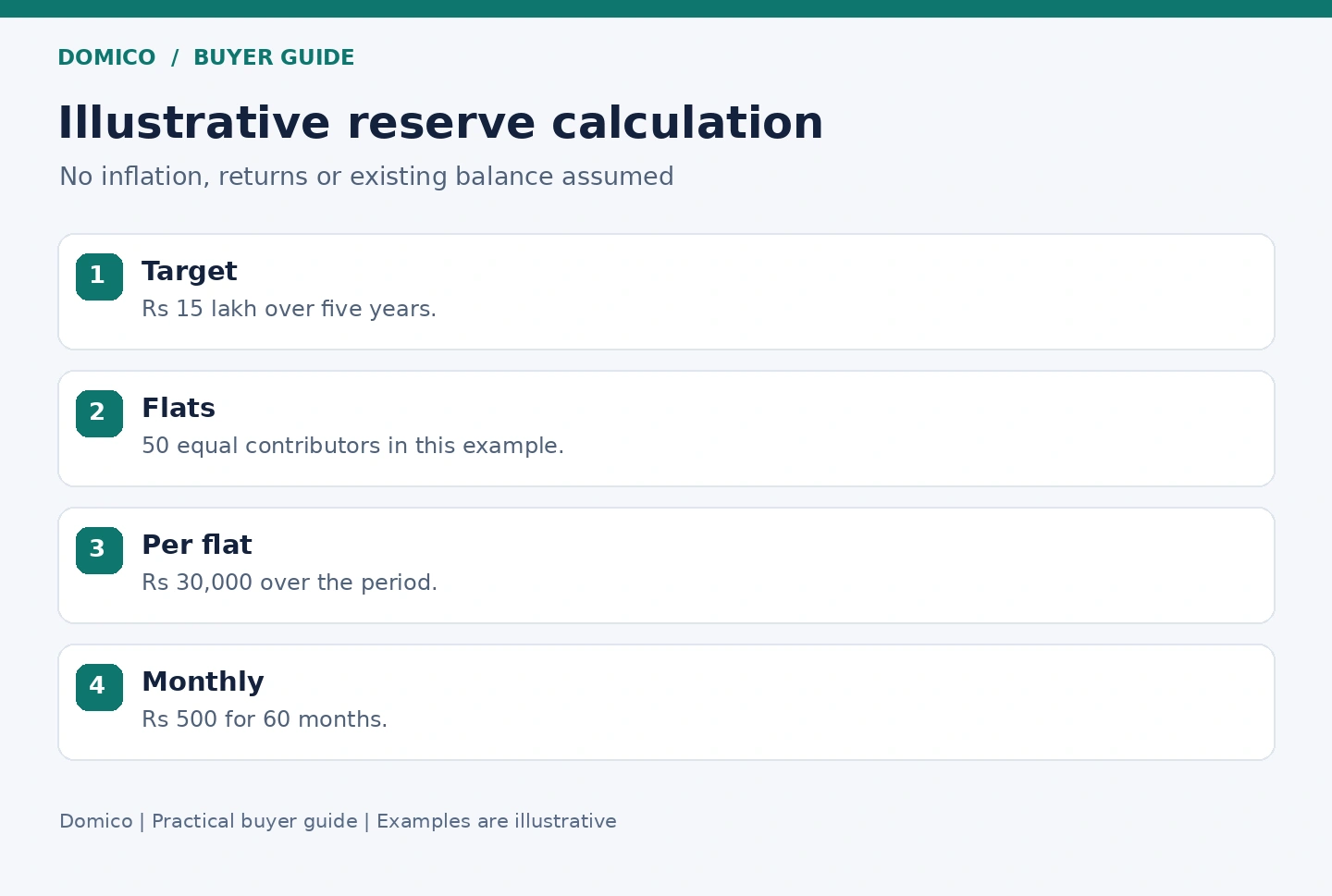
Imagine a hypothetical 50-flat building planning a Rs 15 lakh replacement in five years. Assume, only for this illustration, that every flat contributes equally and there is no existing reserve, investment return, inflation or other expense.
| Illustrative step | Calculation | Result |
|---|---|---|
| Amount to collect | Rs 15,00,000 | Rs 15,00,000 |
| Per-flat total | Rs 15,00,000 / 50 | Rs 30,000 |
| Collection period | 5 years x 12 months | 60 months |
| Monthly contribution per flat | Rs 30,000 / 60 | Rs 500 |
This is a teaching example, not a legally prescribed rate or a replacement-cost estimate. A real plan must consider inflation, taxes, collection shortfalls, existing balances and technical changes. The association may also use a different valid allocation method.
The example shows why a monthly reserve contribution can be easier to manage than an unexpected large demand. It does not mean that a building charging Rs 500 is adequately funded without knowing the assets and costs.
Ask where funds are held, who is authorised to operate the accounts and what approvals govern spending. Review the applicable rules before assuming any investment is permitted. Safety, liquidity and reporting matter alongside return.
A promise that interest will cover all future maintenance deserves scrutiny. Ask for the principal amount, realistic net income assumptions and the operating budget. Returns can change, expenses can grow and major repairs can require principal under the governing terms.
Do not compare a fund to a personal fixed deposit you can withdraw at will. The money may belong to the association or be subject to restrictions tied to the building. Your individual rights need documentary and legal review.
A seller may expect reimbursement of an earlier corpus payment through the sale price. A buyer may think the payment should be refunded by the association. Neither expectation should be assumed without reviewing the governing arrangement.
Ask whether any amount is refundable, transferable, adjustable or simply remains within the association's funds. Get the current policy and a clear statement about outstanding contributions. Avoid double-paying an amount because the sale negotiation and association demand use different descriptions.
Your lawyer should record who pays any existing special assessment and how changes between agreement and completion are handled. A no-dues certificate may need updating if a new resolution or demand arises before the transaction closes.
A demand letter that combines “corpus and maintenance” into one line makes comparison difficult. Request a breakdown. Ask for separate purposes and accounting even where payment is made in one transfer.
A very low maintenance charge supported by aggressive investment-return assumptions is another reason to investigate. So is a large reserve that has no associated asset plan or transparent accounts. These observations do not prove wrongdoing; they identify questions that should be answered before purchase.
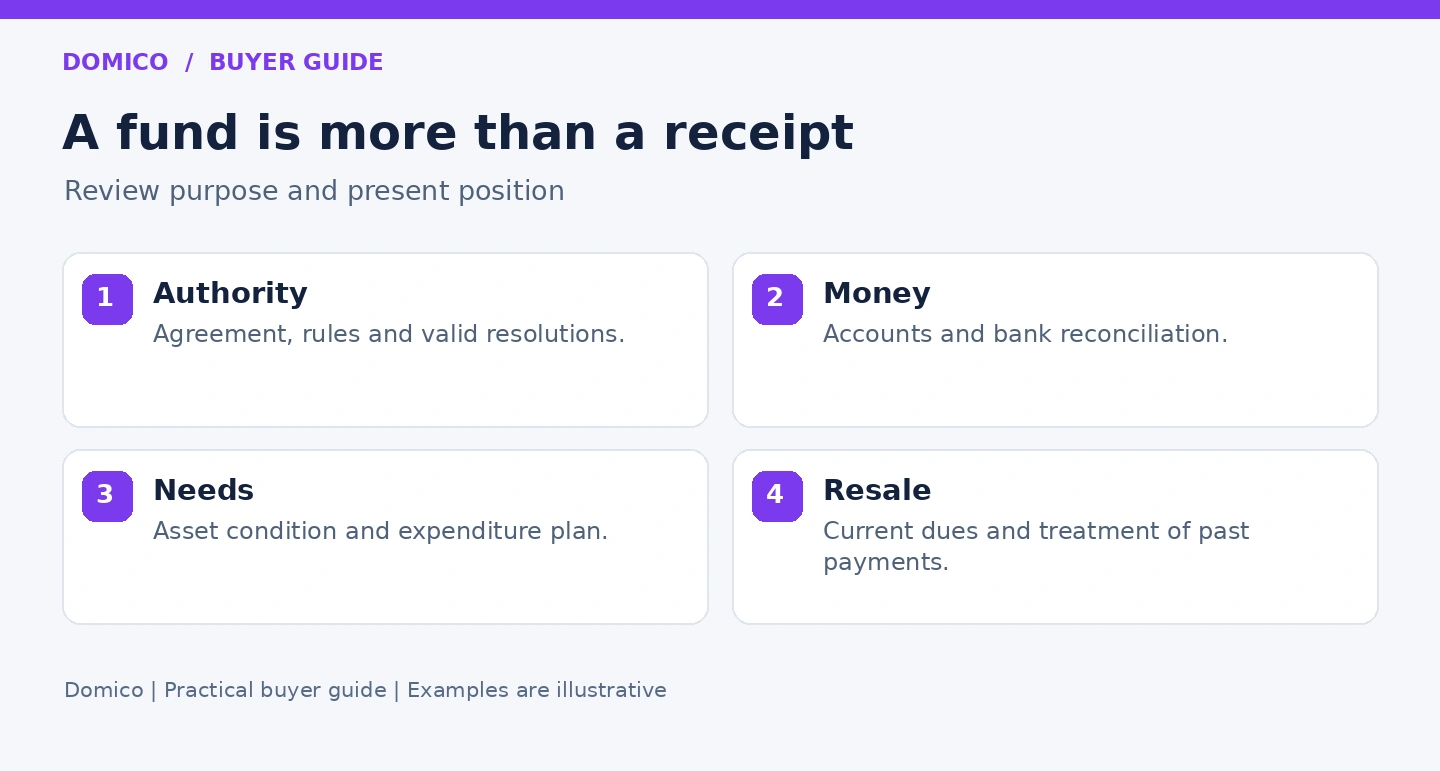
| Document | What to look for | Question if unclear |
|---|---|---|
| Agreement or governing rules | Purpose and authority | Why is this collection required? |
| Payment receipt | Amount, date and fund description | Which account or obligation was credited? |
| Accounts and reconciliation | Opening balance, movements and closing position | Does the cash support the ledger? |
| Asset plan | Planned work and professional estimates | What future need is being funded? |
| Resale statement | Dues and treatment of prior payments | What will the incoming buyer owe? |
Ask an accountant to reconcile any unexplained difference between the fund ledger and the bank position. There may be valid timing items or committed expenditure, but the explanation should be traceable. Keep the distinction between collected amounts, accounting reserves and readily available cash clear when comparing two buildings; they answer different financial questions.
Not necessarily. Advance maintenance usually refers to payment for an operating period, while a corpus may serve a different purpose. The documents must define the actual treatment and any adjustment.
Do not assume a universal rule. Ask for the applicable agreement, bylaws and legal position. The label alone cannot determine an individual refund right.
No single rate should be assumed for every jurisdiction and entity. Applicable rules and valid governing arrangements must be checked. A useful financial amount also depends on the building's needs.
That depends on the fund restrictions, legal framework and authorised process. Ask for a qualified review if proposed use conflicts with the stated purpose or governing documents.
No such conclusion follows automatically. Compare the actual operating budget, reserve needs, investment assumptions and future responsibilities before accepting a long-term cost promise.
A well-managed fund has a clear job, traceable money and a plan. Ask for all three before treating it as a benefit included in the apartment price.
Download the topic-specific review checklist. Use it to record evidence, unanswered questions and follow-up actions for the exact property.
Planning to buy or rent in Indore? Browse verified properties in Indore or read more Indore guides.
Check who owes the lender, how builder-paid interest works, when support ends and whether you can carry the loan if payments stop.



