Buying Guide
Buying Company-Owned Property: Authority Checks
Verify the company owner, sale approvals, authorised signatory, lender security and payment route before buying a company-owned property.

Table of contents
A director can represent a company. Check the authority for this particular sale.
When the seller is a company, the person sitting across the table is not necessarily the property's owner in their personal capacity. The owner may be a legal entity whose name appears on the title. The individual signing needs appropriate authority to bind that entity.
This distinction matters even in a small family business. The founder, managing director and shareholder may be the same person, but the company's property and the individual's property remain different legal questions.
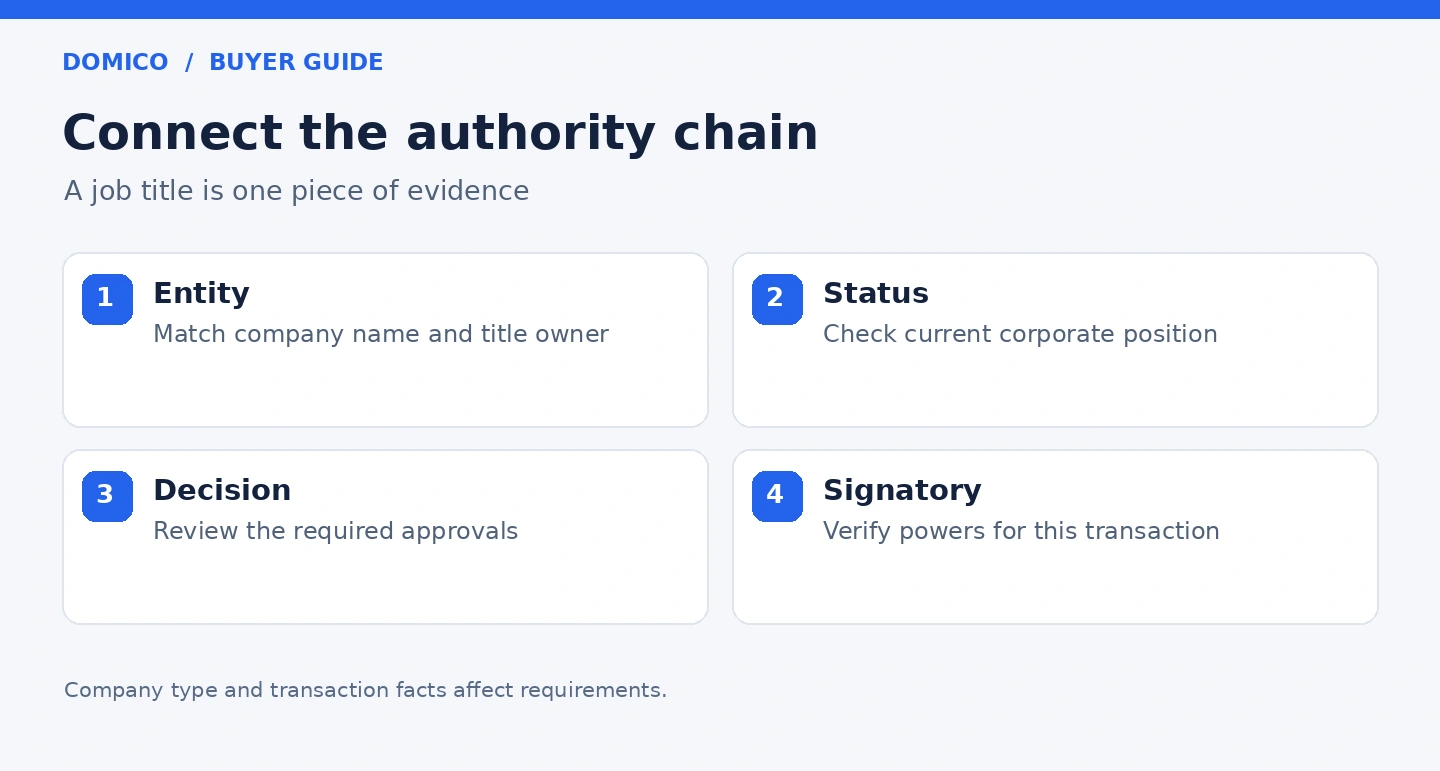
A well-organised purchase file should connect four things: the correct company, its title to the property, the required approvals for the sale, and the authorised person executing it.
Confirm the exact legal owner
Start with the registered acquisition deed. Compare the owner's full company name, former names where relevant, corporate identity number and registered office with the corporate records.
A brand name used on a signboard may differ from the entity that owns the land. A group can have several companies with similar names. Do not accept an agreement made with one entity while the title remains in another without a properly reviewed legal explanation.
Use the Ministry of Corporate Affairs and its appropriate company information services for corporate verification. Ask your professional adviser to obtain and interpret the relevant records; public master data is only one part of diligence.
Establish the company's present status
Check whether the company is active and whether there are circumstances affecting its ability to sell, such as insolvency, liquidation, a court restriction or another formal process. The answer can change who has authority to deal with the property.
A director's business card does not establish that they remain in office. Ask for current supporting records and a properly certified authority document. Where a restructuring or name change occurred, trace the connection to the property title.
If the owner is actually an LLP, partnership, trust or society, use the rules and constitutive documents relevant to that entity. A checklist labelled “company sale” should not be applied mechanically to every organisation.
| Check | What it establishes |
|---|---|
| Property title | Which entity acquired the asset? |
| Corporate identity | Is this the same legal entity today? |
| Current status | Are there proceedings or restrictions affecting the sale? |
| Approval record | Has the appropriate corporate decision been made? |
| Signatory authority | Who can execute and complete this transaction? |
Read the resolution carefully
Ask for the relevant board resolution or other valid authority approving the transaction and naming the signatory. The description should be specific enough to connect it with the property and sale being proposed.
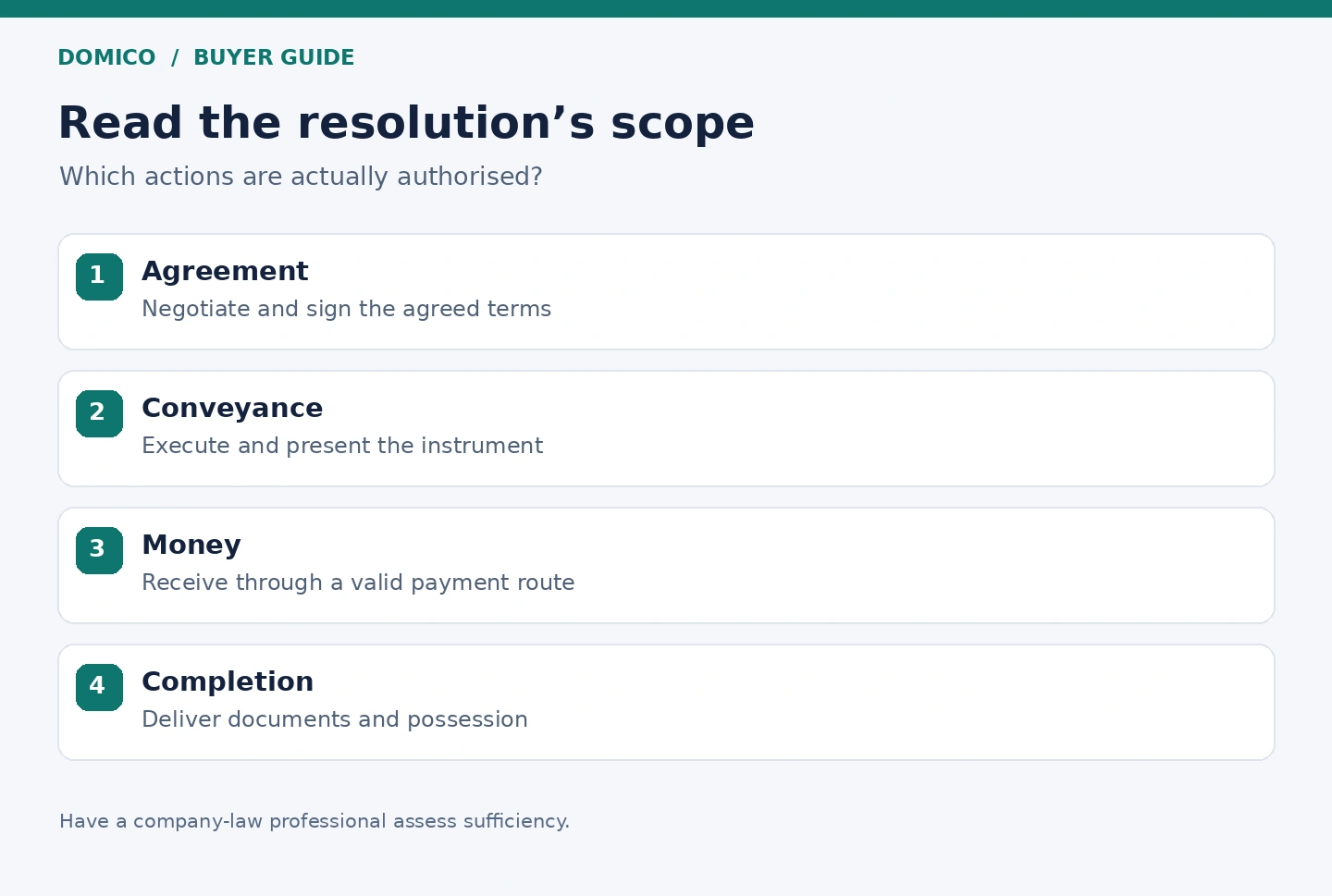
Check the scope. Does the authority cover signing the agreement, executing the conveyance, presenting it for registration, receiving consideration, handing over possession and completing related applications? An authority only to negotiate may not be enough to complete the sale.
Have a company-law professional review whether any shareholder approval, additional consent or other requirement applies. The Companies Act, 2013 contains different approval and power provisions. It would be wrong to assume that every property sale requires the same resolution or that every private company is governed identically for this purpose.
Check the articles and any relevant limitations
The company's constitutive documents, financing agreements and applicable law can affect the approval route. A standard resolution copied from another transaction may miss a restriction relevant to this company.
Ask your adviser to identify any issue arising from the nature or scale of the asset, related-party arrangements, lender security or a disposal forming part of a wider undertaking. The objective is not to collect every corporate filing ever made. It is to establish an adequate, defensible chain of authority for this transaction.
Keep certified copies of the documents relied on. If the company changes the proposed signatory shortly before registration, ask for the updated authority rather than simply substituting a name in the deed.
Investigate mortgages and corporate charges
A company's borrowing may involve security over a particular property, a group of assets or a wider charge. Ask for the relevant lender and corporate charge records and compare them with the title search.
A search of corporate charges should not replace land-registration or other appropriate searches. Conversely, a property search alone may not explain the company's financing arrangements. Have the professionals connect the findings.
If lender consent or release is required, obtain a property-specific plan. A general no-objection letter should be read for its conditions, amount, validity and scope. Do not assume a company can sell a mortgaged asset free of security because the sale proceeds will eventually repay a loan.
Confirm who receives the purchase money
Payment should follow the lawful, documented transaction structure. Verify the company beneficiary and account directly through an independent channel. Treat a request to send the price to a director's personal account as a matter requiring specific legal and tax review.
The signatory's authority to execute a deed does not automatically justify any account they nominate. Where money will go directly to a secured lender, record that payment's relationship to the purchase consideration and obtain appropriate receipts.
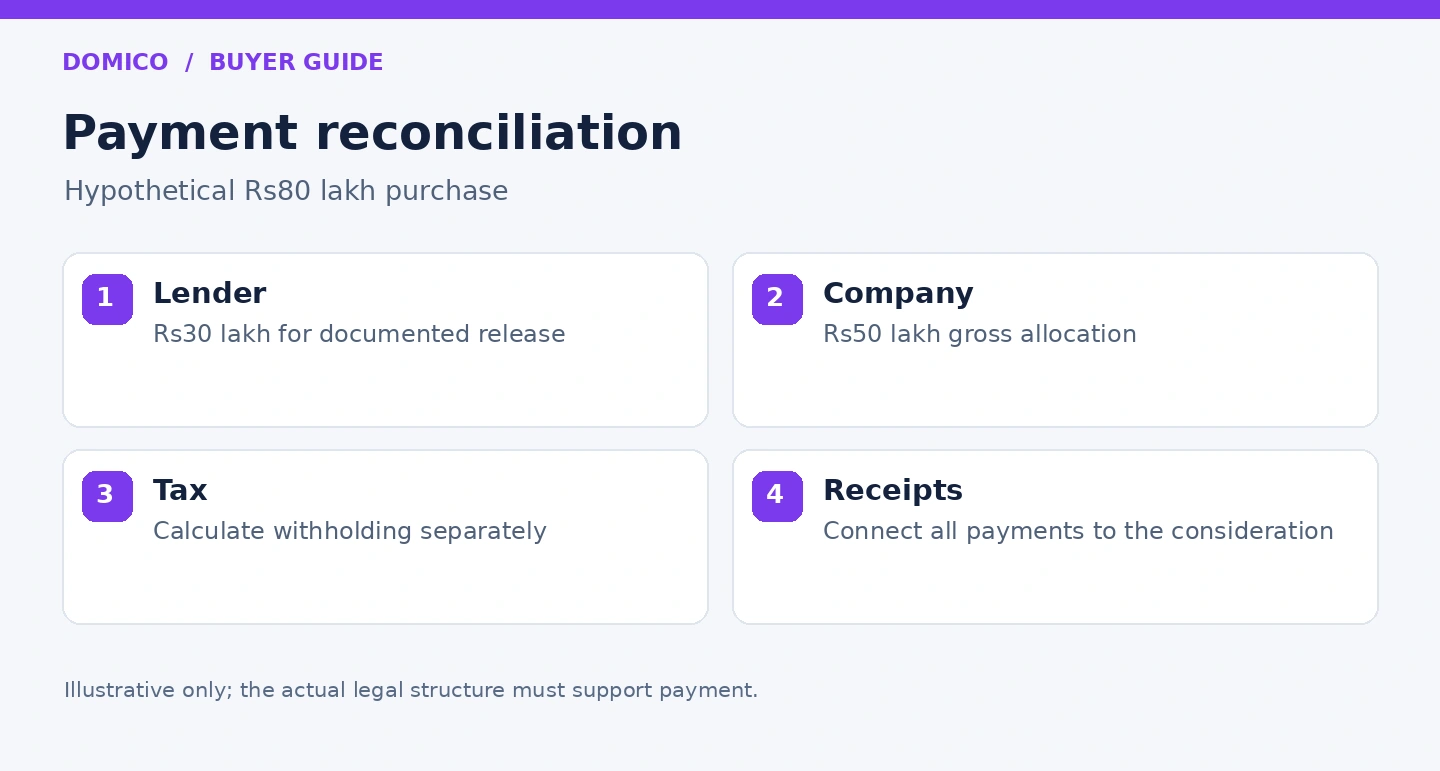
Consider an illustrative purchase price of Rs 80 lakh. The agreed plan allocates Rs 30 lakh to the lender for a documented release and Rs 50 lakh to the company, before applicable withholding adjustments. Both payments should be recorded against the same consideration.
| Hypothetical gross consideration allocation | Amount |
|---|---|
| Direct lender payment on company seller's behalf | Rs 30 lakh |
| Gross balance allocated to company seller | Rs 50 lakh |
| Total purchase price | Rs 80 lakh |
| Tax withholding and closing expenses | Determine and reconcile separately |
This example does not establish that any particular payment route is legally sufficient. The release documents, agreement and tax analysis must support the actual structure.
Keep tax diligence separate from signing authority
The seller's entity status and the property transaction can affect withholding, GST analysis or other tax questions. Ask a tax adviser to determine the applicable treatment before the first payment.
Do not assume every company sale is subject to GST, or that company ownership automatically changes a ready home's treatment in one predictable way. The property, nature of supply and transaction facts matter.
Make sure invoices, receipts and deed consideration agree with the actual structure. If a group company provides an invoice while a different company owns the property, ask for the legal basis before paying.
Verify occupation and use of the property
A company may use the home for staff accommodation, have leased it to a third party or hold it as an investment. Establish who occupies it and what rights they claim.
If you are buying for your own residence, specify vacant-possession requirements. A company undertaking to move its employees later should be documented and assessed just as carefully as a tenant's continued occupation.
Check the approved use and alterations. An office operating in a residential building may raise different issues from a lawful home. Do not value unauthorised modifications as an unquestioned benefit.
Organise the completion file
Before registration, have the legal owner name, signatory description and authority references checked in the draft. Ensure the instrument identifies the company as seller and the individual as its duly authorised representative in the appropriate form.
| Closing document | Practical purpose |
|---|---|
| Certified corporate authority | Connects the decision and signatory to this sale |
| Identity and current role evidence | Supports the representative's identity and status |
| Lender release or consent | Addresses relevant secured obligations |
| Payment receipts | Reconciles consideration paid for the property |
| Registered conveyance | Records the completed transfer in the required form |
| Possession and original-document inventory | Shows what was physically and documentary handed over |
If a resolution or lender letter is conditional, record how each condition was fulfilled. A closing checklist should refer to evidence rather than simply marking every item “done.”
Printable buyer worksheet
Download the topic-specific review checklist. Use it to record evidence, unanswered questions and follow-up actions for the exact property.
Frequently asked questions
Can a managing director sell company property without another document?
Do not infer sufficient authority from the job title alone. The company's documents, applicable law and transaction circumstances must establish the relevant powers and approvals.
Is a board resolution always enough?
Not necessarily. Additional approvals or consents may be relevant depending on the company, transaction and restrictions. Have the required route determined professionally.
Can I pay the director personally if they own all the shares?
Share ownership and ownership of company assets are different matters. Obtain legal and tax advice on the proposed payee and keep payments aligned with the valid sale structure.
Does a corporate charge search prove the property is clear?
It is one diligence tool. Title, registry, lender and proceeding searches need to be considered together. Each source can have limits and update delays.
What if the company is in insolvency proceedings?
Stop treating the sale as an ordinary director-led transaction. A specialist must identify the authorised decision-maker, applicable process and necessary approvals before you commit funds.
Ask for authority that survives scrutiny
A company-owned purchase should have a clear chain from entity to title, decision, signatory, payment and possession. When those links are evidenced, the fact that a business owns the property becomes a manageable transaction feature rather than an unanswered risk.
Official sources and related reading
- buyer-guide-100
- homebuyers
- company-owned-property
- indore
Planning to buy or rent in Indore? Browse verified properties in Indore or read more Indore guides.



