Buying Guide
Buying With Friends or Siblings: Co-Ownership Guide
Plan ownership shares, contributions, EMI responsibility, occupation, rental income and exit terms before buying property with friends or siblings.

Table of contents
Agree on the exit while everyone is still excited about the purchase.
Buying with a sibling or friend can make a property affordable and spread responsibilities. It can also connect two households' finances for many years. One buyer may later move cities, lose income, marry, need cash or want to sell while the other still wants to live there.
A shared purchase works better when the owners decide how those situations will be handled before paying the booking amount. Good relationships benefit from clear records; they should not be expected to replace them.
This guide focuses on the arrangement between incoming co-buyers. It is different from checking whether all existing sellers have authority to sell.
Start with the purpose of the property
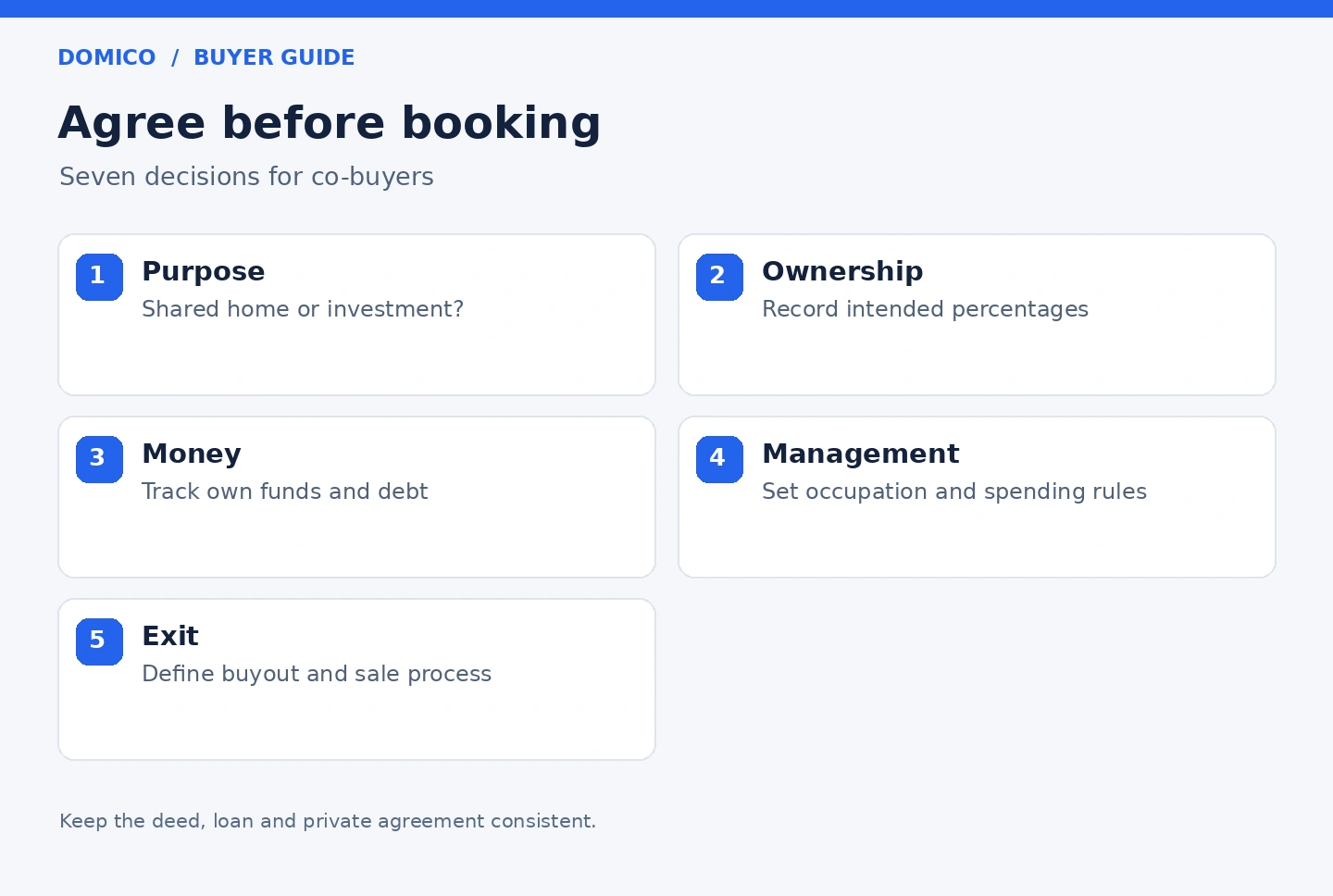
Write down whether you are buying a shared home, a rental investment, a home occupied by one owner, or land intended for later development. Each purpose creates different questions about use and contributions.
If one sibling will live in the flat and another will contribute only as an investor, discuss the arrangement openly. Will the occupant pay rent or cover a larger share of maintenance? Who decides when the property is sold? Can the investor require a buyout?
A conversation that seems awkward today can prevent a much harder argument after several years of unequal payments. Record the agreement in an appropriate legal form rather than relying on memories of a family discussion.
Put ownership percentages in the right documents
Do not assume that paying half of an EMI automatically creates half ownership. The acquisition deed, contribution evidence, applicable law and valid agreements need to be aligned.
The Transfer of Property Act includes provisions concerning joint transfers for consideration. Your lawyer should explain how the proposed ownership and contribution arrangement should be recorded for the actual facts.
If the buyers intend a 60:40 split, make that intention clear in the relevant documents and payment records. An informal spreadsheet that conflicts with the conveyance can create avoidable uncertainty later.
| Decision | What to record |
|---|---|
| Ownership | Intended share of each purchaser |
| Initial funding | Deposit, down payment and transaction costs |
| Borrowing | Who signs and what the loan requires |
| Occupation | Who may live there and on what terms |
| Income and expenses | Allocation of rent, dues, repairs and taxes |
| Exit | Sale, buyout, valuation and dispute procedure |
Separate ownership share from loan responsibility
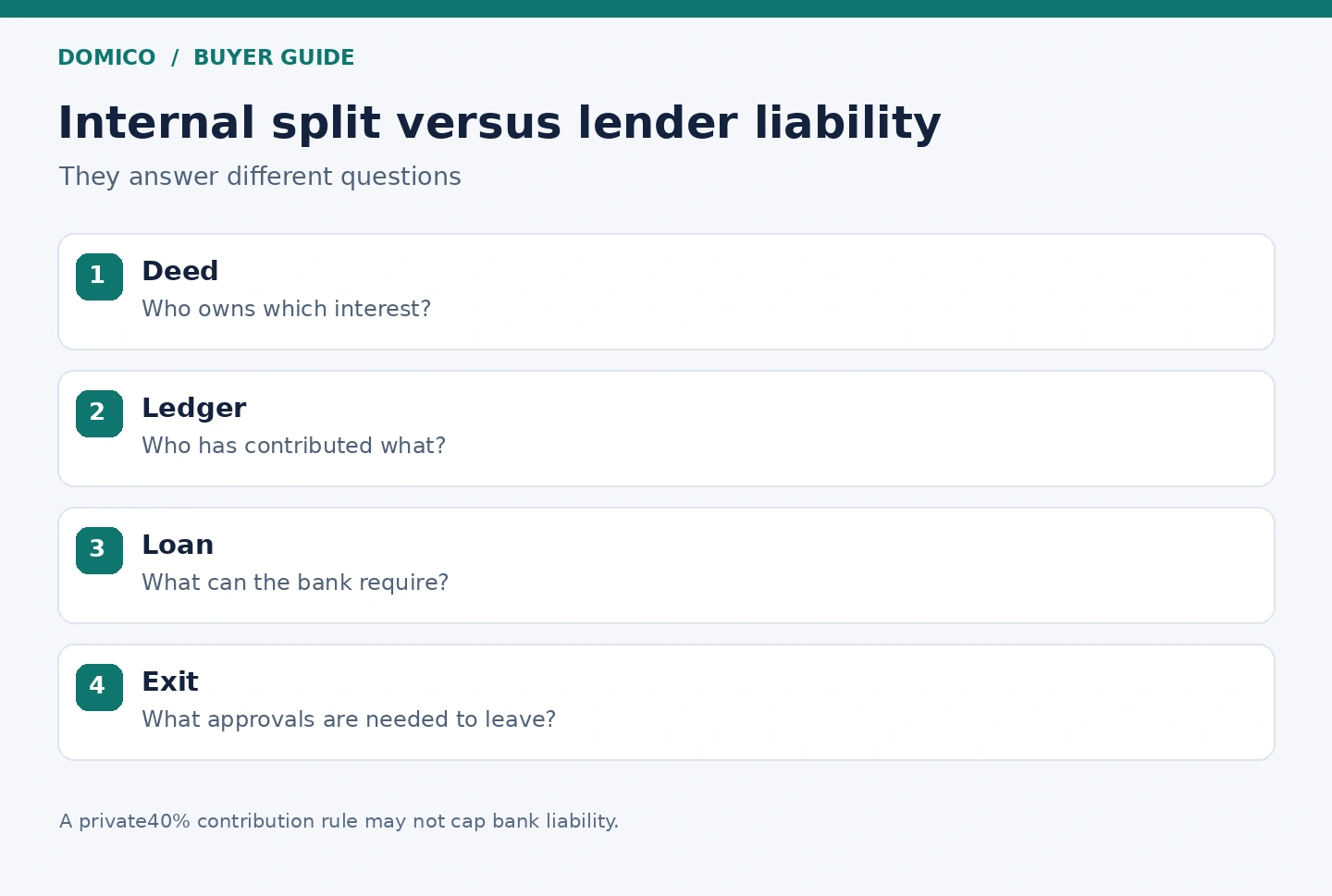
A lender's contract determines the borrowers' obligations to it. A private understanding that one friend pays 40% may not limit the lender to recovering only that share from that person.
Ask the bank to explain each borrower's liability and the permitted relationship between applicants. Not every lender accepts friends or every combination of siblings as joint applicants. Obtain a written eligibility position before assuming pooled incomes will be accepted.
If one purchaser is not contributing income but will be an owner, tell the bank. The ownership and mortgage structure must be acceptable to the lender. Do not add or omit a person's name merely to fit an online eligibility estimate.
Reconcile the initial contributions
Prepare a closing contribution statement. Include the token, own contribution, stamp duty, registration, professional charges and any immediate fit-out. Identify which payments are treated as ownership funding, a loan between co-buyers or an expense shared in another ratio.
For illustration, two buyers acquire a Rs 60 lakh home with a Rs 40 lakh bank loan. Buyer A contributes Rs 12 lakh and Buyer B contributes Rs 8 lakh to the price. They intend 60:40 ownership and must also decide how the debt and other purchase expenses are allocated.
| Hypothetical price funding | Buyer A | Buyer B | Combined |
|---|---|---|---|
| Own contribution to price | Rs 12 lakh | Rs 8 lakh | Rs 20 lakh |
| Agreed internal share of Rs 40 lakh debt | Rs 24 lakh | Rs 16 lakh | Rs 40 lakh |
| Total internal economic allocation | Rs 36 lakh | Rs 24 lakh | Rs 60 lakh |
This is an internal example, not a statement that the bank limits liability in the same proportions. Nor does it determine tax deductions. The deed, loan contract and actual payments need their own review.
Decide what happens when contributions change
Suppose Buyer A pays both EMIs for six months while Buyer B has an income interruption. Is A making a recoverable advance, contributing extra equity or helping without expecting repayment? Those alternatives have different consequences.
Agree on the process before it happens. Keep a ledger, state whether an amount earns interest and specify when it is repaid. Do not automatically alter ownership percentages after every uneven payment unless the legally documented arrangement supports that approach.
Set a review date for prolonged defaults. A clear escalation process might begin with discussion, then a written repayment plan, and finally an agreed buyout or sale mechanism. Your lawyer should frame enforceable terms rather than relying on a verbal threat to remove a name.
Set rules for everyday use
For a shared residence, discuss rooms, guests, parking, pets, home-office use and privacy. For a property occupied by one owner, consider utility payments, upkeep and whether any occupation charge is appropriate.
For a rental investment, decide who selects tenants, signs agreements, collects rent and approves repairs. Both owners should have access to the relevant records. Rental income should not disappear into one person's account without reconciliation.
Distinguish routine expenses from major improvements. Replacing a broken tap and renovating the entire kitchen should not require the same approval process. Set practical thresholds so that the home can be managed without constant disagreement.
Build a workable exit method
An exit clause should identify how an owner can express an intention to sell, whether the other owner has a first opportunity to buy, how value is determined and what deadlines apply.
Avoid an indefinite right of first refusal that traps everyone in negotiation. A valuation method might use an agreed independent valuer or a defined process for resolving differing valuations. The appropriate mechanism depends on the property and legal advice.
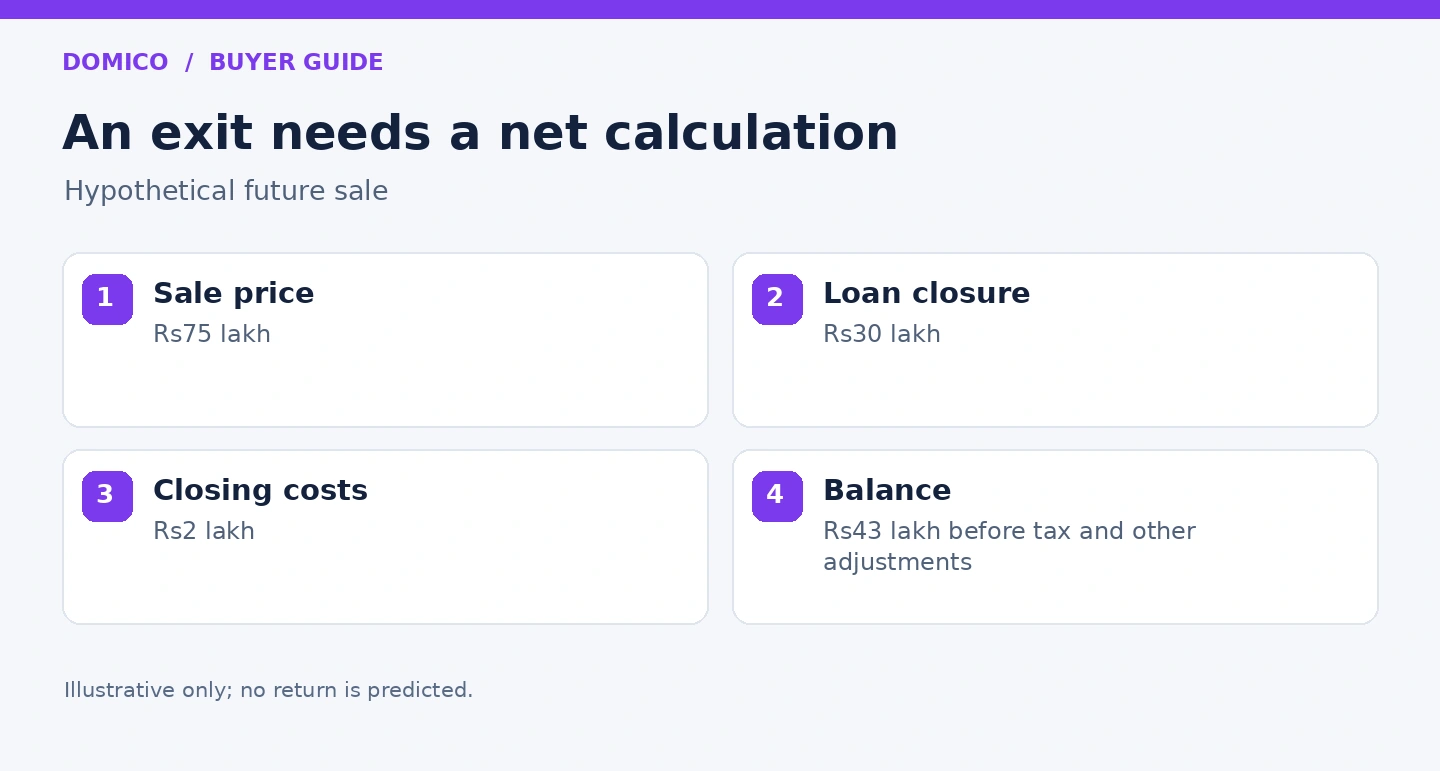
Account for the outstanding loan, selling costs and agreed balances between owners before distributing proceeds. A gross sale price is not the amount available to divide.
| Illustrative exit calculation | Amount |
|---|---|
| Gross future sale price | Rs 75 lakh |
| Loan closure amount | Rs 30 lakh |
| Selling and agreed closing costs | Rs 2 lakh |
| Balance before tax and inter-owner adjustments | Rs 43 lakh |
If ownership is 60:40, an initial split of that Rs 43 lakh would be Rs 25.8 lakh and Rs 17.2 lakh before the separate tax and internal adjustments. These are hypothetical numbers, not a return forecast.
Do not assume the loan name can simply be removed
A co-owner buyout may require lender approval, a refinance or a revised loan arrangement, as well as the proper transfer instrument and applicable taxes or charges. Paying the departing owner does not by itself remove their bank liability.
Ask the lender what would be required if one person wants to leave. Knowing the answer before purchase can reveal that a planned future exit is harder than expected.
If the home cannot be refinanced by the remaining buyer, the practical solution may be an open-market sale rather than a private promise that the departing borrower will be protected.
Plan for death, incapacity and succession
Do not assume a co-owner automatically inherits the other's share. Succession depends on the applicable law, title structure and valid estate planning.
Discuss wills, insurance and nomination with appropriate advisers. A nomination used for administrative purposes should not be casually treated as a complete replacement for succession analysis.
Make sure family members can locate the deed, loan details, co-ownership agreement and contribution ledger. The arrangement should be understandable even if one original participant cannot explain it later.
Printable buyer worksheet
Download the topic-specific review checklist. Use it to record evidence, unanswered questions and follow-up actions for the exact property.
Frequently asked questions
Can friends buy a home together?
A joint acquisition may be possible, but ownership structure and lender acceptance require separate review. Check your proposed borrower combination with the bank before committing to the purchase.
Must co-owners have equal shares?
Do not assume equality is mandatory. The intended arrangement should be lawfully documented and aligned with contribution evidence. Ask your lawyer to record the actual position clearly.
Can one owner sell the whole property alone?
A person cannot assume authority to transfer another owner's interest. Selling a share and selling the whole property involve different legal questions, restrictions and practical consequences.
Does an internal EMI split protect me from the bank?
The bank is governed by its loan contract, not merely your private contribution agreement. Ask for a plain-language explanation of each borrower's liability before signing.
Should we make a written agreement even within a family?
Yes, a professionally prepared record can clarify expectations and protect the relationship. It should address money, occupation, management and exit while remaining consistent with the deed and loan.
Make the partnership understandable
Before booking, prepare a shared decision sheet covering purpose, ownership, contributions, bank liability, use, management and exit. A property partnership should still make sense when life changes—not only on the day the keys arrive.
Sources and related reading
- buyer-guide-100
- homebuyers
- co-buying-property
- indore
Planning to buy or rent in Indore? Browse verified properties in Indore or read more Indore guides.



