Buying Guide
Buying Below Stamp Duty Value: Buyer Tax Questions
Learn how a genuine below-guideline property price can affect buyer tax, valuation tolerance, agreement dates, TDS and the complete purchase budget.
Updated 8 min read

Buying Guide
Learn how a genuine below-guideline property price can affect buyer tax, valuation tolerance, agreement dates, TDS and the complete purchase budget.
A genuine bargain can still need a separate tax calculation.
You negotiate a property below its official stamp duty value and feel that you have secured an excellent deal. That may be true commercially. But the difference between the genuine price and statutory value can create tax questions for the buyer as well as the seller.
The important distinction is between honestly buying at a discount and understating the actual price. One requires proper analysis and evidence. The other can create legal and financial problems that a lower number in the deed does not remove. This guide deals with a genuine transaction and the checks to complete before signing.
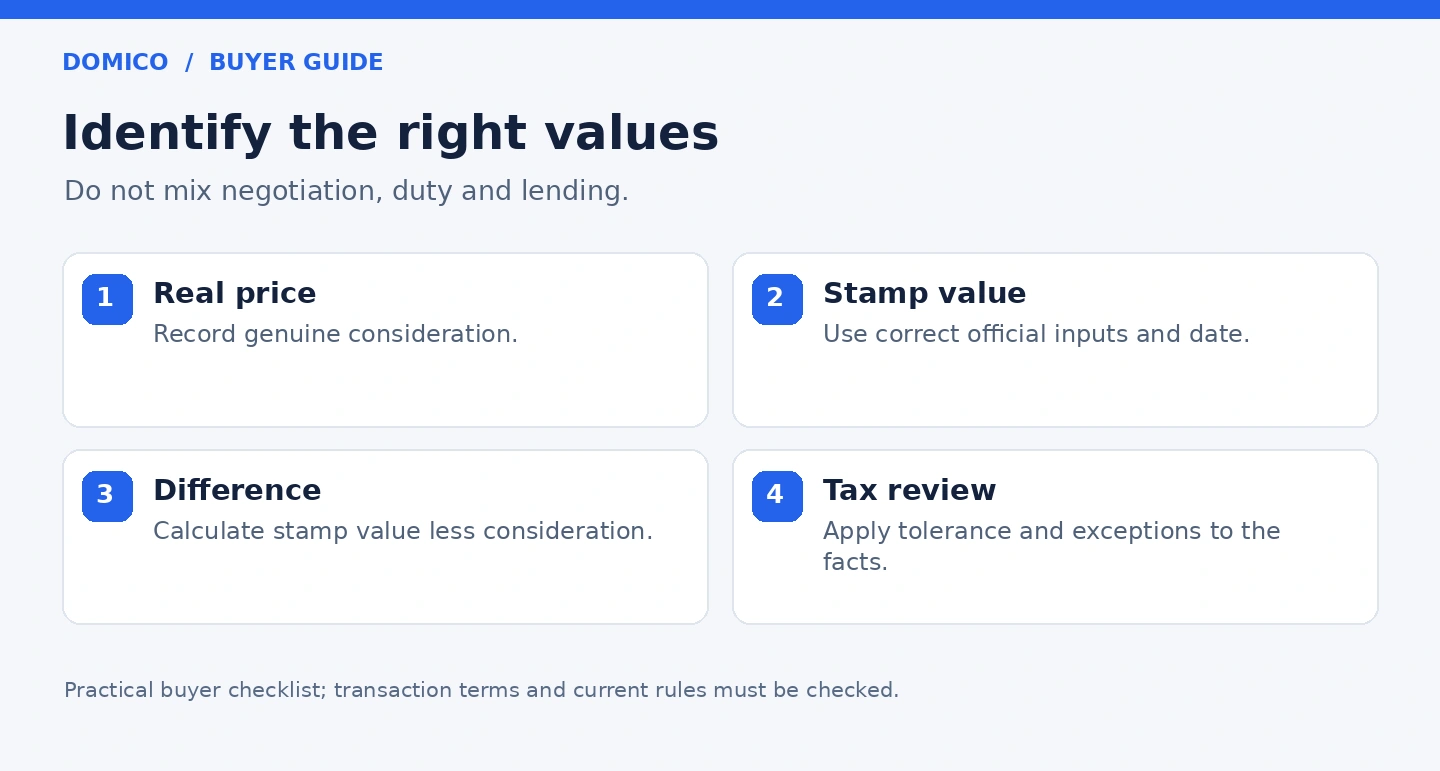
The consideration is the real amount paid or payable for the transfer. Stamp duty value is the value adopted, assessed or assessable for duty purposes under the relevant law. Bank valuation serves another purpose and should not be substituted for either number.
For an Indore property, obtain the official valuation for the correct location, property type, area and deed. An error in the input can produce a misleading comparison. A commercial-use assumption applied to a different category, or an incorrect area, deserves correction through the proper process.
| Number | What it represents | What to verify |
|---|---|---|
| Genuine consideration | Real transaction amount | Agreement, deed and complete payment trail |
| Stamp duty value | Statutory valuation for duty | Correct official inputs and applicable date |
| Asking price | Seller’s initial expectation | It may differ from actual consideration |
| Bank value | Lending assessment | It does not determine the buyer’s tax by itself |
Do not use a broker's rough percentage as the final duty value. Keep the official calculation and supporting property details so your tax adviser can work with the same facts as the registration professional.
For tax years under the Income-tax Act, 2025, section 92 contains the relevant buyer-side rule for specified property received for inadequate consideration. In a qualifying case, the excess of stamp duty value over consideration can become income from other sources when it exceeds the higher of ₹50,000 and 10% of the consideration, subject to statutory exceptions and conditions.
This means the first calculation is the difference, and the next is the applicable tolerance. Do not assume that every ₹1 difference is taxable, or that only the amount exceeding the tolerance becomes income. Have the actual provision applied to your facts.
Older articles commonly refer to section 56(2)(x) of the 1961 Act. That reference can remain relevant for earlier periods, but a transaction in a tax year beginning from April 2026 should be reviewed under the current law and transition rules.
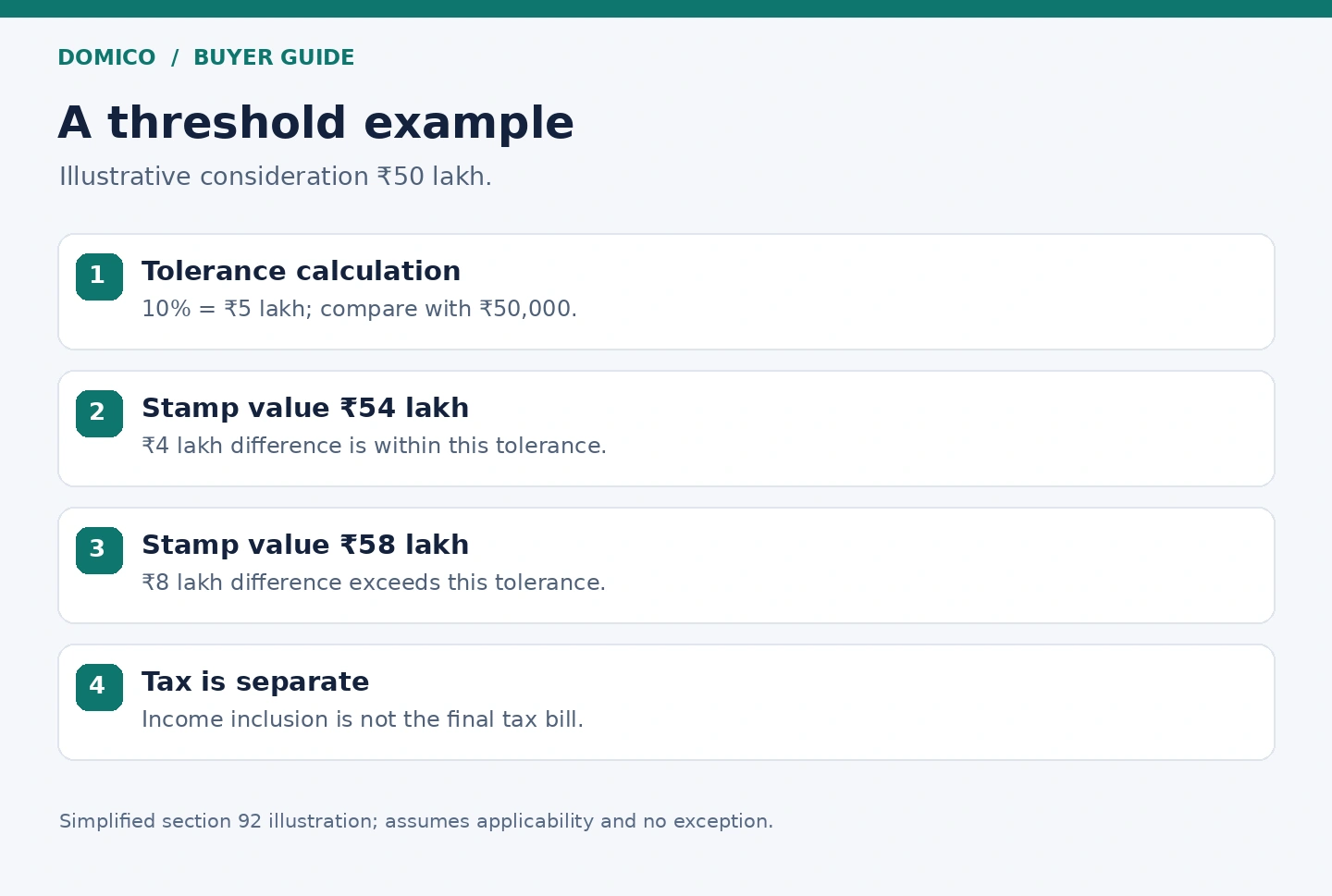
Assume a straightforward eligible purchase with no applicable exception. In Example A, consideration is ₹50 lakh and stamp duty value is ₹54 lakh. The difference is ₹4 lakh. Ten per cent of consideration is ₹5 lakh, so the difference does not exceed the higher tolerance in this simplified example.
In Example B, consideration is ₹50 lakh and stamp duty value is ₹58 lakh. The difference is ₹8 lakh, which exceeds ₹5 lakh. Subject to the actual facts and law, the buyer-side inclusion can concern the ₹8 lakh difference, not merely the ₹3 lakh above the tolerance.
| Illustration | Consideration | Stamp value | Difference | Higher of ₹50,000 or 10% of consideration |
|---|---|---|---|---|
| A | ₹50 lakh | ₹54 lakh | ₹4 lakh | ₹5 lakh |
| B | ₹50 lakh | ₹58 lakh | ₹8 lakh | ₹5 lakh |
| C | ₹20 lakh | ₹23 lakh | ₹3 lakh | ₹2 lakh |
These are threshold illustrations, not personalised tax computations. An income inclusion is not the same as tax payable. The eventual liability depends on the taxpayer's full position, applicable rates and other provisions. Do not quote the difference itself as the amount of tax due.
A deal may be agreed months before registration, during which guideline values change. The current provision addresses use of the agreement-date stamp value where its conditions are met, including the required payment in a specified banking or online mode on or before that agreement date.
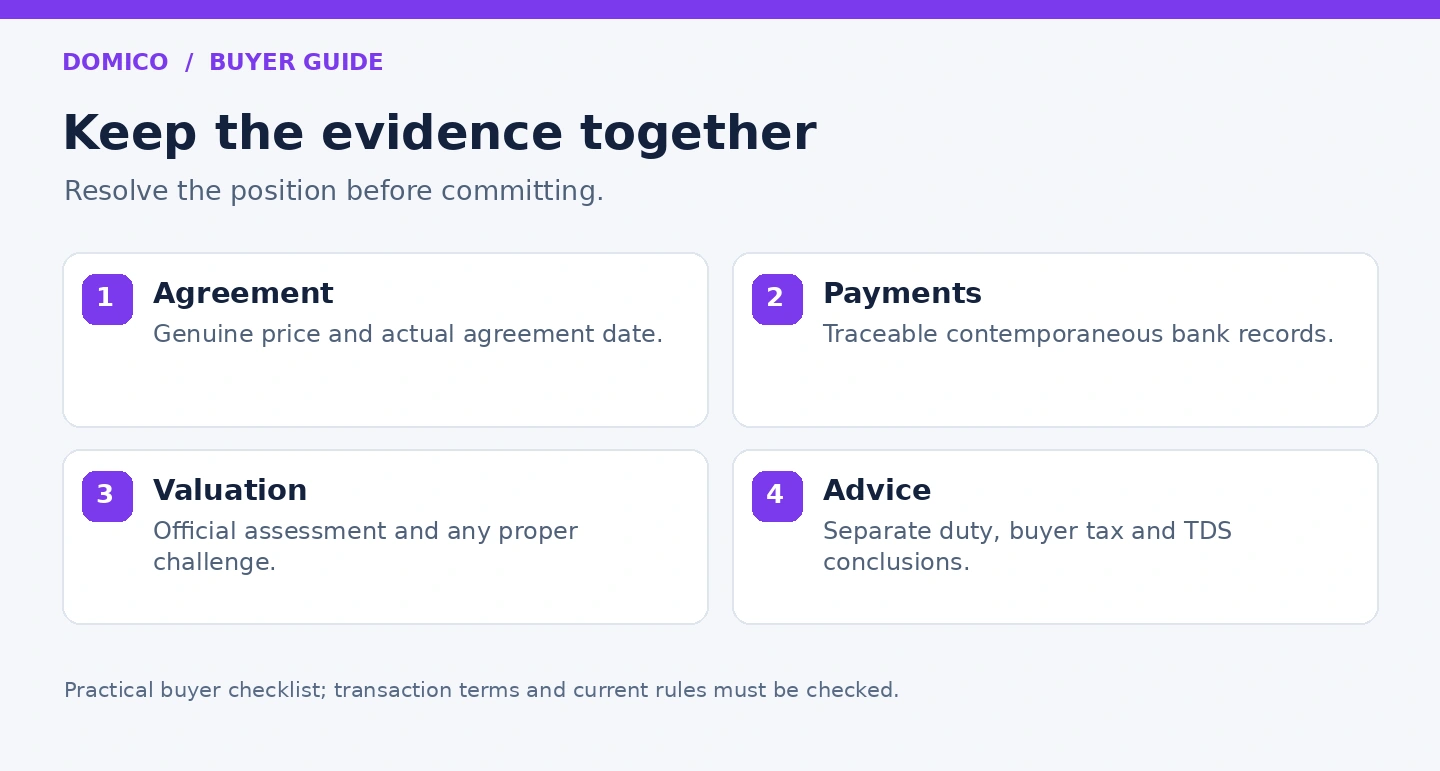
Keep the genuine dated agreement, bank trail and property description. A later statement claiming that the price was agreed earlier is not a substitute for contemporaneous evidence. Do not backdate documents or create a payment history that did not occur.
Ask the tax adviser to record which date is used and why. Registration and income-tax analysis may involve connected but distinct rules. A favourable treatment under one provision should not be assumed to settle every other calculation.
A discount can reflect a seller's need for liquidity, a property's condition, a difficult access road, a tenant, a lease restriction or unresolved documents. Some reasons are manageable; others may make the property unsuitable regardless of the tax outcome.
Inspect the property and obtain independent title and technical advice. Ask whether you can obtain vacant possession, finance the asset and sell it later. A low price caused by a genuine defect is not automatically a bargain once repair, delay and resale costs are included.
Document the commercial basis of the agreed price: inspection reports, repair quotations, correspondence and relevant comparables. Such evidence does not automatically override statutory valuation, but it helps professionals understand the facts and any proper challenge.
The law provides a valuation-reference mechanism in specified circumstances. Ask a qualified adviser whether your situation qualifies and what procedure and time limits apply. Do not assume that a private valuer's report automatically replaces the statutory figure in a return.
Likewise, do not unilaterally reduce a duty payment because the market has softened. Use the applicable state process and retain the resulting order or valuation record. A properly documented challenge is different from simply choosing the lower figure you prefer.
If the purchase is not yet committed, price the potential tax and professional cost into your decision. You may still proceed, renegotiate or choose another property. Make that decision with the complete cost visible.
A seller may have a different deemed-value calculation for capital gains or business income. Your purchase-side TDS obligation also has its own conditions. Paying stamp duty on the official value does not necessarily remove income-tax consequences arising from the price difference.
Prepare one transaction fact sheet, but ask for separate conclusions for each liability. This avoids a common misunderstanding: someone says the registry office has accepted the document, so all tax questions must be finished. Registration does not perform the buyer's complete income-tax computation.
| Issue | Who should examine it? | Output to retain |
|---|---|---|
| Duty assessment | Registration professional and relevant authority | Official calculation or order |
| Buyer income inclusion | Tax professional | Written computation and relevant exception analysis |
| Seller tax position | Seller’s adviser | Seller’s own compliance plan |
| Purchase TDS | Buyer’s tax professional | Deduction and filing worksheet |
| Actual payment trail | Buyer and seller | Reconciled receipts and bank records |
If a seller asks for an unrecorded cash component, the transaction is no longer the genuine below-value purchase described in the initial example. Your real outflow and the deed would disagree, making proof, financing and tax compliance more difficult.
Do not confuse paying a lower duty value with negotiating a lower actual price. Insist that the records reflect the real arrangement and use proper payment channels. A receipt or private promise does not make an unlawful cash structure safe.
Ask the seller to state the commercial terms clearly in the agreement and correspondence. If the price reflects repairs, obtain an inspection and actual quotations. If the transaction includes an occupied property, record the possession arrangement. These facts help you assess whether the apparent saving survives the costs you will inherit.
Separate evidence of a discount from evidence supporting a statutory valuation challenge. A repair estimate explains a commercial concern, but does not automatically change the official value or satisfy every tax procedure. Your adviser should identify which evidence is relevant to each question.
Before committing, prepare a second budget that includes the potential tax outcome under professional review. Compare that with a similarly usable alternative property. A negotiated saving can remain worthwhile, but it should be measured after foreseeable costs rather than announced as the gap between two headline values.
Keep the actual payment trail consistent with the explanation. A genuine discount should reduce real consideration; it should not be used to disguise an additional amount paid outside the documents.
Download the topic-specific review checklist. Use it to record evidence, unanswered questions and follow-up actions for the exact property.
A genuine transaction can have a price below statutory value, but the applicable duty and tax consequences must be examined. The discount itself is not a reason to ignore the relevant provisions.
The buyer-side rule discussed here concerns the specified difference in a qualifying inadequate-consideration case. It is not a general rule taxing the whole purchase price as income. Obtain the actual computation.
No. A valuation tolerance is not permission to understate consideration or make unrecorded payments. The agreement and payment records should state the genuine transaction.
The statute contains exceptions, including specified relative relationships, but their scope and other consequences require review. Stamp duty, documentation and the nature of the transfer remain separate questions.
Potentially, where the statutory conditions are satisfied. Preserve the real agreement and qualifying payment evidence and have the relevant date and rule verified before relying on it.
Planning to buy or rent in Indore? Browse verified properties in Indore or read more Indore guides.
Check who owes the lender, how builder-paid interest works, when support ends and whether you can carry the loan if payments stop.



