Buying Guide
Apartment Parking Rights: Documents and Practical Checks
Check apartment parking categories, allocation rights, approved plans, vehicle fit, mechanical systems and ongoing charges before buying a flat.
Updated 8 min read
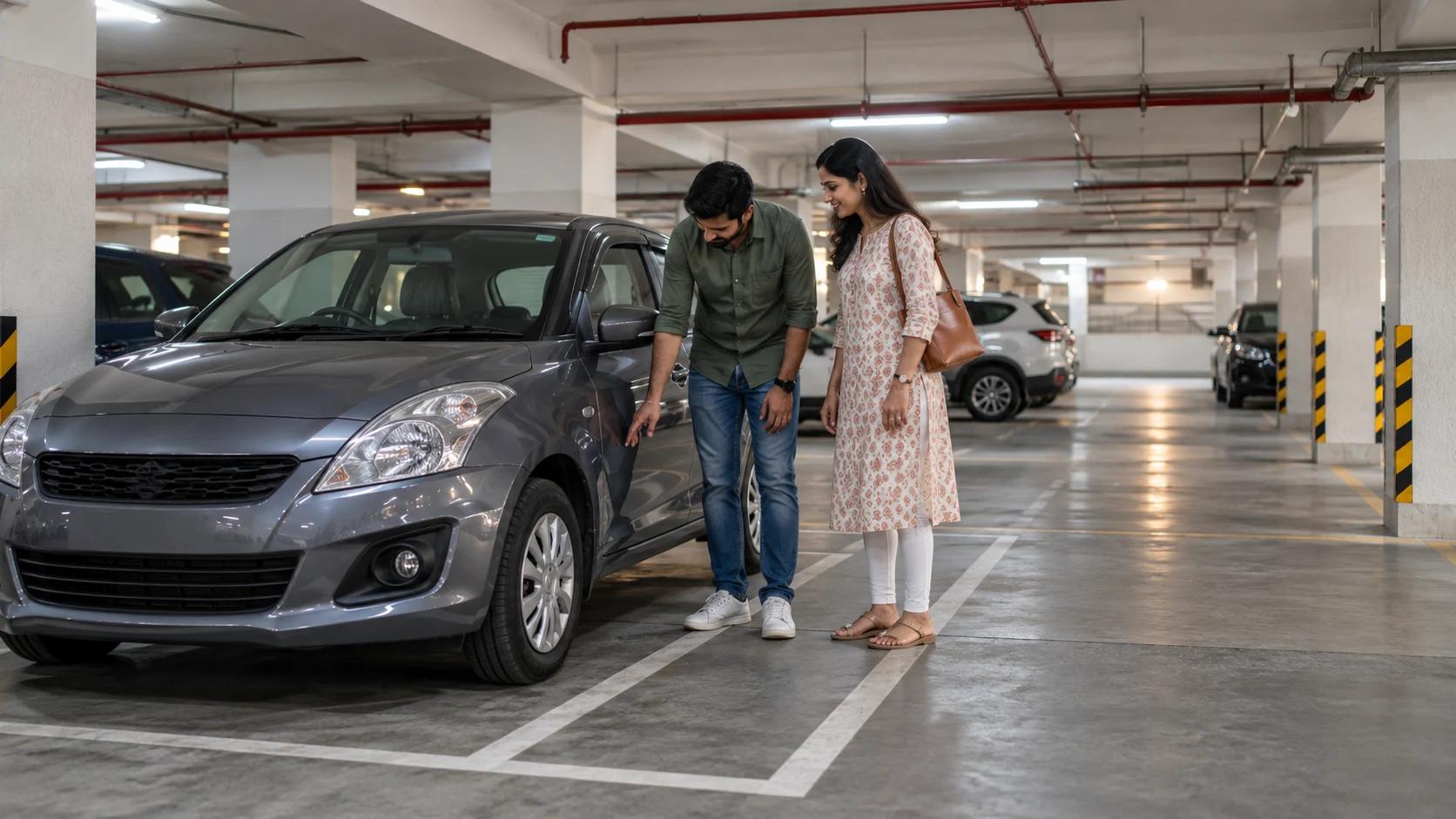
Buying Guide
Check apartment parking categories, allocation rights, approved plans, vehicle fit, mechanical systems and ongoing charges before buying a flat.
A painted number on the floor is useful. The right to use that space needs a document.
Parking can become a frustrating surprise after an otherwise successful apartment purchase. The bay may be difficult to enter, allocated to someone else, dependent on moving another vehicle or described more strongly in the sales pitch than in the agreement.
Before buying, separate three questions: what kind of parking space exists, what right is being offered, and whether your vehicle can actually use it. A receipt saying “parking” does not answer all three. This guide explains the records, measurements and practical tests that help a buyer resolve those questions.
Ask whether the space is open, stilt, basement, enclosed garage, mechanical stack or another approved arrangement. Match the description to the sanctioned parking plan and the physical location. A roof alone does not make every parking space the same legal category.
The RERA Act includes open parking within its common-area definition and separately defines a garage using a roof and walls on three sides. Have a local property lawyer apply the relevant law, documents and project facts before accepting an ownership or sale claim.
Avoid the opposite oversimplification too: a common-area classification does not by itself tell you which allocation or use arrangement applies to your flat. That needs the project documents, applicable rules and association records.
| Parking description | Practical point to verify | Documentary question |
|---|---|---|
| Open bay | Exposure, markings and access | What lawful allocation or use right is recorded? |
| Basement or stilt | Columns, turning and ventilation | Does the approved plan match the offered bay? |
| Enclosed garage | Actual enclosure and access | What precise property or right is transferred? |
| Mechanical stack | Vehicle limits and operating dependence | What use terms, costs and maintenance apply? |
| Tandem parking | One car blocks another | Who controls both spaces and daily movement? |
Ask the seller to explain whether the agreement transfers a separately recognised interest, records an exclusive-use allocation, or provides parking subject to association rules. Do not accept these descriptions as interchangeable.
For a resale flat, obtain the original parking reference, subsequent changes and confirmation from the authorised association representative. Establish whether the arrangement passes with the apartment and whether any procedure or outstanding charge applies.
If the seller says parking was purchased separately many years ago, have the documents reviewed rather than assuming the old payment makes the present claim valid. Likewise, do not assume that long informal use prevents a future dispute.
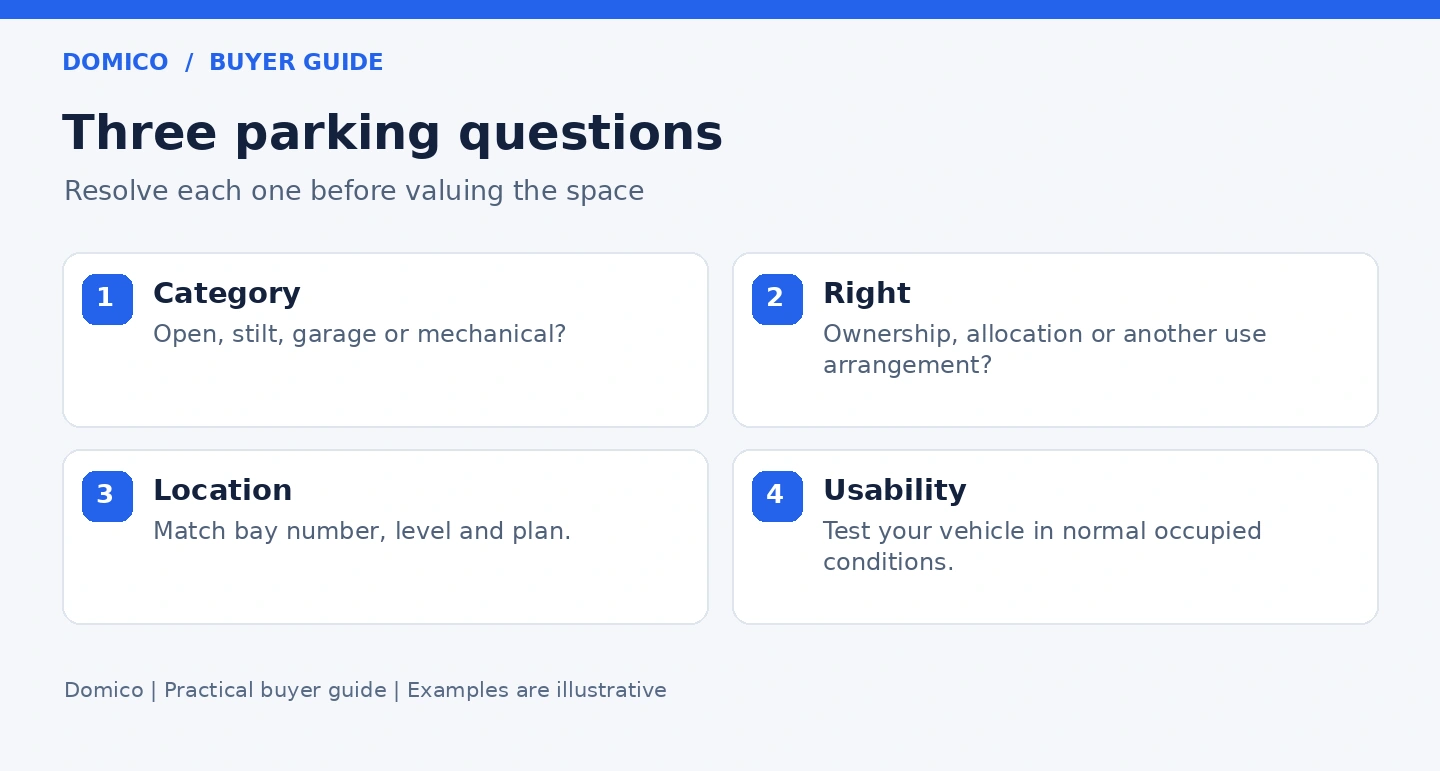
Write down the bay number, level, location and dimensions. Mark it on the approved plan and compare it with the agreement or allocation record. If numbers were changed, request the documented explanation.
Check for duplicate or conflicting allocations. Ask whether the association has a current parking register and whether the seller's space appears there. A letter issued by an unauthorised person is less useful than a record that can be traced to the governing arrangement.
If the project is under construction, ask what happens if the final bay location changes. The agreement should not leave an important practical feature dependent only on a verbal promise about a “good parking spot near the lift.”
Bring the vehicle you use, or obtain a realistic dimensional assessment if that is impossible. Drive through the gate, ramp and turning route with permission. Park without relying on empty adjacent bays that will later be occupied.
Open the doors enough for normal entry and exit. Check whether a child seat, elderly passenger or wheelchair transfer changes the space needed. A nominal bay length and width do not capture a column beside the driver's door.
For a vehicle you plan to buy, obtain the manufacturer's dimensions and ask a competent designer to assess the access route. A larger car can create a different problem even if the existing hatchback fits easily.
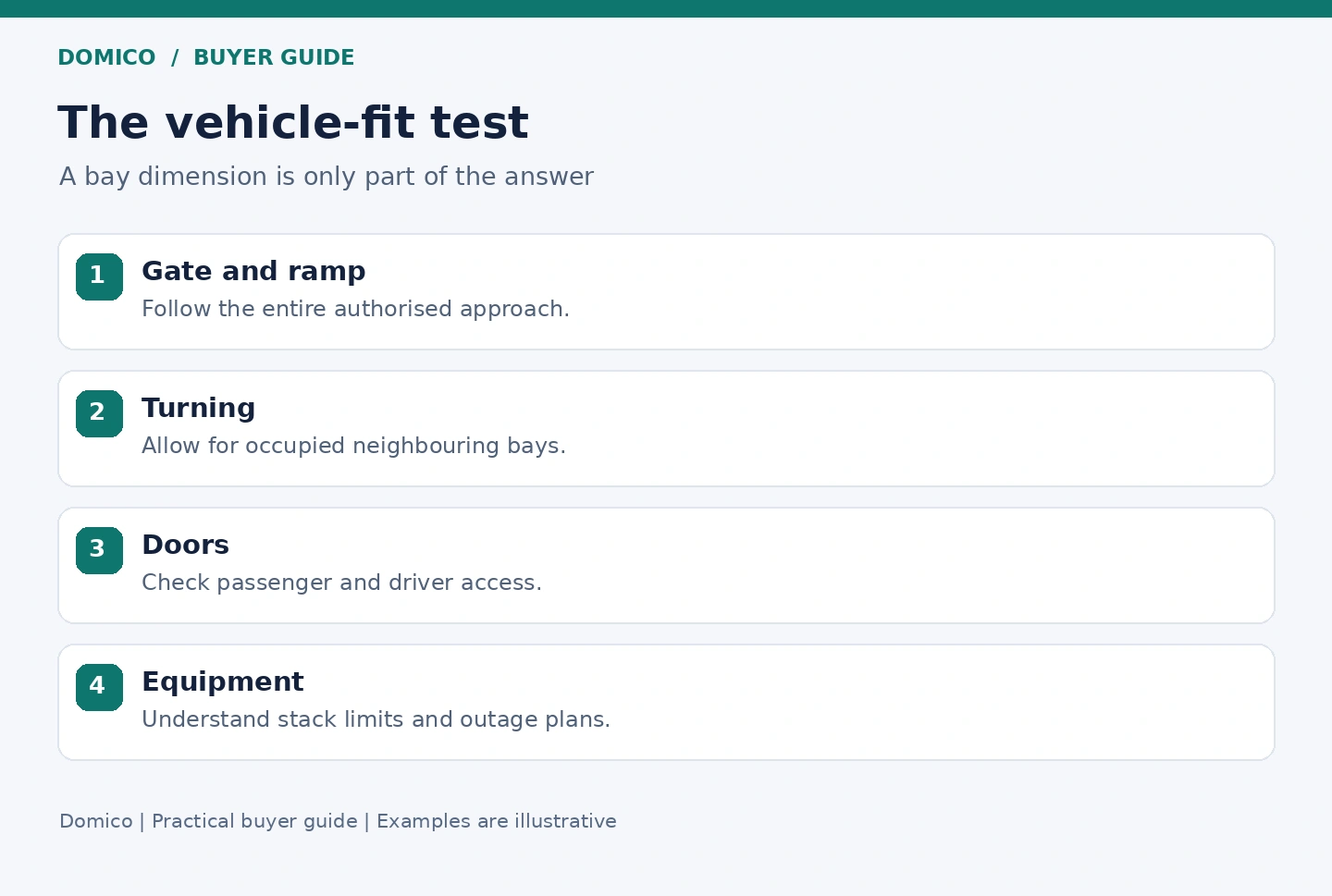
Observe the ramp gradient and transitions from the driver's perspective without making unsafe manoeuvres. Ask about scraping reports, water entry during rain and how two-way movement is managed. Check mirrors, visibility and the route pedestrians use.
Do not infer that a ramp is safe or compliant from one successful drive. Applicable dimensions and design requirements need professional review. The National Building Code overview identifies the wider design and service context, while local approved plans govern the particular project.
For basements, ask the manager about drainage, ventilation, lighting and emergency arrangements. Equipment should be checked by authorised professionals; a buyer should not test pumps, alarms or electrical panels independently.
Mechanical parking has operating and maintenance requirements. Ask for vehicle weight and size limits, instructions, availability during outages, service history and the response process when a system is unavailable. Confirm whether a trained operator is needed.
For tandem parking, understand who owns or uses the other position. If two unrelated households must coordinate every morning, the arrangement can be inconvenient even when technically workable. Do not value two tandem spaces as equivalent to two independent bays without considering use.
A stack system may also involve recurring charges beyond ordinary maintenance. Obtain the actual charging basis and warranty or service arrangements. A sales demonstration on a quiet day does not establish long-term availability.
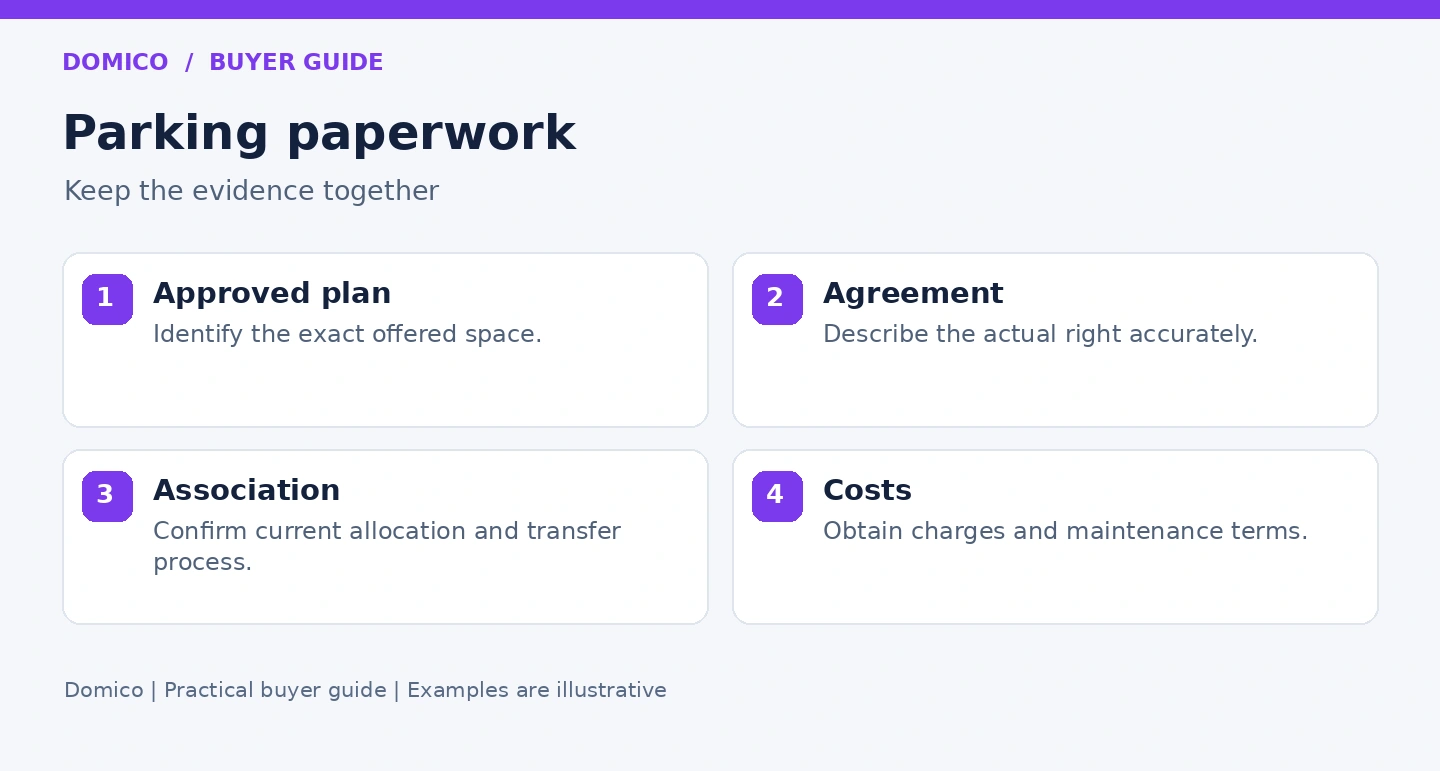
If charging matters, ask whether the proposed installation is approved, who will supply the power, how it will be metered and who will maintain the equipment. Electrical capacity, cable routes, protection and fire-safety considerations require qualified assessment.
Do not run an extension lead from the flat or use a common socket without proper authorisation and technical review. An informal practice by another resident is not a suitable installation plan.
If charging is described as a future amenity, request the documented scope and status. Decide whether the home works for you if the proposed installation takes longer than expected or offers a different charging arrangement.
Consider an illustrative buyer comparing an independent bay with a cheaper mechanical arrangement. The figures below are invented to explain how to organise the comparison, not actual parking quotations or a statement about the lawfulness of a particular charge.
| Hypothetical cost | Independent arrangement | Mechanical arrangement |
|---|---|---|
| Quoted initial amount requiring legal review | Rs 3,00,000 | Rs 2,00,000 |
| Additional annual operating charge assumed | Rs 0 | Rs 12,000 |
| Ten-year simple operating total at unchanged charge | Rs 0 | Rs 1,20,000 |
| Simple combined amount | Rs 3,00,000 | Rs 3,20,000 |
The calculation excludes finance, inflation, major repairs and the value of convenience. It does not prove that one arrangement is cheaper in a real project. Obtain lawful, documented charges and actual maintenance information before comparing prices.
| Issue to resolve | Evidence to request | Why it matters |
|---|---|---|
| Exact location | Marked approved plan and bay reference | Prevents ambiguity about what is offered |
| Nature of right | Lawyer-reviewed agreement and allocation | Separates use from ownership claims |
| Resale continuity | Association confirmation and procedure | Reduces transfer surprises |
| Usability | Actual vehicle test and measurements | Identifies columns, turns and door conflicts |
| Ongoing costs | Current bills and service terms | Makes the budget comparable |
Record unresolved points in the purchase process and obtain proper advice about conditions. Avoid completing the transaction on the assumption that the association will give you a different bay later.
For a two-car household, test both vehicles together instead of checking the spaces separately. Consider who leaves first, whether a charger cable could cross a route and where a visitor would stop briefly. Establish the applicable visitor-parking rules too. A convenient informal habit during low occupancy can become impossible when every home is occupied.
Do not rely on a blanket sales claim. RERA treats open parking as common area, and the applicable legal framework and project documents need review. Get a lawyer's assessment of the exact right and charge proposed.
Not by itself. Review the agreement, approved layout, governing rules and allocation history. The payment description may not establish the nature of the legal interest.
That depends on the association's valid arrangements and required approvals. Do not assume a private swap will be recognised unless the correct process is completed and documented.
Treat that as a practical problem. Test normal occupied conditions and obtain a design assessment where needed. Future neighbours are entitled to use their own spaces under the relevant arrangement.
If parking is important to the purchase, identify and investigate it early. Have the contract clearly reflect what is being offered and what conditions apply before committing larger amounts.
A parking space should work on paper and on a busy evening. Verify both before assigning it value.
Download the topic-specific review checklist. Use it to record evidence, unanswered questions and follow-up actions for the exact property.
Planning to buy or rent in Indore? Browse verified properties in Indore or read more Indore guides.
Check who owes the lender, how builder-paid interest works, when support ends and whether you can carry the loan if payments stop.



