Buying Guide
Undivided Share of Land in a Flat: Buyer Guide
Understand apartment land share, common-property rights, allocation documents and phase boundaries before buying a new or resale flat.

Table of contents
Your apartment sits on land. The paperwork should explain your connection to it.
A flat buyer usually measures rooms, checks a balcony and asks about parking. The underlying land often receives less attention. Yet an apartment's long-term ownership position depends on more than the four walls of the unit.
The phrase undivided share, or UDS, commonly describes an owner's proportionate interest in the land associated with an apartment development. The exact arrangement and terminology depend on the applicable state law, the project's legal structure and the registered documents. Some projects involve an apartment ownership framework; others use a cooperative or another permitted structure.
The practical question is straightforward: what rights in the land and common property accompany this apartment, and where are they recorded?
What “undivided” means
An undivided interest is not usually an individually fenced piece of the site that you can point to and sell independently. It describes a proportionate interest held with others under the relevant ownership arrangement.
If the papers say your share corresponds to a certain area or percentage, do not assume that a corner of the garden becomes your personal plot. The physical use of common land is governed by the approved plans, legal documents and applicable rules.
The RERA Act addresses common areas and transfer of title, including proportionate rights through the relevant association or competent authority. Local law and the actual conveyance determine how those principles operate in a particular development. Ask your lawyer to explain the structure rather than applying a formula found online.
Separate three kinds of area
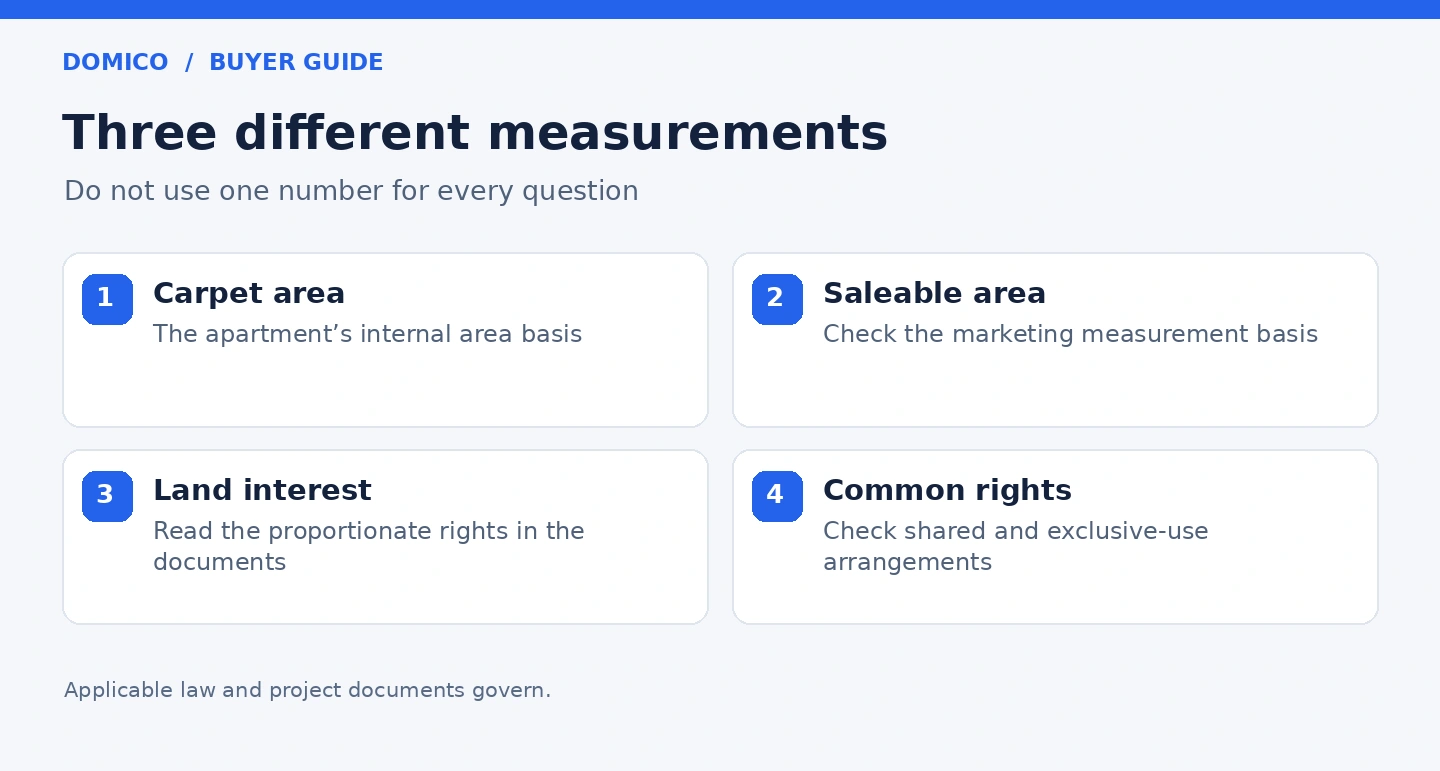
Carpet area, saleable or super built-up descriptions, and land share answer different questions. Carpet area helps describe the usable internal apartment area under the applicable definition. A marketing area may include additional components. UDS concerns the land interest associated with the unit.
| Term | Main question it answers | What it should not be mistaken for |
|---|---|---|
| Apartment carpet area | How is the unit's internal area measured? | A measure of its land rights |
| Marketing or saleable area | What area basis is used in the sales description? | Automatic proof of approved space |
| Undivided land interest | What proportionate land interest accompanies the unit? | A separately demarcated personal plot |
| Common-area rights | What facilities and shared property serve owners? | Exclusive ownership of every facility |
A larger advertised saleable area does not automatically establish a larger land share. Verify the allocation in the governing documents. Domico's area measurement guide explains the apartment-area side of this comparison.
Find the documents that explain the arrangement
Start with the land title, approved project or phase plan, draft apartment conveyance and relevant declaration or association documents. The seller should identify the exact land parcel or phase to which the unit belongs.
For a resale flat, obtain the previous conveyance and any supplemental instruments. Check whether the land description and percentage have been carried consistently through later transfers. A photocopied builder brochure is not a replacement for the registered record.
Ask who holds title to the land at present and what has been conveyed to owners or their association. If a developer and landowner are separate parties, examine how the development rights and conveyance obligations connect. A building can look complete while the title-transfer paperwork remains unfinished.
Check the denominator, not just the share
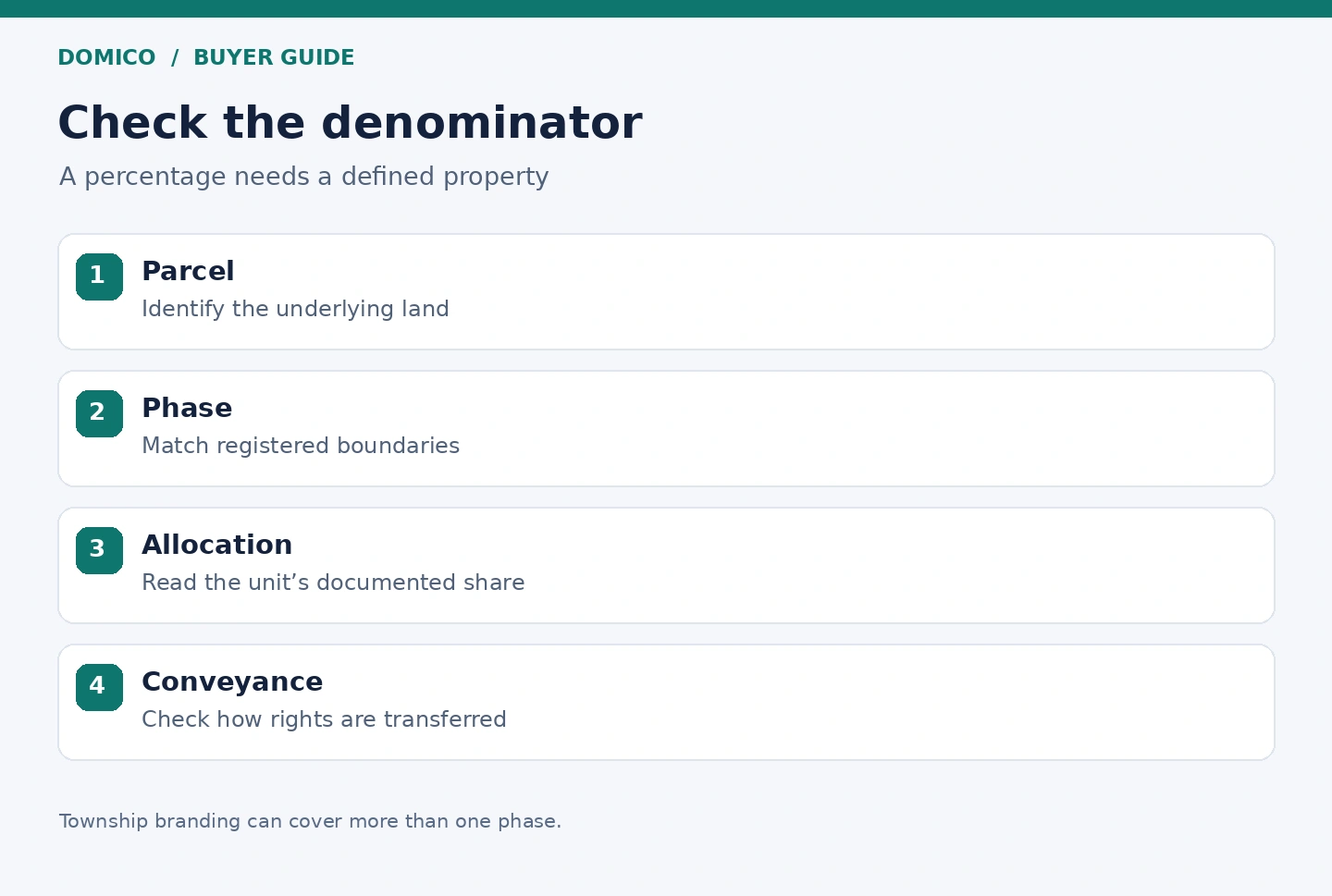
A percentage is meaningful only when you know what it is a percentage of. Is it linked to the entire township, one registered phase, one parcel or another legally defined property? Does the description include future phases that are not part of your conveyance?
This matters in phased developments. A project marketing name can cover a larger area than the registered phase connected with your unit. Ask for a plan showing the relevant boundaries, access and facilities. Check any rights over roads or amenities outside the phase.
Also ask how commercial premises, additional towers or permitted future development are handled. You do not need to become a surveyor. You do need a written explanation of what the denominator includes and whether it matches the governing documents.
Understand the allocation method before calculating
There is no universal rule that every apartment must receive an equal land share or a share based solely on carpet area. Applicable law and the project's valid documentation govern the allocation.
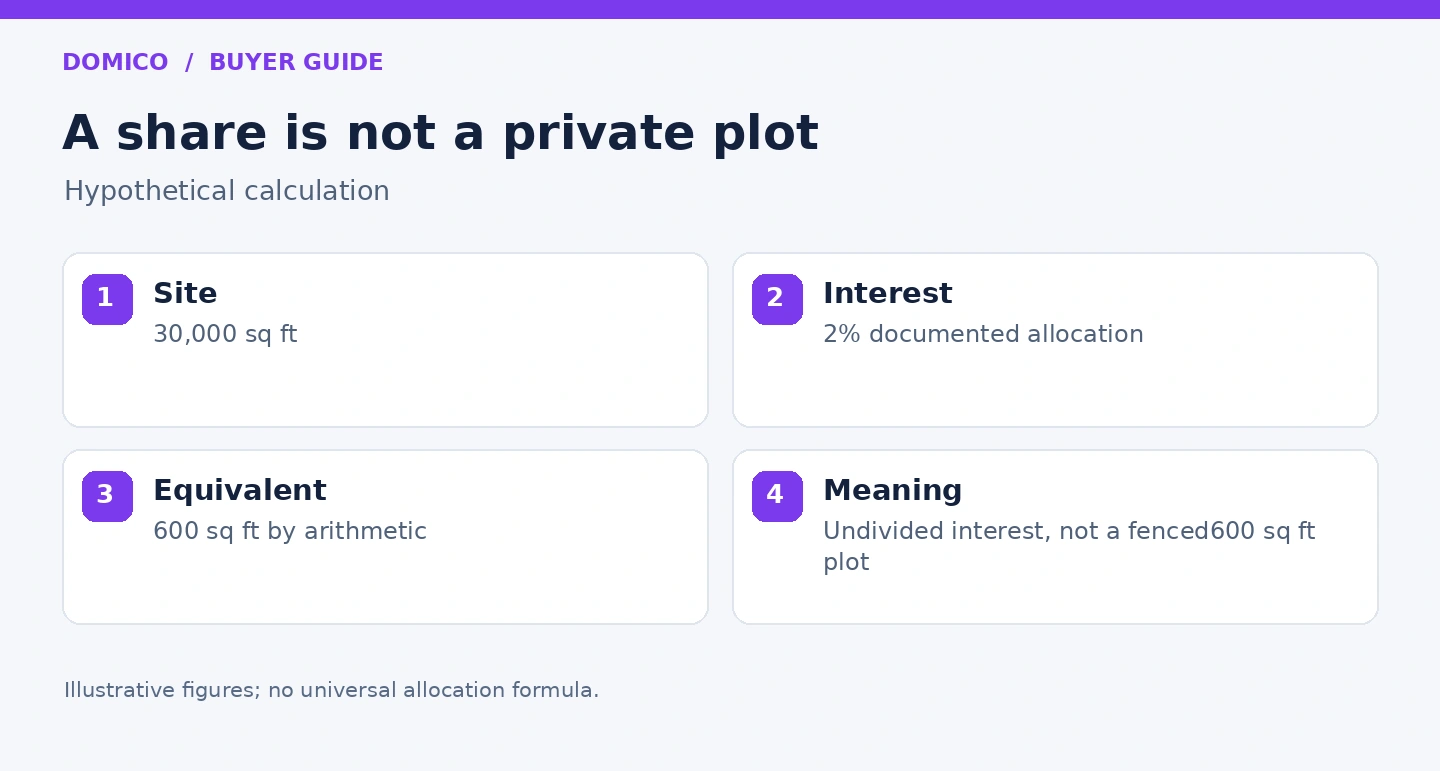
Here is a purely illustrative calculation: suppose a legally defined site has 30,000 square feet of land and the relevant documents allocate a unit a 2% undivided interest. Multiplying 30,000 by 2% gives 600 square feet as an area equivalent. That does not create a 600-square-foot private plot.
| Hypothetical allocation | Calculation |
|---|---|
| Relevant site area | 30,000 sq ft |
| Documented unit percentage | 2% |
| Area equivalent | 30,000 × 0.02 = 600 sq ft |
| Physical meaning | A shared interest under the documents, not a marked personal plot |
Use arithmetic to check consistency, not to invent a legal entitlement. If an agreement gives only an unexplained number, ask the professional reviewing the title to identify its basis.
Ask about the total allocation
If a project provides a unit-wise allocation schedule, have the relevant professional check that the figures are internally consistent and connect to the applicable parcel. Watch for unexplained differences between the schedule, declaration and individual deed.
A buyer need not demand other owners' private financial records. The objective is to understand the allocation framework and verify the proposed unit's position within it. Where a developer cannot explain the basis, seek clarification before signing rather than expecting registration alone to fix the gap.
Keep written responses with the purchase file. If the answer changes during negotiation, ask for the corrected draft instrument rather than retaining two conflicting explanations.
Why land share matters over a long holding period
Land rights can become particularly important when a building requires major rebuilding or redevelopment. They form part of a wider legal and commercial discussion that can also involve structural condition, approvals, owner consent, financing and development potential.
A larger percentage should not be marketed as a guaranteed redevelopment payout. Future outcomes depend on the legal structure, the project and the law at that time. Equally, an attractive new flat should not distract you from unresolved rights in the underlying land.
Think of land-share diligence as understanding what you are acquiring for the full holding period. It belongs alongside construction quality and location, rather than replacing them.
Shared ownership does not remove shared costs
Common property requires management, repairs and funding. The way maintenance or major works are allocated may follow the relevant law, declaration, valid bylaws and decisions. It is not safe to assume every payment must equal the UDS percentage.
Ask for the current maintenance basis and major-work contribution policy. Check whether there are pending disputes about common land, terraces, parking or access. These disputes may affect daily use even when your unit description is clear.
| Issue to clarify | Useful evidence |
|---|---|
| Relevant land parcel | Title schedule and approved phase plan |
| Unit's proportionate interest | Conveyance, declaration or allocation schedule |
| Common-property conveyance | Registered instrument and association records |
| Exclusive-use claims | Approved plan and enforceable supporting documents |
| Shared expenses | Bylaws, budgets and valid contribution decisions |
Resale checks buyers should not skip
Compare the seller's unit number, floor, area and land-interest description across the registered deed and association records. If a former owner changed the apartment number informally, obtain a documented reconciliation.
Check that any claimed exclusive terrace, garden or parking right is supported by the legal arrangement and approved plan. An area can be accessible only from one apartment without automatically becoming separately owned land.
Ask whether the association has received the common documents and whether there is pending litigation or unresolved developer handover. A functioning residents' group and completed title conveyance are different matters.
Printable buyer worksheet
Download the topic-specific review checklist. Use it to record evidence, unanswered questions and follow-up actions for the exact property.
Frequently asked questions
Can I sell my undivided land share separately from the flat?
Do not assume that you can. Apartment and common-property interests are generally tied together within the applicable legal structure. Have the governing law and conveyance reviewed before proposing a separate transfer.
Does every project use the same UDS formula?
No universal area-based formula should be assumed. The state framework, declaration, project structure and valid documents need to be checked. An online calculator can only perform arithmetic on the figures supplied to it.
Is a flat with more UDS automatically a better investment?
A percentage alone cannot decide value. Compare the relevant land parcel, legal rights, building condition, location, restrictions and costs. A high share of a problematic parcel is not automatically more attractive.
What if UDS is missing from the draft deed?
Ask your lawyer how the applicable structure records land and common-property rights and whether the draft adequately conveys the intended interest. Resolve the issue before signing rather than inserting an unsupported number yourself.
Does owning UDS give me the right to build on common land?
It does not by itself authorise private construction. Approved use, shared rights, governing documents and applicable permissions remain relevant. Obtain professional guidance before treating common land as an expansion opportunity.
A better question for your next meeting
Ask the seller: “Please show the land parcel, my unit's proportionate rights and the registered documents connecting the two.” A clear answer is more useful than a promise that land value will always rise.
Sources and related reading
- buyer-guide-100
- homebuyers
- apartment-land-share
- indore
Planning to buy or rent in Indore? Browse verified properties in Indore or read more Indore guides.