Buying Guide
Are Premium Apartment Amenities Worth the Price?
Evaluate apartment amenities through actual household use, access rights, capacity, maintenance, recurring charges and practical alternatives.
Updated 8 min read

Buying Guide
Evaluate apartment amenities through actual household use, access rights, capacity, maintenance, recurring charges and practical alternatives.
The best amenity is the one you use. The most expensive is the one you keep paying for and rarely enter.
A swimming pool, gym, clubhouse and landscaped court can make apartment living enjoyable. They can also influence the purchase price and create recurring costs. The buyer's challenge is to distinguish useful convenience from an impressive list that adds little to the family's actual routine.
This does not mean rejecting premium amenities. It means evaluating them as services with access conditions, capacity and maintenance needs. A practical usage-and-cost comparison helps you decide what is worth paying for before the model apartment and weekend event create unrealistic expectations.
List the facilities each person currently uses or would realistically use. Record a likely frequency and time of day. If you have not exercised regularly for years, do not assume that buying a home with a gym automatically creates a daily habit.
Distinguish high-frequency convenience from occasional enjoyment. A shaded walking route used every evening may matter more than a banquet room booked once in several years. Both can have value, but they should not carry the same weight in your purchase decision.
Ask the family to choose its three most useful amenities before visiting. This keeps the comparison focused when a salesperson introduces a much longer list.
| Facility | Personal use question | Operating question |
|---|---|---|
| Gym | Who will use it and at what time? | Is the equipment sufficient and maintained? |
| Pool | How often would the household actually swim? | What supervision, testing and access rules apply? |
| Clubhouse | Which events or activities need it? | Are bookings and extra charges practical? |
| Play area | Does it suit the children's ages? | Is the equipment inspected and maintained? |
| Walking space | Will it be usable during your daily free time? | Is the route safe, lit and genuinely available? |
Ask whether the facility is part of the registered project or phase, a separately operated club, or a future proposal. Match the sales claim to the agreement and relevant plans. A rendering is not evidence that the amenity is complete or that access is included.
The RERA Act provides a framework for project disclosures and common facilities. Have a lawyer review the actual rights offered, especially where several phases share a clubhouse or an outside operator controls membership.
Clarify whether the right passes with resale, whether tenants may use the facility and whether guests incur charges. These details can change the value for an owner-occupier or investor.
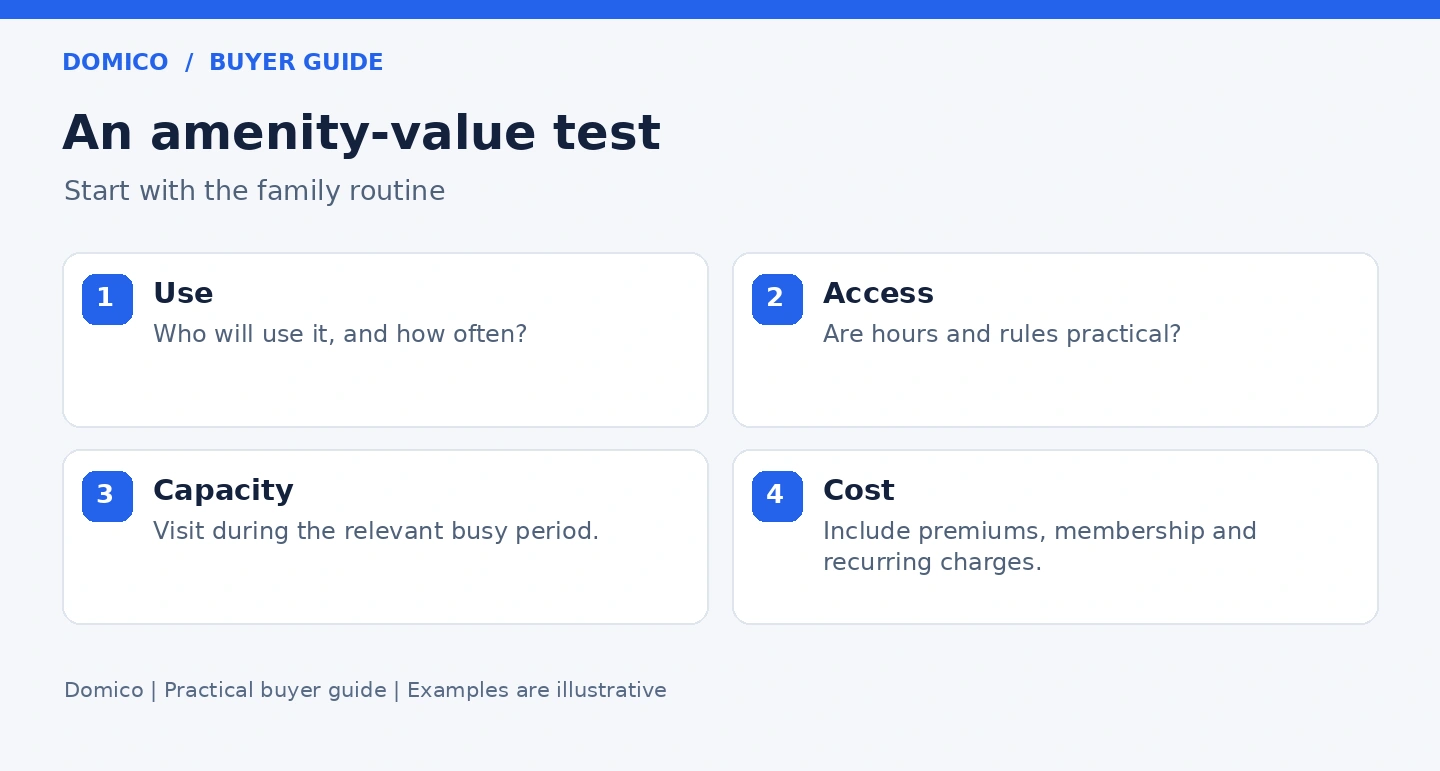
A small gym may look excellent at noon and feel crowded after work. Visit during the time you would use it. Count the usable equipment and observe whether the layout supports ordinary activity safely without interfering with users.
For a pool, ask for the operating rules, maintenance process and responsible trained staff. Do not assess water suitability by appearance alone or enter a closed facility to test it. Relevant technical and safety questions should be answered by competent personnel.
For a clubhouse, check the actual booking calendar, fees and restrictions through the authorised process. Avoid seeking private event information. You need to know whether the service is available to your household under workable conditions.
Opening hours, age restrictions, guest rules, training fees, seasonal closures and booking limits all matter. A facility open only while you are commuting may have little practical value to you.
Ask how residents are notified of closures and how faults are handled. For a separately operated service, check the term of the arrangement and what happens if the operator leaves. A premium facility can be less useful if access depends on an unstable contract.
For a project still being built, identify the promised delivery date and the contractual position if the amenity is delayed or changed. Make the purchase decision workable without assuming every future facility will arrive exactly as advertised.
The first is any purchase-price premium you pay for the project or location. The second is a one-time membership, joining or facility-related amount, where lawfully applicable. The third is ongoing maintenance, usage or booking charges.
Ask for an itemised schedule. A phrase such as “club included” may refer to access while excluding coaching, events or certain operating costs. Do not add imagined fees, but do not overlook charges simply because they appear under another heading.
The National Building Code overview includes asset and facility management. Buyers should ask how maintenance and eventual replacement are funded, because a facility has costs after the opening ceremony.
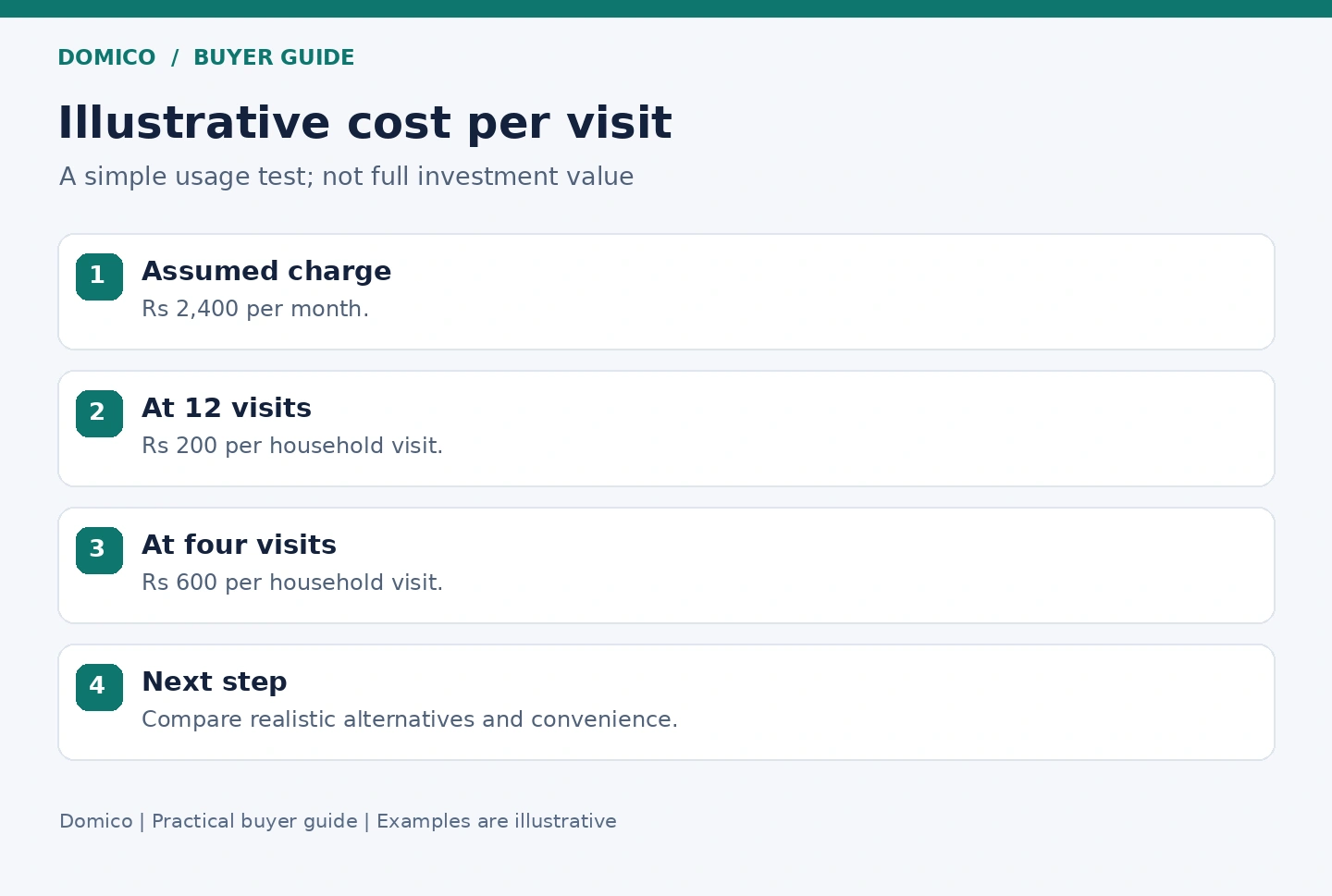
Suppose a household attributes Rs 2,400 of its monthly shared charges to amenities it is evaluating. That allocation is an assumption for the example; a real society may not provide a clean per-amenity split. Assume the household uses the included facilities 12 times monthly.
| Illustrative monthly calculation | Amount or frequency | Result |
|---|---|---|
| Assumed amenity-related charge | Rs 2,400 | Starting cost |
| Household visits | 12 | Combined actual visits |
| Simple cost per visit | Rs 2,400 / 12 | Rs 200 |
| If usage falls to four visits | Rs 2,400 / 4 | Rs 600 per visit |
This does not measure the full value. It excludes the price premium, convenience, community benefits, taxes if relevant and future changes. It does show why optimistic usage assumptions can make an amenity appear cheaper than it feels after possession.
Compare against realistic alternatives. If the family would pay for an external gym anyway, the onsite facility may save money and travel. If nobody would buy that service separately, calling it a “saving” may be misleading.
An onsite amenity can make a short activity possible between household commitments. A parent may value the ability to supervise a child nearby, or an older resident may prefer a familiar walking route. Those benefits are real even when they are hard to price.
Record them in words rather than force them into an invented financial return. At the same time, check whether the route to the amenity is accessible from the flat and whether weather, construction or parking interrupts it.
A gym across a busy public road can be a different experience from one reached by a safe internal route. A pool in another phase can be less convenient than the site plan suggests. Walk the actual journey before valuing the brochure location.
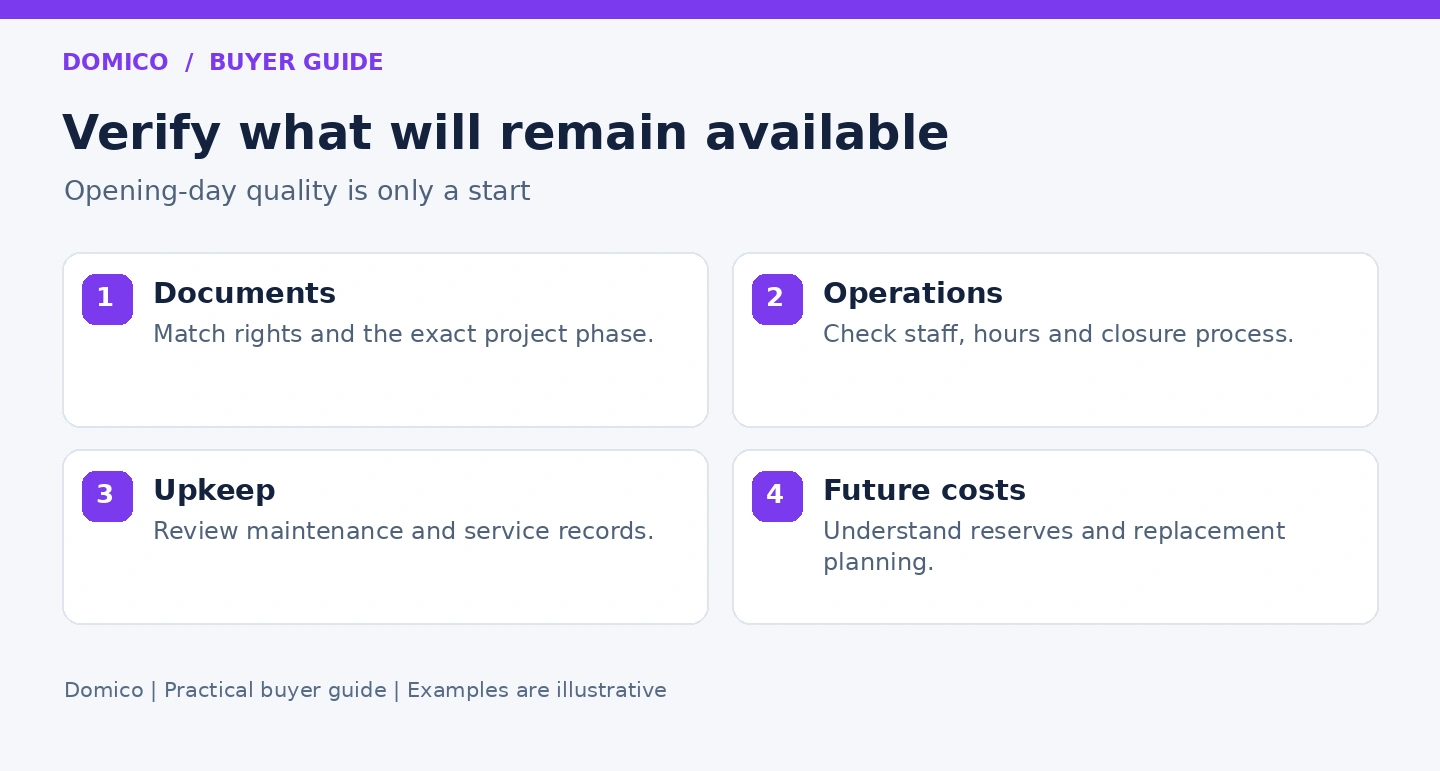
Ask how the association monitors equipment condition, cleaning, inspections and service contracts. Review available maintenance records and approved budgets. A facility that is currently attractive may still need expensive work soon.
For a resale project, ask residents what has been unavailable during the past year and why. Identify whether closures were planned maintenance or unresolved funding problems. A temporary closure is not automatically a failure, but the explanation and follow-through matter.
Do not assume that a large upfront contribution eliminates future charges. Read the fund terms and compare reserves with known asset needs. An association may need later collections under its valid governing arrangements.
Living beside a clubhouse, pool or play area can be convenient and lively. It can also create noise, lighting, privacy or visitor activity that affects the flat. Visit during ordinary use and compare the bedrooms' orientation.
The best location for someone who enjoys social activity may be unsuitable for a buyer working night shifts. A quieter unit further from the facility may retain access without the same immediate exposure.
Assess the relationship as part of the whole purchase. Do not let the excitement of a facility hide a poor room layout, difficult commute or an unaffordable monthly commitment.
| Before paying a premium | Evidence to collect | Household decision |
|---|---|---|
| Right to use | Agreement and facility rules | Is access included and transferable? |
| Availability | Operating hours and current status | Can we use it at our actual free time? |
| Capacity | Relevant-hour visit | Is ordinary use comfortable? |
| Cost | Itemised initial and recurring charges | Does the benefit justify the full spend? |
| Sustainability | Maintenance records and asset budget | Is continued service credibly funded? |
No automatic return follows from a longer list. Demand depends on the facilities' condition, charges, local preferences and competing homes. Use relevant evidence rather than assume every amenity premium is recovered.
Keep it separate from operational facilities. Review its documented status, promised scope and contract terms, and decide whether the home works if delivery is delayed.
Compare the actual recurring charge, any price premium, usable equipment, hours and your expected use. Convenience can be valuable, but the cost comparison needs realistic assumptions.
Read the governing terms and confirm whether tenants may use the facility, what fees apply and whether access requires a separate process. Do not promise tenants rights that are not documented.
Check the valid charging arrangement; personal non-use does not automatically remove a contribution obligation. Decide whether the overall package remains worthwhile before purchase rather than assuming you can opt out later.
An amenity earns its place in your budget when it is usable, maintained and meaningful to your routine. Count the visits and the conditions, not just the icons.
Download the topic-specific review checklist. Use it to record evidence, unanswered questions and follow-up actions for the exact property.
Planning to buy or rent in Indore? Browse verified properties in Indore or read more Indore guides.
Check who owes the lender, how builder-paid interest works, when support ends and whether you can carry the loan if payments stop.



