Buying Guide
2 BHK vs 3 BHK: Space, Budget and Family Needs
Compare 2 BHK and 3 BHK homes using usable room sizes, work needs, family changes, location and the full cost over a longer stay.
Updated 8 min read

Buying Guide
Compare 2 BHK and 3 BHK homes using usable room sizes, work needs, family changes, location and the full cost over a longer stay.
An extra bedroom is useful when it solves a recurring need. It is expensive when it exists only in the brochure.
The choice between a 2 BHK and a 3 BHK often begins with a simple thought: buy the biggest home you can afford. A better starting point is how the household will live over the next several years. A well-planned two-bedroom apartment can work better than a cramped three-bedroom layout, while a genuine third room can remove years of daily friction.
The decision combines space, affordability, location and flexibility. This guide gives you a way to compare those factors without assuming that every family must eventually upgrade or that more bedrooms automatically mean a better investment.
Write down who will live in the home today and what is reasonably likely to change. Consider children, parents, regular overnight guests, remote work, study and a caregiver. Distinguish recurring needs from occasional events.
If guests stay six nights a year, a permanently reserved guest room may have a different value from a room used for work five days a week. If a parent is likely to move in, privacy and bathroom access can be more important than the advertised size of the living room.
Discuss these uses with everyone who will live there. One person's “spare room” may be another person's only quiet workspace. Agree on the priority before visiting homes, so a beautiful model apartment does not reset the requirements.
| Household pattern | A 2 BHK may suit when | A 3 BHK may help when |
|---|---|---|
| Couple working outside home | Two rooms meet sleeping and occasional guest needs | Frequent guests need a permanent separate room |
| Regular home working | A quiet desk fits without disrupting sleep | Work needs a room with a door and calls |
| Young family | Children can comfortably share for the relevant period | Separate sleep or study schedules create conflict |
| Parents joining later | A second bedroom remains available | Existing occupants already need both bedrooms |
| Visiting relatives | Visits are occasional and flexible | Long stays are frequent and predictable |
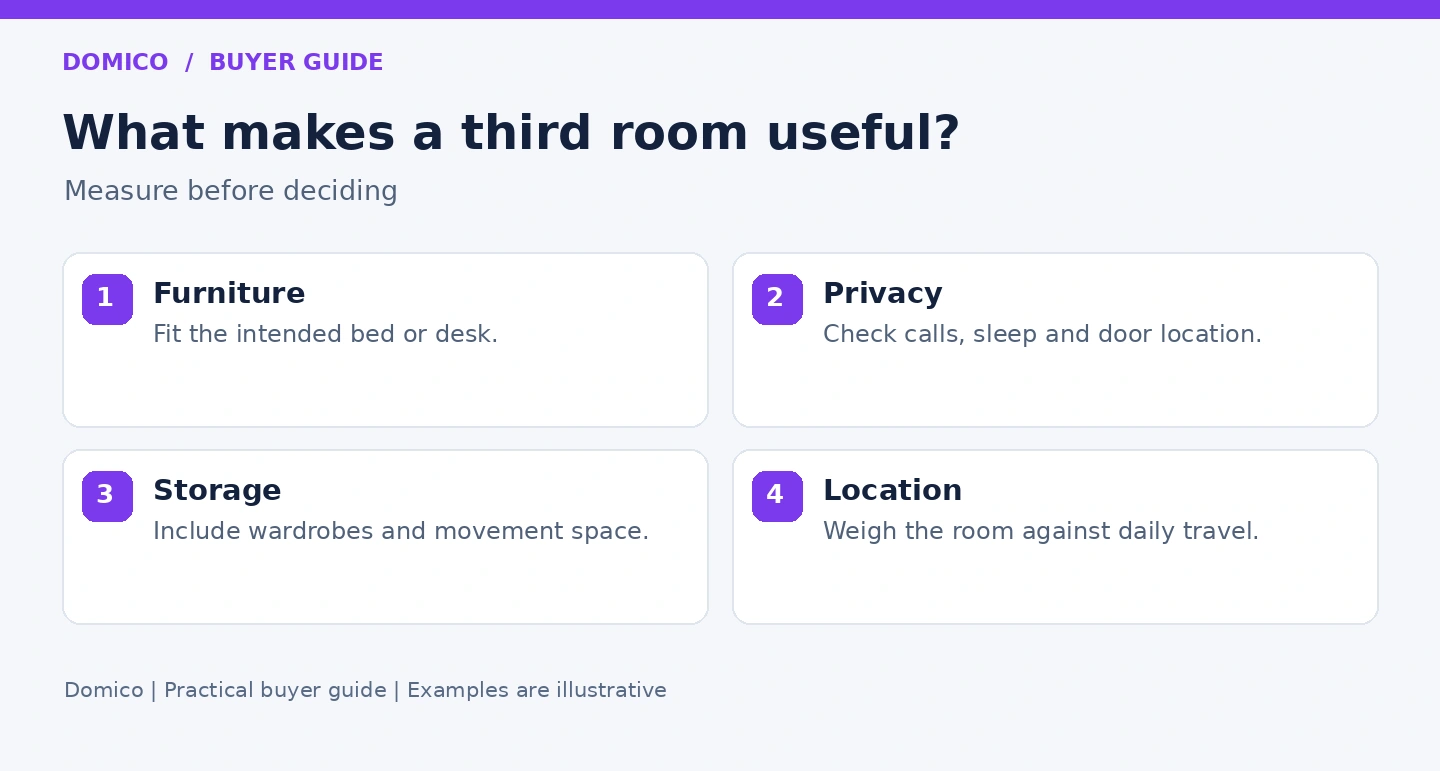
A third bedroom should accommodate its intended furniture and movement. Ask for clear internal dimensions, window positions and door swings. A room that fits only a bed may be unsuitable as a bedroom-plus-study even if the advertisement calls it a large third bedroom.
Look at the usable living and dining areas too. Some three-bedroom plans achieve their room count by shrinking shared spaces or adding narrow passages. A two-bedroom home can have more generous rooms and storage.
The RERA Act's carpet-area definition gives buyers a statutory area concept, but the total still does not describe furniture fit. Compare the disclosed area with a measured plan and the particular family's needs. Avoid converting carpet area into an assumed number of comfortable bedrooms through a universal formula.
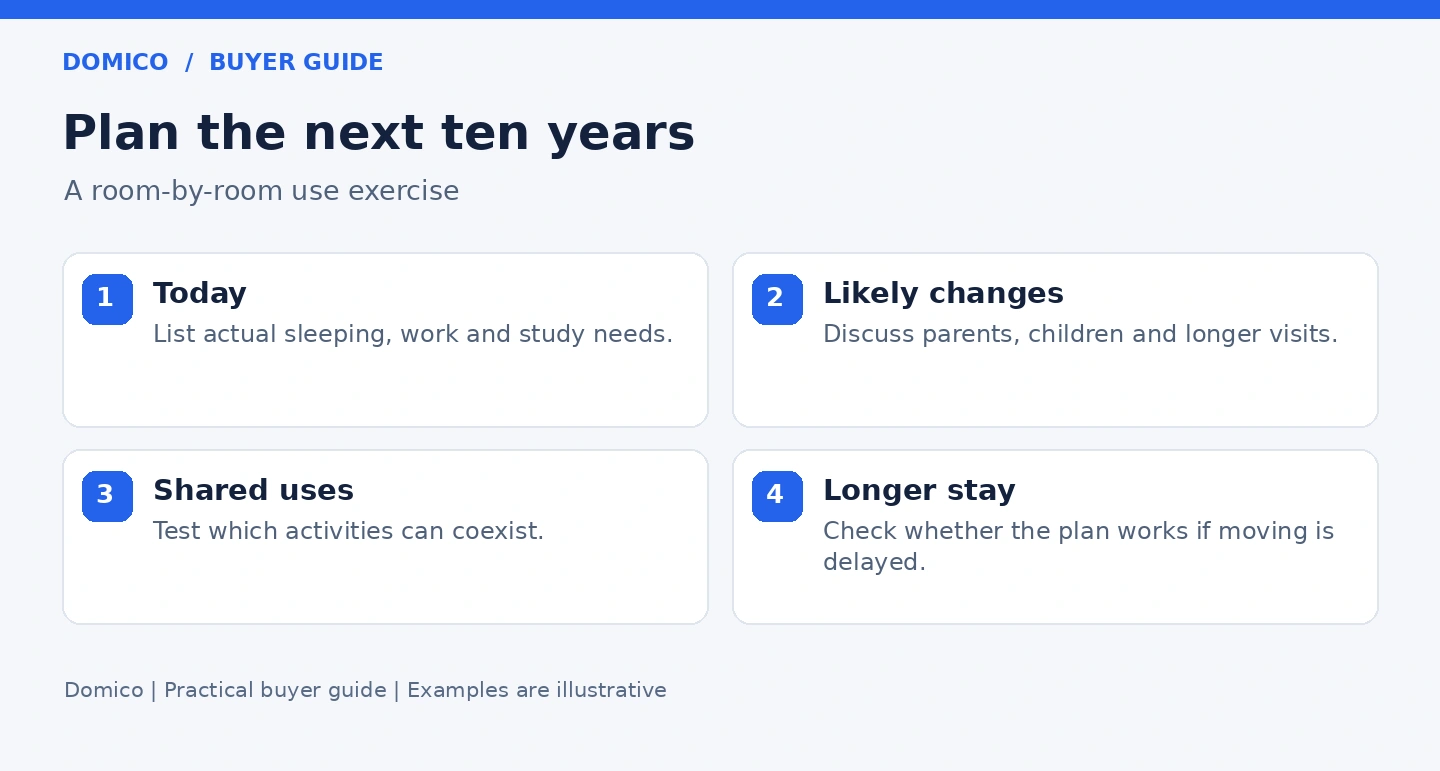
Divide the period into realistic phases: now, a likely change in three to five years, and a later scenario. This is planning, not a prediction. Record which room would serve each function and whether the arrangement depends on daily folding, moving or sharing.
For example, a young couple might use bedroom two as a study today. If a child arrives, that room may become a nursery. The work area could then move to the living room, but only if calls, noise and privacy remain manageable. A theoretical solution is not useful if it disrupts everyone.
Equally, do not buy a distant three-bedroom home solely for a possible future event while accepting a difficult commute today. The extra room has a cost in both money and daily time. Compare the probability and impact of the need, rather than treating every imagined change as certain.
Use a clearly labelled budget with purchase price, transaction charges, loan costs, interiors and ongoing expenses. Ask for actual quotations and verify which maintenance basis the project uses. A larger apartment does not necessarily pay proportionately more under every society's rules.
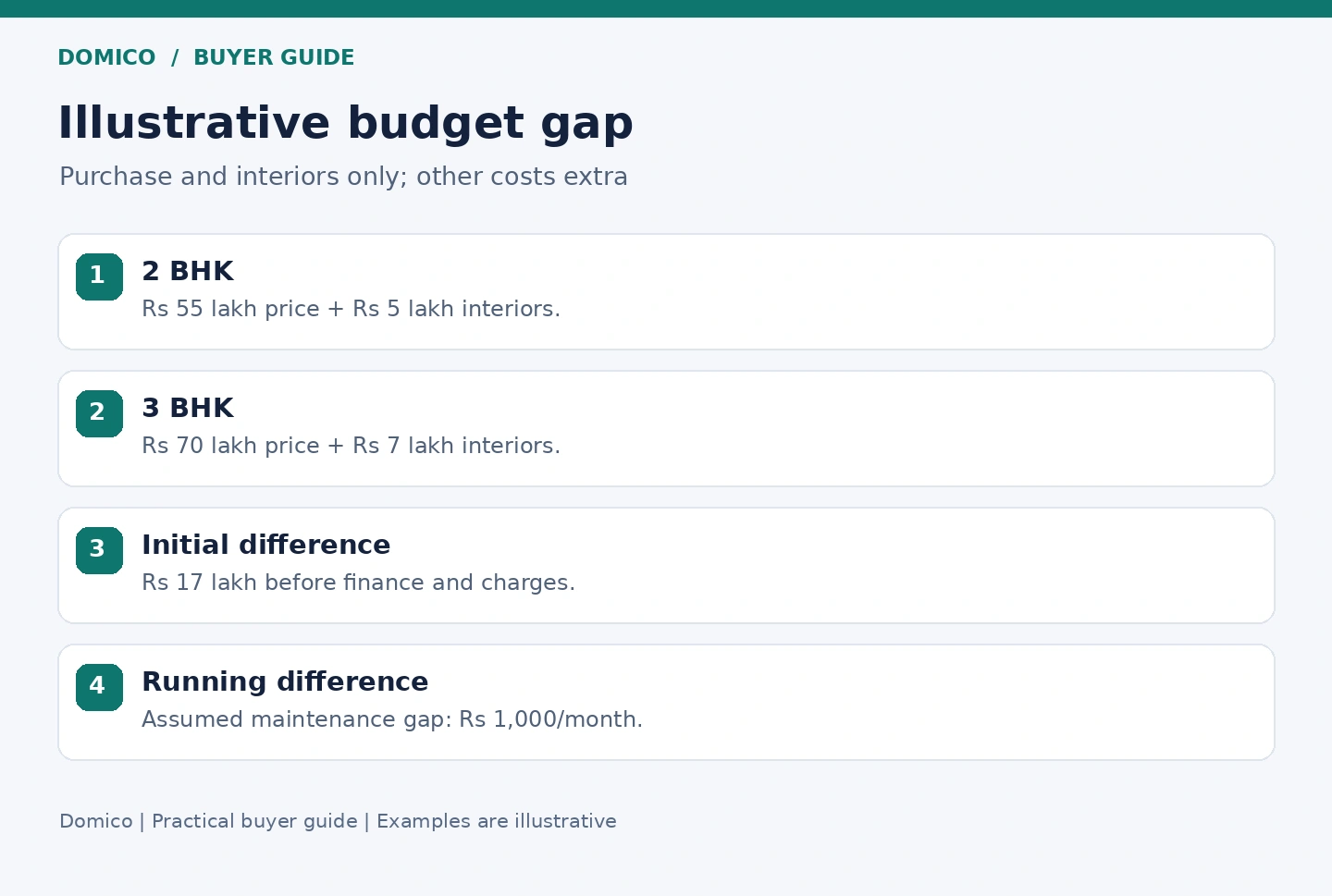
Here is an illustrative comparison. The amounts are invented to explain a method, not quoted Indore prices or lender offers.
| Assumed item | 2 BHK | 3 BHK |
|---|---|---|
| Purchase price | Rs 55,00,000 | Rs 70,00,000 |
| Initial interior budget | Rs 5,00,000 | Rs 7,00,000 |
| Monthly maintenance assumption | Rs 3,000 | Rs 4,000 |
| Initial subtotal before other costs | Rs 60,00,000 | Rs 77,00,000 |
The initial difference is Rs 17 lakh before applicable transaction charges and finance costs. The assumed maintenance difference adds Rs 12,000 per year at unchanged rates. Over ten years, that simple difference would be Rs 1.2 lakh, but actual charges and usage will change.
A family should obtain the lender's EMI calculation for its own down payment, rate and tenure. Check whether the larger purchase leaves room for emergencies, furnishing and a period of income disruption. An additional room is not a substitute for financial resilience.
Sometimes the real choice is a 2 BHK closer to work or a 3 BHK further away. Estimate the additional journey using observed travel times on normal working days. Add fuel, parking, transport and the household's willingness to spend time travelling.
Do not invent a monetary value for every minute unless the family finds that useful. Simply documenting another hour of travel can clarify the trade-off. Ask how the route works during rain, school traffic and late returns.
Also compare access to family support. A larger flat may offer less practical help if it is far from parents, childcare or medical care. Conversely, an extra room can make a location more workable if parents can stay comfortably. The assessment should reflect your own support network.
Furniture can improve flexibility: a properly sized study desk, a sofa bed or storage planned around daily routines. These options should be tested on the measured plan. A room cannot perform several functions at once merely because a marketing render shows movable furniture.
Do not assume that walls can be removed or an enclosed balcony can become a bedroom. Structural, approval, ventilation and society issues may prevent the change. Ask a qualified professional to assess any proposed alteration before including it in your purchase logic.
For a home under construction, confirm whether the developer will provide the requested layout and record agreed specifications. An informal assurance that a room can “easily become larger” is not a documented plan.
Buying a smaller home and upgrading later can be sensible, but the later transaction has costs and uncertainty. There may be brokerage, moving expenses, new interiors, loan changes and transaction charges. Your existing home may not sell when you want or at the expected price.
Buying a larger home now can avoid a future move, but commits more money sooner. Compare both paths using cautious assumptions. Do not credit the larger home with guaranteed appreciation or assume the smaller one will be easy to sell.
A sound decision should still work if the household stays for longer than planned. That is especially important when the purchase consumes a large part of savings.
| Test | Question for the 2 BHK | Question for the 3 BHK |
|---|---|---|
| Daily fit | Which activity must share space? | Will the extra room have a real use? |
| Financial resilience | Does the saving improve your safety margin? | Can you fund the difference comfortably? |
| Location | What daily convenience does it retain? | What travel or service compromise does it require? |
| Long stay | Could you remain if upgrading is delayed? | Will maintenance and furnishing remain affordable? |
| Exit | Is there real demand for this exact layout? | Is the premium supported by local evidence? |
No. Local demand, total price, room quality, condition and competing homes matter. Compare actual transactions where available and avoid treating the bedroom count as a return guarantee.
That is a household decision involving ages, routines, privacy and room size. Test beds, storage and study arrangements rather than assume sharing is either always easy or always unsuitable.
Identify how much acoustic privacy and dedicated equipment your work requires. A suitable separate room may be valuable, but a poorly placed third bedroom can be less useful than a well-planned work area elsewhere.
Compare the particular layouts. Clear room dimensions, storage, bathrooms and circulation can matter more than the label. Select the plan that supports your recurring activities.
Rework the full budget before committing. A home should remain usable and financially manageable after possession. Include essential furnishing and a reasonable emergency reserve using figures appropriate to your household.
Choose enough space for the life you can reasonably foresee, at a cost your family can carry through change. That is a stronger decision than buying a room count.
Download the topic-specific review checklist. Use it to record evidence, unanswered questions and follow-up actions for the exact property.
Planning to buy or rent in Indore? Browse verified properties in Indore or read more Indore guides.
Check who owes the lender, how builder-paid interest works, when support ends and whether you can carry the loan if payments stop.



